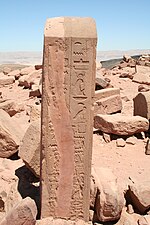
Serabit al-Hadim [2] ( Arabic. سرابيط الخادم - saraːˈbiːtˤ alˈχaːdɪm ) is a locality in the south-west of the Sinai Peninsula , Egypt . In antiquity, extensive turquoise mining was carried out here, mainly by the ancient Egyptians. During archaeological excavations begun by Sir Flinders Pitris , ancient mines and the temple of the Egyptian goddess Hathor , who defended the desert areas, existed for many years, were discovered.
| Sarabit al-Hadim | |
|---|---|
| Arab. سرابيط الخادم | |
| A country |  Egypt Egypt |
| Governorate | South sinai |
| History and Geography | |
| Center height | |
| Timezone | UTC + 2 |


Mount Sinai
In her book, The Story of Sinai, Lina Eckenstein suggested that Serabit al-Hadim was the historical site of Mount Sinai, where Moses received the 10 commandments. In particular, this theory is confirmed to a large extent by the fact that the temple of the goddess Hathor , which is believed to have been built by Jews to worship the golden calf, is located in this place, while Moses was on top of the mountain.
Notes
- ↑ http://www.geonames.org/349599
- ↑ Map sheet H-36-XXVIII . Scale: 1: 200 000. Indicate the date of issue / condition of the area .
Sources
- Albright, WF "The Early Alphabetic Inscriptions from Sinai and Their Decipherment." Oakland: Bulletin of the American Schools of Oriental Research. 1948.
- Butin, R., “The Serabit Inscriptions: II. The Decipherment and Significance of the Inscriptions ”, Harvard Theological Review, Vol. 21, No. 1 (Jan. 1928), p. 9-67.
- Butin, R., “The Protosinaitic Inscriptions”, Harvard Theological Review, Vol. 25, No. 2 (April 1932), p. 130-203.
- WM Flinders Petrie, Researches in Sinai , London, 1906.
- R. Giveon, The Stones of Sinai speak , Tokyo, 1978.
- Eckenstein, Lina , A History of Sinai . London: Society for Promoting Christian Knowledge, 1921.
- Lake, K. and Blake, R., “The Serabit Inscriptions: I. The Rediscovery of the Inscriptions”, Harvard Theological Review, Vol. 21, No. 1 (Jan. 1928), p. 1-8.