Vasile Conta ( roman. Vasile Conta ; November 15, 1845 , Gindeoani , Neamt - April 24, 1882 , Bucharest ) is a Romanian philosopher , writer and politician of Armenian origin [1] .
| Vasile Conta | |
|---|---|
| room. Vasile Conta | |
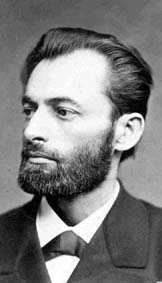 | |
| Date of Birth | November 15, 1845 |
| Place of Birth | Gindeoani , Neamt |
| Date of death | April 24, 1882 (36 years old) |
| A place of death | Bucharest |
| A country | |
| Core interests | |
Biography
Vasile Conta was born into a family of a hereditary priest. Educated at the gymnasium in Neamt and then at the Mihailiane Academy in Iasi, where in 1868 he received a bachelor's degree; In 1862-1864 he interrupted his studies, joining the troupe of the Moldavian wandering theater, while working with whom he wrote a play.

Since 1868 he taught philosophy at the Academy of Mikheiliane, in the same year he went on to teach at the Faculty of Law. In October 1869, he received a scholarship to study at the University of Antwerp in Belgium from Pogor-Fătu (a society that promoted the acquisition of higher education by talented young Romanians abroad), where he studied commerce and graduated in 1871. Having received a degree, he remained at the same university to study law, having managed to get a doctorate in just one year. Upon returning to his homeland, he opened a private law practice, and since 1873, with the rank of professor, he headed the Department of Civil Law at Iasi University. In 1879 he was elected to parliament. From October 20, 1880 to April 10, 1881 he served as Minister of Education and Religion (despite the critical attitude to it). He retired for health reasons, having received a place in the court of cassation.
Vasile Conta died of tuberculosis , shortly before his death, returning to his homeland from a trip to Italy.
From the second half of the 1870s, Comte was interested in philosophy (he held materialistic views), wrote a number of philosophical works in which he tried to analyze social sciences from the point of view of dialectics and criticized idealism and religion. He was known for his hostile relations with Jews and in some sources is even called the first ideologist of Romanian anti-Semitism [2] . The most famous works: “Incercari de metafizica”, “Teoria ondulatiunii universale”, “Origina speciilor” and others. Some of his works have been translated into French .
Notes
- ↑ Stoica Lascu // Dobrudjan contributions to the development of contemporary armenology
- ↑ Volovici, Leon. Nationalist Ideology and Antisemitism: The Case of Romanian Intellectuals in the 1930s. - Pergamon Press, 1991. - ISBN 0-08-041024-3 .
Links
- Biography (rum.) .