The Kingdom of Romania ( rum. Regatul României ) is a state that existed on the territory of modern Romania , Moldova , partially Ukraine and Bulgaria from 1881 to 1947 .
| Historical state | |||||
| Kingdom of Romania | |||||
|---|---|---|---|---|---|
| room. Regatul României | |||||
| |||||
| Hymn : | |||||
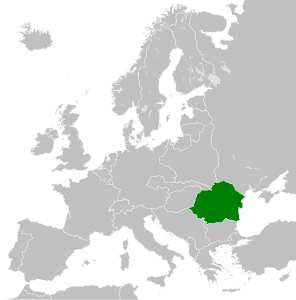 Kingdom of Romania in 1938 | |||||
←  ←  ←  ←  ←  ←   → → → → → → → → → →March 26, 1881 - December 30, 1947 | |||||
| Capital | Bucharest | ||||
| Languages) | Romanian | ||||
| Religion | Orthodoxy | ||||
| Currency unit | |||||
| Form of government | A constitutional monarchy | ||||
| Dynasty | Hohenzollern-Sigmaringen | ||||
| Anthem | Trăiască regele | ||||
| Official language | |||||
| King | |||||
| • 1881 - 1914 | Carol I | ||||
| • 1914 - 1927 | Ferdinand I | ||||
| • 1927 - 1930 | Mihai I | ||||
| • 1930 - 1940 | Carol II | ||||
| • 1940 - 1947 | Mihai I | ||||


Content
Geographical and demographic data
Territory
The Kingdom of Romania in different years of its existence covered various territories. By the time Romania was proclaimed kingdom, the state included Wallachia , Moldova , Dobrudja . The eastern border of the kingdom passed along the Prut and Danube rivers , the southern border along the Danube river, the western border along the eastern reaches of the Banat, the northern border along the peaks of the Carpathian Mountains and then east to the Prut. In the southeast, the kingdom overlooked the Black Sea .
In 1913 , according to the results of the Second Balkan War , Romania annexed Southern Dobrudja, previously owned by Bulgaria .
A large-scale change in borders occurred in 1918 , with the collapse of Austria-Hungary and the Russian Empire . After the collapse of these states, Romania included Banat , Bukovina , Transylvania , Maramures , Bessarabia (the latter was considered occupied territory in the USSR ).
From 1918 to 1940, the borders of Romania ran south from Kranevo on the Black Sea to Turtukai Mountain near the Danube. It begins in the west near the Turtukai Mountain on the Danube, then passes a straight line to the Black Sea south of Kranevo, then along the Danube to Banat; in Banat, the border turned north (this region was divided into two parts by Romania and Yugoslavia ), and then near the borders of Hungary to the north-east and passed through the northern regions of Transylvania to Bukovina; here she turned east and walked to the Dniester , and then along the Dniester to the south to the Dniester estuary and the Black Sea.
In 1940, the kingdom lost a series of regions: Northern Transylvania , which went to Hungary, Bessarabia and Bukovina, which became part of the Soviet Union, Southern Dobrudja, which again became part of Bulgaria. Now the eastern border of the kingdom again passed along the Prut and Danube, and the border at Dobrudja passed along the 1912 line. Romanian territory has declined significantly.
During World War II, Romania attacked the USSR, occupying Bessarabia, Bukovina and the interfluve of the Dniester and the Southern Bug . These territories, except Transnistria , were declared by the Romanian authorities as an integral part of Romania. Transnistria was an occupation zone. After World War II, Romania returned to Northern Transylvania, in turn the Hertz region , Snake Island and several islands in the Danube Delta were transferred to the USSR.
The Kingdom of Romania, before the First World War, was bordered by the Bulgarian kingdom, Serbia , Austria-Hungary and the Russian Empire . As a result of the First World War, new states arose, and in the 20th century the kingdom bordered Bulgaria, Yugoslavia, Hungary, Czechoslovakia , Poland , the UPR, and then the Ukrainian SSR . On the eve of World War II, Romania lost its common borders with Czechoslovakia and Poland due to the cessation of the latter.
Administrative division
The capital of the kingdom was Bucharest . The main administrative-territorial unit is the cheater . The territory of the Kingdom of Romania throughout its existence has repeatedly changed, therefore, at different periods in its history, the kingdom had a different number of people. At the end of the XIX - beginning of the XX centuries, Romania was divided into 3 provinces ( Wallachia , Dobrudja and Moldova ), each of which consisted of districts. In total there were 32 districts in the state, similar to the later introduced cheaters. By that time, Romania did not include Bessarabia , South Dobrudja and Transylvania .
From 1938 to 1940, the kingdom was divided into the cynics of Arges , Krishur , Dunarii , Zhiu , Mayor , Mures , Nistru , Prut , Suceava , Timis .
From 1918 to 1940, Romania reached the maximum expansion of its borders in its history, at that moment there were 71 people in it [1] : Alba (center - Alba-Julia ), Arad (center - Arad ), Arges (center - Curtea de Argesh ), Bacau (center - Bacau ), Baia (center - Falticeni ), Bihor (center - Oradea ), Botosani (center - Botosani ), Brasov (center - Brasov ), Braila (center - Braila ), Buzau (center - Buzau ), Balti (center - Balti ), Vaslui (center - Vaslui ), Vlashka (center - Giurgiu ), Valcea (center - Ramnicu Valcea ), Gorge (center - Tirgu Jiu ), Dolzh (center - Craiova ), Dorokhoy (center - Dorohoi ) Durostor (center - Silistra ), Dambovita (center - Targovishte ), Ismail (center - Ishmael ), Ilfov (Center - Bucharest ), Kaliakra (center - Bazardzhik ) Karash (center - Oravice ), Cahul (center - Cahul ) , Cluj (center - Cluj ), Kovurluy (center - Galati ), Constanta (center - Constanta ), Kympulung (center - Kympulung ), Lapushna (center - Chisinau ), Maramures (center - Siret ), Mehedintsi (center - Turnu Severin ), Mures (center - Tirgu Mures ), Muschel (center - Kympolung ), Nesaud (center - Bistrica ), Neamt (center - Pyatra Neamt ), Odorhei (center - Odorhei ), Alt (center - Slatina ) , Orhei (center - Orhei ), Prahova (center - Ploiesti ), Putna (center - Fokshany ), Roman (center - Roman ), Romanatsi (center - Caracal ), Ramnicu-Sarat (center - Ramnicu-Sarat ), Radauti (center - Radauti ), Satu Mare (center - Satu Mare ), Severin (center - Lugoj ), Sibiu (center - Sibiu ), Somesh (center - Dezh ), Soroka (center - Soroki ), Storozhynets (center - Storozhynets ), Suceava (center - Suceava ), Selaj (center - Zaleu ), Tecuci (center - Tecuci ), Teleorman (center - Turnu-Magurele ), Tigina (center - Tigina, sovr. Bender ), Timis Torontal (center - Timisoara ), Trey Skaune (center - Sfintu Gheorghe ), Tulcha (center - Tulcha), Turda (center - Turda ), Tutova (center - Barlad), Tyrnava Mare (center - Sighisoara ) , Tyrnava-Mike (center - Blazh ), Fagaras (center - Fagaras ), Falchiu (center - Hushi ), Khotyn (center - Khotyn ), Hunedoara (center - Virgo ), Chernautsi (center - Chernivtsi ), Chetatya-Alba (center - Chetatya-Alba, modern Belgorod-Dniester ), Chuk (center - Merkurya-Chuk ), Yalomitsa (center - Calarasi ), Iasi (center - Iasi ).
In 1940, Romania lost the Balti, Ishmael, Cahul, Lapusna, Orhei, Magpie, Storozhinets, Tigina, Khotin, Chernauti, Chetatya-Alba (Sri Lanka), Bihor, Cluj, Maramures, Mures, Nesaud, S-Odorhei Mare, Somesh, Selaj, Trey Skaune, Chuk ( became part of Hungary ), Durostor and Kaliakra ( became part of Bulgaria ) [1] .
Population
The number of inhabitants of Romania was not constant; population growth at the end of the 19th century was high. In 1890, 5,300,000 people lived in Romania, in 1900 - 6,000,000 people, in 1910 - 6,900,000 people, in 1915 - 7,800,000 people. In 1921, the country's population increased sharply, mainly due to the expansion of the territory in previous years, and amounted to 15.6 million people. In 1939, 19.9 million people already lived in the state. With the loss of Northern Transylvania, Southern Dobrudja, Northern Bukovina and Bessarabia, the population of the state decreased due to the loss of part of the inhabitants living in these territories, and amounted to 13.6 million people. With the return of Northern Transylvania on the eve of the liquidation of the monarchy in 1946, the number of inhabitants of Romania increased again and amounted to 15.8 million people [2] .
The basis of the state’s population was Romanians , their number in different years ranged from 71.9% ( 1930 ) to 92.2% ( 1899 ). Until 1918, Jews ranked second in number after Romanians (about 5%). After 1918, the second largest people in the kingdom were Transylvanian Hungarians ( sekéi and Changoshi ), Jews took fourth place (after the Germans ). In 1930, the number of Hungarians in Romania was 7% or 1,400,000, Germans - 4.1%, Jews - 4%. According to the 1930 census , Rusyns and Ukrainians accounted for 3.2%, Russians - 2.3%, Bulgarians - 2%. Also in Romania, Turks , Gagauzes , Czechs , Slovaks , Serbs , Croats , Slovenes , Poles , Tatars , Armenians , Albanians, and others lived. [3] In 1930, 73% of the inhabitants of the kingdom named Romanian , 8.6% - Hungarian , 4.2% - Russian , 3.6% - Ukrainian , 2.9% - Yiddish , 2% - Bulgarian , 1.6% - Turkish and Tatar . According to the census, 72% of the Romanian population professed Orthodoxy , 7.9% - Greek Catholicism , 6.8% - Roman Catholicism , 3.9% - Calvinism , 2.2% - Lutheranism [3] .
Political History
Board of Carol I
Kingdom Background and Proclamation
Vassal of the Ottoman Empire The United Principality of Wallachia and Moldavia was formed by Alexander Kuza in 1859 . Alexandru Cuza, the first ruler of a united Romania, after the creation of the state decided to carry out agrarian reforms. They did not arrange boyars, as they provided for a reduction in their land holdings. In 1864, Kuza carried out a coup d'etat , expelling the dissatisfied with his rule boyars from the National Assembly, and taking all power in his hands. The boyar opposition in response formed the “ Monstrous Coalition ” [4] , which in 1866, together with high-ranking army officials, expelled Kuza from the principality [5] .
The new dominator was elected Carol I. On May 10, he arrived in Bucharest and immediately took the vacant throne. In 1878, the state he led achieved independence . Three years after independence, the constitution of the principality was amended, thanks to which Karol I could become king. May 10, 1881, on the 3-year anniversary of the arrival of Carol I to Bucharest and the proclamation by the prince of the United Principality of Wallachia and Moldova, a coronation took place. The Principality has become the kingdom of Romania.
Peasant riots
In the XIX century , the accelerated development of the Romanian society and economy was observed. Despite this, the situation of the peasants was unsatisfactory. This was partly due to the half-agrarian reforms of the 1860s, Alexander Kuzy, the conduct of which was hindered by the boyars. Then the peasants were endowed with too small plots of land, and part of the peasantry did not receive land at all. In the following decades from the moment of Kuza’s resignation, the influence of the boyars increased, and with them their pressure on the peasants increased again [6] .
This led to the peasant uprising of 1888 . However, this peasant revolt did not lead to an improvement in the situation in the village. According to statistics, by 1907, 23.8% of peasants had no land, and 33.7% had only 0.5 to 3 hectares. The discontent of the peasants after 1888 intensified, spilling out in 1907 into a larger revolt. Initially, it covered only the northern part of Moldova, but then it covered the provinces of Vlaška , Olt , Teleorman and Doge . The uprising was brutally crushed by the army. Peasant unrest forced the country's authorities in 1913 to proceed with the seizure of private land from large owners and their distribution to the poor strata of the peasantry. However, the reform dragged on, and its implementation began already under King Ferdinand I in 1917 . The authorities passed directly to the seizure of land only in 1921 [6] .
Second Balkan War
In 1912, the First Balkan War broke out in the neighboring Balkans of Romania, the main reason for which was the desire of the Balkan states (Serbia, Montenegro, Greece, Bulgaria) to include large European possessions of the weakening Ottoman Empire, populated mainly by the titular peoples of the Balkan Union countries. As a result of the war, which ran from October 1912 to May 1913 , Turkey ceded almost all of its possessions in Europe to the Balkan Union. During the First Balkan War, Bulgaria’s relations with Romania worsened as Romania made claims on the Bulgarian Southern Dobrudja . Romania began to face political pressure on Bulgaria, threatening to escalate into war [7] [8] [9] .
In the summer of 1913, a crisis began in the Balkans related to the redistribution of the former Turkish territories by the countries of the Balkan Union. Bulgaria had contradictions with all its former allies, so in the new war they opposed it. June 29 hostilities began.
Events in neighboring Bulgaria took advantage of Romania. The invasion of Bulgaria from the south on July 12 by Turkish troops “untied the hands” of Romania, and on July 14, Romanian troops under the command of General Alexandre Averescu crossed the Danube, entering the Bulgarian territory. Dobrudja was occupied without much effort, the Romanian units did not meet resistance. This was largely due to the fact that almost all of the Bulgarian troops were concentrated in the west of the country, near the borders of Serbia and Bulgaria. In order to accelerate the outcome of the war, two cavalry corps were sent by Romania to the direction of Varna and Sofia . The hopeless situation in southeastern Bulgaria, as well as the rapid offensive of the Romanian cavalry against Sofia, forced the Bulgarian leadership to surrender on July 29 . Peace talks began in Bucharest, during which Bulgaria signed a peace treaty on adversary terms. According to the Bucharest Treaty , as a result of the war, Romania expanded its territory to receive Southern Dobrudja. During the campaign, Romanian troops suffered small losses, losing 2000 people in total, wounded and killed (most of the soldiers were injured) [10] .
World War I
Interwar Romania
After the end of the First World War, the Romanian authorities faced a new task - to integrate new territories in which a significant number of representatives of national minorities (Hungarians, Germans, Poles, Ukrainians) resided in the new state. The Romanian authorities took the path of Romanization . During the interwar period, two constitutions were adopted in Romania - 1923 and 1938. Both of them proclaimed the equality of all citizens, regardless of nationality. In the kingdom, a whole series of both Romanian and local parties operated. However, in 1938 the multi-party system was liquidated. First, a decree of February 16, 1938 ordered “civil servants, church workers of all faiths, teachers of secondary and higher educational institutions, and generally to anyone who receives any form of salary from the state, county, or society” to stop engaging in political propaganda, not to participate in political parties and demonstrations of a political nature [11] . On March 31 of the same year, all parties were liquidated, and on April 14 it was forbidden to conduct propaganda about changing the political system [12] . Then the decree of December 15, 1938 established the only political party - the National Revival Front with the Hungarian and German sections [12] .
World War II
Economics
The monetary unit - lei, was introduced:
- Copper coins in denominations of 1, 2 and 5 baths, copper-nickel coins in denominations of 10 and 20 baths, silver coins in denominations of 50 baths, 1, 2 and 5 lei [13] , gold coins in denominations of 10 and 20 lei, minted by the State Mint of Romania ( Monetăria Statului )
- Banknote of 5, 10, 20, 50, 100, 500 and 1000 lei [14] issued by the National Bank of Romania ( Banca Națională a României )
Culture, Art, and Science
Culture and the Press
The impetus for the development of Romanian culture was given in the middle of the XIX century . One of the main directions was the development of Romanian literature . V. Alexandri , I. Creanga , N. Filimon, A. Odobescu, M. Eminescu became classics of Romanian literature of the late 19th century. Also widely known were G. Kozhbuk, M. Sadovyan, and others.
| Kingdom romanian press |
In parallel, the development of the press was going on, which had a significant impact on literature. In the second half of the 19th century, censorship was reduced as a result of democratic reforms. Thanks to this, many new newspapers of various orientations were founded in Romania, of which the largest circulation was Romania Romire, Steaua Dunarii, Romanul, Adeverul, Universul, Diminyatsa. In addition, the newspapers Rominia Viitoare and Junimia romine continued to be published, which appeared even before the creation of the Romanian state, and the magazines Point, Vyatsa Rominyaske and others appeared. With the lapse of some time and the formation of Romanian political parties, periodicals were differentiated. by political affiliation. So, on the eve of the 1940 coup , many pro-fascist newspapers and magazines appeared (Porunka Vremy, Kuvyntul, Gindirya, etc.) At the beginning of the 20th century, the first newspapers for the state’s national minorities began to be published in their native languages. In 1928, broadcasting broadcasts began in Romania [6] .
With the foundation back in the time of the United Principality in 1866, the Romanian Philharmonic began the development of Romanian music. Widespread in author's music received folk art. Composer C. Porumbescu, when creating his works, took folk music as a basis. Another famous composer was D. Enescu , who created in 1884 the first Romanian opera company.
Broadcasting
The Radio Broadcasting Society of Romania ( Societatea de Difuziune Radiotelefonică din România ) (since 1936 - the Romanian Broadcasting Society ( Societatea Română de Radiodifuziune )), included the following radio stations:
- Radio România broadcasts on long waves
- Radio București was broadcasting on medium waves
- Radio Basarabia broadcasting on medium waves
Science and Education
Fundamental changes in the educational system were carried out during the time of the United Principality. Several higher education institutions were founded, and compulsory primary education was introduced. The authorities continued the policy of the 1860s - 1870s in subsequent years. From 1899 to 1914, there was a high rate of eradication of illiteracy. After the First World War, progress began again in the development of the educational system. In 1920, the literacy process resumed. By 1930, about 75% of city dwellers and 50% of peasants were literate; the overall literacy rate in the country was 51.1%. Of the literate part of the country's population, 83% had primary education, 8.6% had secondary education, 3.2% had specialized secondary and 3% had higher education [6] .
In order to increase literacy among the population since 1924, a seven-year course was introduced in elementary schools instead of a four-year course of study, school attendance became mandatory. The state also allocated scholarships to students studying abroad. Education in interwar Romania was constantly evolving due to an increase in the cost of education and the emergence of new schools. However, almost immediately after 1919, the country began the Romanization of educational institutions. Already in 1919-1921, out of 168 primary schools in Bukovina, 93 were translated into the Romanian language of instruction [15] . In 1925-1927, Ukrainian schools that existed under Austrian rule were liquidated, and compulsory teaching of the Romanian language and the study of a number of subjects in it were prescribed in private schools [16] . In the late 1930s, language policy was somewhat relaxed - on May 1, 1938, the General Commissariat for National Minorities was established, and in April 1940, the partial introduction of the Ukrainian language at the University of Chernivtsi and at schools was allowed [17] .
Religion
Most believers - Orthodox, were represented by the Romanian Orthodox Church ( Biserica Ortodoxă Română ):
- Ugro-Vlaš Metropolis ( Mitropolia Ungrovlahiei )
- Bucharest Archbishopric ( Arhiepiscopia Bucureștilor ) (Department in
- Episcopia Râmnicului
- Episcopia Argeşului
- Episcopia Tomisului
- Episcopia Buzăului
- Moldavian Metropolia ( Mitropolia Moldovei )
- Jasa Archbishopric ( Arhiepiscopia Iaşilor )
- Romanesque and Bacau Episcopacy ( Episcopia Romanului )
- Diocese of Husha ( Episcopia Huşilor )
- Lower Danube Episcopacy ( Episcopia Dunării de Jos )
- Transylvanian Metropolis ( Mitropolia Ardealului )
- Sibius Archbishopric ( Arhiepiscopia Sibiului )
- Cluj Episcopia ( Episcopia Clujului )
- Caransebes Diocese ( Episcopia Caransebeșului )
- Episcopia Aradului
- Episcopia Oradiei
- Bukovina Metropolis ( Mitropolia Bucovinei )
- Chernivtsi diocese
- Khotyn Episcopia ( Episcopia Hotinului )
- Bessarabian Metropolis ( Mitropolia Basarabiei )
- Chisinau Archbishopric ( Arhiepiscopia Chişinăului )
- Bilhorod-Dniester-Izmail bishopric ( Episcopia de Cetatea Albă şi Ismail )
Until 1919, Catholics were represented by the Archdiocese of Bucharest and the Diocese of Iass, who were directly subordinate to the Holy See. In 1930, the structure of the Catholic Church in Romania acquired the following form:
- Metropolis of Bucharest
- Archdiocese of Bucharest ( Arhidieceza de București )
- Diocese of Iasi ( Dieceza de Iași )
- Diocese of Oradea ( Dieceza de Oradea Mare )
- Diocese of Satu Mare ( Dieceza de Satu Mare )
- Diocese of Timisoara ( Dieceza de Timișoara )
- Diocese of Transylvania ( Arhidieceza de Alba Iulia , Gyulafehérvári egyházmegye )
- The metropolis of Fagaras and Alba-Julia of the Byzantine rite - mainly united the Romanian Uniates of Transylvania
- Archdiocese of Fagaras and Alba Julia ( Arhieparhia de Făgăraș și Alba Iulia )
- Diocese of Oradea ( Eparhia de Oradea Mare )
- Diocese of Lugoj ( Eparhia de Lugoj )
- Diocese of Cluj-Gerla ( Eparhia de Cluj-Gherla )
- Diocese of Maramureș ( Eparhia de Maramureș )
- Ordinate of the Armenian rite
Protestants were represented by:
- The Evangelical Church of the Augsburg Confession of Romania ( Biserica Evanghelică de Confesiune Augustană din România , Evangelische Kirche AB in Rumänien ) - mainly united the German Lutherans of Transylvania
- The Evangelical Lutheran Church of Romania ( Biserica Evanghelică Luterană din România ) - mainly unites Hungarian Lutherans and Slovo Lutherans of Transylvania
- Румынская реформатская церковь ( Biserica Reformată din România , Romániai református egyház ) - объединяла преимущественно венгров-кальвинистов Трансильвании [18]
- Баптистский союз Румынии ( Uniunea Baptistă din România ) - объединяла преимущественно румын-баптистов Молдавии и Валахии
- Венгерский баптистский союз Румынии (с 1920 году) - объединял преимущественно венгров-баптистов, а также мадьяризированных немцев-баптистов и румын-баптистов Трансильвании
- Румынская уния Церкви адвентистов седьмого дня - объединяла адвентистов седьмого дня
See also
- Объединённое княжество Валахии и Молдавии
- Социалистическая Республика Румыния
- Старое королевство
- Великая Румыния
- Экономический кризис в Румынии (1899—1901)
Notes
- ↑ 1 2 Румыния (недоступная ссылка) . World Wide History Project . Дата обращения 28 февраля 2009. Архивировано 23 июня 2006 года.
- ↑ Population of Eastern Balkans (англ.) . Historical Atlas. Дата обращения 7 марта 2009. Архивировано 24 февраля 2012 года.
- ↑ 1 2 Populaţia pe Neamuri : [ рум. ] . — Institutul Central de Statistică. — P. XXIV. (inaccessible link)
- ↑ Н. Н. Морозов. Гогенцоллерны в Румынии // Новая и новейшая история. — 1995. — № 1 .
- ↑ Очерки политической истории Румынии 1859-1944. — Кишинёв, 1985. — С. 30—35.
- ↑ 1 2 3 4 И. А. Ожог, И. М. Шаров. Краткий курс лекций по истории румын. Новая история . — 1992. Архивировано 5 марта 2009 года.
- ↑ Балканская война. 1912-1913 гг . — М. : Издание Товарищества издательского дела и книжной торговли Н.И. Пастухова, 1914.
- ↑ Задохин А. Г. , Низовский А. Ю. Пороховой погреб Европы . — М. : Вече , 2000. — 416 с. — (Военные тайны XX века). - 10,000 copies. — ISBN 5-7838-0719-2 .
- ↑ Влахов Т. Отношения между България и централните сили по време на войните 1912—1918 г. — София, 1957.
- ↑ Secondary Wars and Atrocities of the Twentieth Century (англ.) . Дата обращения 21 декабря 2008. Архивировано 21 августа 2011 года.
- ↑ Борисенок Е. Ю. Концепции «украинизации» и их реализация в национальной политике в государствах восточноевропейского региона (1918‒1941 гг.). Диссертация на соискание ученой степени доктора исторических наук. — М., 2015. — С. 679—680. Режим доступа: http://www.inslav.ru/sobytiya/zashhity-dissertaczij/2181-2015-borisenok
- ↑ 1 2 Борисенок Е. Ю. Концепции «украинизации» и их реализация в национальной политике в государствах восточноевропейского региона (1918‒1941 гг.). Диссертация на соискание ученой степени доктора исторических наук. — М., 2015. — С. 680. Режим доступа: http://www.inslav.ru/sobytiya/zashhity-dissertaczij/2181-2015-borisenok
- ↑ Королевство Румыния
- ↑ Королевство Румыния
- ↑ Борисенок Е. Ю. Концепции «украинизации» и их реализация в национальной политике в государствах восточноевропейского региона (1918‒1941 гг.). Диссертация на соискание ученой степени доктора исторических наук. — М., 2015. — С. 382. Режим доступа: http://www.inslav.ru/sobytiya/zashhity-dissertaczij/2181-2015-borisenok
- ↑ Борисенок Е. Ю. Концепции «украинизации» и их реализация в национальной политике в государствах восточноевропейского региона (1918‒1941 гг.). Диссертация на соискание ученой степени доктора исторических наук. — М., 2015. — С. 383. Режим доступа: http://www.inslav.ru/sobytiya/zashhity-dissertaczij/2181-2015-borisenok
- ↑ Борисенок Е. Ю. Концепции «украинизации» и их реализация в национальной политике в государствах восточноевропейского региона (1918‒1941 гг.). Диссертация на соискание ученой степени доктора исторических наук. — М., 2015. — С. 680—681. Режим доступа: http://www.inslav.ru/sobytiya/zashhity-dissertaczij/2181-2015-borisenok
- ↑ Реформатская церковь Румынии
Literature
На румынском
- Florin Constantiniu, O Istorie sinceră a poporului român , editura Univers Enciclopedic, Bucureşti 2002
- Nicolae C. Nicolescu, Şefii de stat şi de guvern ai României (1859-2003) , editura Meronia, Bucureşti 2003
In Russian
- Kotov B. S. The Inter-Allied War of the Summer of 1913 in the Perception of Russian Society (Based on Press) // New and Recent History. - 2015. - No. 3.