Siege of Orleans - the siege of the secret capital of the Huguenots of Orleans by Catholic troops in the framework of the First Huguenot War in France.
| Siege of orleans | |||
|---|---|---|---|
| Main Conflict: First Huguenot War | |||
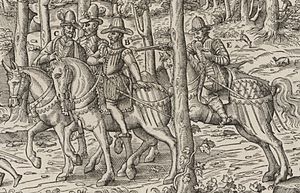 The assassination of Duke Giz during the siege | |||
| date | 1563 | ||
| A place | Orleans | ||
| Total | lifting the siege after the death of François de Guise, the beginning of the peace talks | ||
| Opponents | |||
| |||
| Commanders | |||
| |||


The conflict was provoked by the Catholic troops of the Duke of Guise on March 1, 1562, in Vassi . As a result, Prince Conde , the Huguenot commander, moved to Orleans to turn him into one of his strongholds. The city became Protestant, only Protestant worship was allowed, Protestants began to prevail in public institutions (governor, aldermen , etc.), the city’s bishop was dismissed in April 1562 , the temples were desecrated, and the relics were destroyed.
In 1563, Catholic troops headed by the Duke of Guise set out to return Orleans, whose defense was entrusted to Admiral de Coligny’s brother, François de Coligny D'Andelaux . On February 18, 1563 , when the situation of the besieged became especially grave, the Huguenot of Poltro de Mere killed the Duke of Guise. This murder led to the conclusion of a treaty between the two parties, which on March 19, 1563 became the basis of the Amboise peace and established peace between the two religious communities. Orleans remained under the control of the Huguenots until 1567 .
Literature
- Wood, James B. The King's Army : [ eng ] . - Cambridge: Cambridge University Press, 1996. - P. XII-349. - ISBN 0-521-55003-3 . .
- Denis Crouzet, Les Guerriers de Dieu: La Vie de la Querce (p. 1525-v. 1610) , Seyssel, Champ Vallon, 2005 ("Époques") (1st edition: 1990) ISBN 2-87673-430- 3