Granitoids are the common name for a group of rocks of igneous , rarely metasomatic origin, acid composition (more than 62% SiO 2 ). The term is used for the field description of rocks similar to granite , as well as unexplored granite-like complexes.
| Granitoids | |
|---|---|
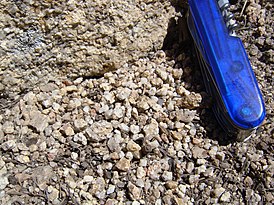 The granitoid (above) crumbles into rubble . The width of the knife is about 2 cm. | |
| Minerals | quartz , feldspars |
| Electrical conductivity | no |
By origin, granitoids are divided into:
- autochthonous - solidified from the melt right at the place of occurrence;
- allochthonous - displaced after crystallization;
- metasomatic - formed without melting.
By chemical and mineral composition are distinguished:
| Granitoids | % quartz | minimum % SiO 2 | % anorthite | % non-ferrous minerals ( biotite , etc.) |
|---|---|---|---|---|
| Quartz Diorites | 5-15 | 62 | 40-30 | 30-20 |
| Granodiorites | 15-25 | 68 | 30-20 | 20-15 |
| Adamellites | 25-30 | 73 | 20-15 | 15-10 |
| Granites | 30-50 | 73 | 15-10 | 10-5 |
Alkaline granitoids contain only alkaline feldspars ; subalkaline granitoids ( syenogranites and granosyenites ) are close to syenites .
Literature
- Granitoids / R. N. Sobolev // Hermaphrodite - Grigoryev. - M .: Big Russian Encyclopedia, 2007. - P. 628. - ( Big Russian Encyclopedia : [in 35 vols.] / Ch. Ed. Yu. S. Osipov ; 2004—2017, vol. 7). - ISBN 978-5-85270-337-8 .
From BDT:
- Geological dictionary. M., 1978. T. 1; Petrographic Dictionary / Ed. V.P. Petrova et al. M., 1981; Petrography / Ed. A.A. Marakusheva. M., 1981. Part 2.