Demolished  architectural monument

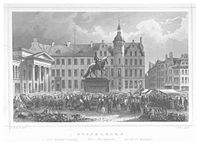
The Old Theater ( German Alte Theater ), also the Grupellotheater ( German Grupellotheater ), is a drama theater that does not exist at present on the Market Square in Düsseldorf ( North Rhine-Westphalia , Germany ). The name "Grupello Theater" recalls that at one time this part of the complex of buildings of the square was owned by the sculptor Gabriel Grubelo, which housed his foundry. It was here that the Jan-Wellem-Reiterdenkmal horse group was cast by Jan Wellem , set in the center of the square. In connection with the construction of the city theater ( Stadttheater Düsseldorf ) on the modern alley of Heinrich Heine (now this theater is also absent), in 1875 the old drama theater on the Market Square was closed.
Content
- 1 History
- 2 notes
- 3 References
- 4 Literature
History
Already in 1747, the old Grupello foundry was used as a theater when the Elector Karl Theodor was in Dusseldorf. In 1750, the building was used as a comedy theater. Since 1751, regular theatrical productions began. In 1781, theater lovers turned to Karl Theodor with a request for the repair of the building. The Elector heeded the requests of educated citizens and instructed his special commissioner to carry out the necessary work. The task was completed and additional decorations were made at the expense of the Elector. In 1805, the theater changed its name to “Bergish National Stage” or “Bergish German Theater”. After Düsseldorf became Prussian, on April 11, 1818, King Frederick William III donated the state-owned building, which was still owned by the city, to Düsseldorf, who leased it to the theater. The official tenant was the Austrian actor and theater director Josef Derossi . He staged mainly musical performances, for example, the opera Virgin of the Danube (Danube Mermaid) (Das Donauweibchen). It was in this performance that the debut of the then seven-year-old actress Constanze Dahn took place. In the troupe of Derossi, then still young talents perform Albert Lorzing and Regina Ales ( Rosina Regina Ahles ).
Since 1829, Karl Lebrecht Immerman has given a new impetus to the development of the theater [1] . In collaboration with Christian Dietrich Grabbe in 1831-1836, he develops and implements completely new productions, which have become a bright page in the history of the theater. In 1834, Immerman’s theater staff included composers and conductors Felix Bartholdi Mendelssohn and Julius Ritz , 20 actors and 11 actresses, 9 soloists of singers and 3 singers, a choir of 10 male and 7 female voices, a theater doctor and a cashier [2] .
Government building advisers, architect Adolph von Vagedes and Goetz, submitted plans for a new theater building, but these plans were rejected and a decision was made to reconstruct the Old Theater. These works were started in 1831 . Costs amounted to 20 thousand thalers . In 1832, according to the project of architect Anton Schnitzler (apprentice of Fagedes), a portico was built based on ionic columns . They are not preserved. Now at this place is the entrance to the council hall of the Düsseldorf Town Hall .
Notes
- ↑ Josef Wolter: Immermanns Leitung des Düsseldorfer Stadttheaters . In: Beiträge zur Geschichte des Niederrheins. Zeitschrift des Düsseldorfer Geschichtsvereins . Siebzehnter Band, Düsseldorf 1902, S. 217 ff. ( online )
Joseph Voltaire : Immermann as the director of the Düsseldorf City Theater. In Contributions to the History of the Lower Rhine. Journal of the Dusseldorf Historical Union. Volume 17, Dusseldorf 1902, p. 217 and on the next. pages. - ↑ Hugo Weidenhaupt: Von der französischen zur preußischen Zeit. In: Hugo Weidenhaupt (Hrsg.): Düsseldorf. Geschichte von den Ursprüngen ins 20. Jahrhundert. Schwann im Patmos Verlag, Düsseldorf 1988, von den Ursprüngen ins 20. Jahrhundert., ISBN 3-491-34222-8 , Band 2, S. 401.
Hugo Weidenhaupt : From French to German Time. Edited by Hudo Weidenhaupt Düsseldorf. History from the foundation to the 20th century. ” Schwann im Patmos Publishing House, Dusseldorf, 1988, Volume 2, p. 401. ISBN 3-491-34222-8 .
Links
- Colorierte Ansicht vom Düsseldorfer Marktplatz (bei Zeno.org)
Color image of the Dusseldorf Market Square with a portico of the Old Theater (mid-19th century).
Literature
- Architekten- und Ingenieur-Verein zu Düsseldorf (Hrsg.): Düsseldorf und seine Bauten. L. Schwann, Düsseldorf 1904, S. 68 und 282.
Düsseldorf Architectural Society (publisher): Düsseldorf and its buildings. publishing house L. Schwann, Dusseldorf, 1904, p. 68 and 282. - Boris Becker: Düsseldorf in frühen Photographien 1855-1914. Schirmer / Mosel, München 1990. Tafel 27.
Boris Becker : Dusseldorf in the early photographs of 1855-1914. Schirmer Mosel, Munich, 1990, illustration 27. - Theo Lücker: Steine sprechen. Kleiner Wegweiser durch die Düsseldorfer Altstadt. Verlag T. Ewers, Düsseldorf 1977, S. 86-87 [Nr. 42 Das erste Düsseldorfer Schauspielhaus].
Theo Lucker : The stones say. A small guide to the Old Town of Dusseldorf. Publisher T. Evers, Dusseldorf, 1977, pp. 86-87. (No. 42 - the first Düsseldorf drama theater).