Trumpler 16 ( Eng. Trumpler 16 , catalog number star clusters R. J. Trumplera , 1930) is a massive open cluster containing several of the brightest stars of the Milky Way . The cluster is located in the Carina Nebula on the arm of the Carina Sagittarius and is located at a distance of about 7,500 light-years from the Sun. The star η Kiela, which is part of the cluster, is visible to the naked eye.
| Trimbler 16 | |
|---|---|
| Star cluster | |
 The image of the Carina Nebula in the infrared, Cluster Trimpler 16 is located on the left, around the star η Carina (the brightest star of the image). | |
| Research history | |
| Designations | C 1043-594 |
| Observational data ( Age J2000.0 ) | |
| Type of | Open cluster |
| Right ascension | |
| Declination | |
| Distance | 7500 St. years (2300 pc ) [2] |
| Visible magnitude (V) | |
| Constellation | Keel |

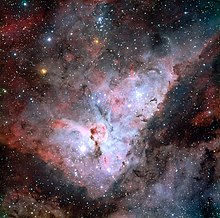
The brightest stars of the cluster are η Kiel and WR 25 , the luminosities of both stars exceed the solar by millions of times; in addition to them, another 6 cluster stars have a spectral class O3. [2] Both η Kiel and WR 25 are binary stars in which the main component provides most of the luminosity, but the second component is also a massive bright star. If we consider the radiation of the entire wavelength range, then WR 25 will turn out to be a brighter star: the luminosity is 6,300,000 luminosities of the Sun , the absolute bolometric magnitude is -12.25. At η Kiel, the total luminosity is 5,300,000 luminosities of the Sun, the absolute bolometric magnitude is -12.0. However, in the images η Kiel seems to be a brighter object, since it is brighter in the optical range of the spectrum, and also immersed in a nebula clearly visible in the images. WR 25 is a very hot star, emitting a significant portion of the energy in the ultraviolet range . This star can be seen in the images below and to the right of the η Kiel star, near the edge of a bright nebula and to the right of the orange star.
Trumpler 16 and Trumpler 14 are the most visible clusters in the Kiel OB1 association, the giant stellar Kiel arm association . Another cluster in the association, Collinder 228 ( Collinder 228 ) is considered a continuation of the Trumpler 16 cluster, visually separated from it by a dust strip . Cluster Trumpler 14 is more young and compact. [4] The spectral classes of cluster stars show that it was formed during a single outburst of star formation. The stellar wind created by the brightest stars threw the remnants of dust clouds from the cluster. A few million years after the brightest stars complete evolution by experiencing supernova explosions , the cluster will slowly complete its evolution.
Notes
- ↑ 1 2 Zhen-Yu; Wu; Zhou, Xu; Ma, Jun; Du, Cui-Hua. The orbits of open clusters in the Galaxy // Monthly Notices of the Royal Astronomical Society . - Oxford University Press , 2009. - Vol. 399 , no. 4 . - P. 2146 . - DOI : 10.1111 / j.1365-2966.2009.15416.x . - . - arXiv : 0909.3737 .
- ↑ 1 2 Wolk, Scott J .; Broos, Patrick S .; Getman, Konstantin V .; Feigelson, Eric D .; Preibisch, Thomas; Townsley, Leisa K .; Wang, Junfeng; Stassun, Keivan G. .; King, Robert R .; McCaughrean, Mark J .; Moffat, Anthony FJ; Zinnecker, Hans. The Chandra Carina Complex Project View of Trumpler 16 // The Astrophysical Journal : journal. - IOP Publishing 2011. - Vol. 194 , no. 1 . - P. 15 . - DOI : 10.1088 / 0067-0049 / 194/1/12 . - . - arXiv : 1103.1126 .
- ↑ SIMBAD Astronomical Database
- ↑ G .; Carraro; Romaniello, M .; Ventura, P .; Patat, F. The star cluster Collinder 232 in the Carina complex and its relation to Trumpler 14/16 // Astronomy and Astrophysics : journal. - EDP Sciences 2004. - Vol. 418 , no. 2 . - P. 525 . - DOI : 10.1051 / 0004-6361: 20034335 . - . - arXiv : astro-ph / 0401144 .