HD 93250 is a hot blue double star of high luminosity in the Carina Nebula in the constellation Kiel .
| HD 93250 AB | |||
|---|---|---|---|
| Star | |||
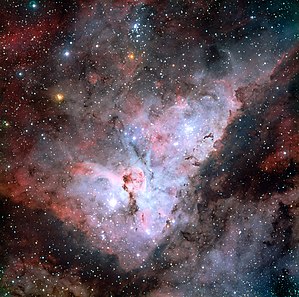 HD 93250 is a bright star to the left and above the center of the image of the Carina Nebula, above the Keyhole Nebula | |||
| Observational data ( Age J2000.0) | |||
| Type of | double star | ||
| Right ascension | |||
| Declination | |||
| Distance | 7 660 St. years (2,350 pc ) [2] | ||
| Visible magnitude ( V ) | 7.41 [3] | ||
| Constellation | Keel | ||
| Astrometry | |||
| Radial velocity ( R v ) | 11.6 [4] km / s | ||
| Own movement (μ) | RA: −7.27 [1] Dec: +2.45 [1] | ||
| Parallax (π) | 0.53 ± 0.42 [1] mas | ||
| Absolute magnitude (V) | −6.14 [5] | ||
| Specifications | |||
| Spectral class | O4 IV (fc) [6] | ||
| Color Index ( B - V ) | +0.17 [3] | ||
| Color Index ( U - B ) | −0.85 [3] | ||
| physical characteristics | |||
| Weight | 83.3 (65 [7] ) M ☉ | ||
| Radius | 15,9 R ☉ | ||
| Age | 1.3 million years | ||
| Temperature | 46 000 K | ||
| Luminosity | 1 000 000 L ☉ | ||
| Rotation | 130 km / s | ||
| |||
| Database Information | |||
| SIMBAD | data | ||
Content
Location
HD 93250 is one of the brightest stars in the area of the Carina Nebula and is located 7.5 arc minutes from Eta Carina [2] . Both of these stars are believed to belong to the open cluster Trimpler 16 , although HD 93250 is closer to the cluster Trumpler 14 [8] .
HD 93250 is an area in the Carina Nebula containing several bright stars, such as HD 93268 and HDE 303311 and relatively few faint stars. Bright stars were supposed to be the core of a separate Collinder 232 cluster, but the lack of concentration of fainter stars in this area suggests that Collinder 232 is not a real cluster, and HD 93250 is a representative of one of the real clusters [9] .
The fact that HD 93250 belongs to the Trumpler 16 cluster makes it possible to estimate the distance and the probable age of the star [5] .
Spectrum
Despite the fact that HD 93250 is a binary star, the spectra of the components separately were not observed, but, probably, they are similar to each other. The spectral class of stars is indicated as O5 [10] , O6 / 7 [11] , O4 [12] or O3 [13] . In some cases, a star is referred to as main sequence stars, in some cases, to giant stars [12] [13] . In the framework of the review of the galactic O-stars of the Galaxy ( English Galactic O-Star Spectroscopic Survey ), this star was considered as a standard representative of the spectral class of subgiants O4 [6] .
Double Star
HD 93250 is the brightest X-ray source in the Carina Nebula [2] . For a long time, it was believed that radiation arises due to the stellar wind collision of a close pair of high luminosity stars, however, no significant radial velocity variations were found during the studies [4] .
In 2010, two stars were identified on the AMBER ( Very Large Telescope ) interferometer in HD 93250. Neither relative motion nor radial velocity variations were detectable; the orbit and properties of the components remained inaccurate. The projection of the distance between the components is 1.5 msd or 3.5 a. e. Stars do not show a significant difference in color and are probably stars of the spectral class O [2] .
Properties
The physical properties of HD 93250 were calculated based on the assumption that the star is single. The temperature is about 50 thousand K , luminosity exceeds solar by 1 million times. Weight estimation depends on the type of model; analysis of the two components separately may allow clarification of this parameter [7] .
Notes
- ↑ 1 2 3 4 5 van Leeuwen, F. Validation of the New Hipparcos Reduction // Astronomy and Astrophysics . - EDP Sciences 2007. - Vol. 474 , no. 2 . - P. 653-664 . - DOI : 10.1051 / 0004-6361: 20078357 . - . - arXiv : 0708.1752 .
- ↑ 1 2 3 4 H .; Sana; Le Bouquin, J.-B .; De Becker, M .; Berger, J.-P .; De Koter, A .; Mérand, A. The Non-thermal Radio Emitter HD 93250 Resolved by Long Baseline Interferometry (Eng.) // The Astrophysical Journal : journal. - IOP Publishing 2011. - Vol. 740 , no. 2 . - P. L43 . - DOI : 10.1088 / 2041-8205 / 740/2 / L43 . - . - arXiv : 1110.0831 .
- ↑ 1 2 3 II; Antokhin; Rauw, G .; Vreux, J.-M .; Van Der Hucht, KA; Brown, JC XMM-Newton X-ray study of early type stars in the Carina OB1 association // Astronomy and Astrophysics : journal. - EDP Sciences 2008. - Vol. 477 , no. 2 . - P. 593 . - DOI : 10.1051 / 0004-6361: 20065711 . - . - arXiv : 0711.3612 .
- ↑ 1 2 G .; Rauw; Nazé, Y .; Fernández Lajús, E .; Lanotte, AA; Solivella, GR; Sana, H .; Gosset, E. Optical spectroscopy of X-Mega targets in the Carina nebula - VII. On the multiplicity of Tr16-112, HD93343 and HD93250 (Eng.) // Monthly Notices of the Royal Astronomical Society : journal. - Oxford University Press , 2009. - Vol. 398 , no. 3 . - P. 1582 . - DOI : 10.1111 / j.1365-2966.2009.15226.x . - . - arXiv : 0906.2681 .
- ↑ 1 2 T .; Repolust; Puls, J .; Herrero, A. Stellar and wind parameters of Galactic O-stars. The influence of line-blocking / blanketing // Astronomy and Astrophysics : journal. - EDP Sciences 2004. - Vol. 415 . - P. 349 . - DOI : 10.1051 / 0004-6361: 20034594 . - .
- ↑ 1 2 J .; Maíz Apellániz; Sota, A .; Arias, JI; Barbá, RH; Walborn, NR; Simón-Díaz, S .; Negueruela, I .; Marco, A .; Leão, JRS; Herrero, A .; Gamen, RC; Alfaro, EJ The Galactic O-Star Spectroscopic Survey (GOSSS). III. 142 Additional O-type Systems (Eng.) // The Astrophysical Journal : journal. - IOP Publishing , 2016. - Vol. 224 . - P. 4 . - DOI : 10.3847 / 0067-0049 / 224/1/4 . - . - arXiv : 1602.01336 .
- ↑ 1 2 C .; Weidner Vink, JS The masses, and the mass discrepancy of O-type stars // Astronomy and Astrophysics : journal. - EDP Sciences 2010. - Vol. 524 . - P. A98 . - DOI : 10.1051 / 0004-6361 / 201014491 . - . - arXiv : 1010.2204 .
- ↑ Nathan; Smith. A census of the Carina Nebula - I. Cumulative energy input from massive stars (Eng.) // Monthly Notices of the Royal Astronomical Society : journal. - Oxford University Press , 2006. - Vol. 367 , no. 2 . - P. 763 . - DOI : 10.1111 / j.1365-2966.2006.10007.x . - . - arXiv : astro-ph / 0601060 .
- ↑ Mauricio; Tapia; Roth, Miguel; Vázquez, Rubén A .; Feinstein, Alejandro. Imaging study of NGC 3372, the Carina nebula - I. UBVRIJK photometry of Tr 14, Tr 15, Tr 16 and Car I (Eng.) // Monthly Notices of the Royal Astronomical Society : journal. - Oxford University Press , 2003. - Vol. 339 . - P. 44 . - DOI : 10.1046 / j.1365-8711.2003.06186.x . - .
- ↑ AD; Thackeray; Tritton, SB; Walker, EN Radial velocities of southern B stars determined at the Radcliffe Observatory — VII // Memoirs of the Royal Astronomical Society: journal. - 1973. - Vol. 77 . - P. 199 . - .
- ↑ N .; Houk; Cowley, AP University of Michigan Catalog of two-dimensional spectral types for the HD stars. Volume I. Declinations -90_ to -53_ƒ0 (Eng.) // University of Michigan Catalog of two-dimensional spectral types for the HD stars. Volume I. Declinations -90_ to -53_ƒ0: journal. - 1975. - .
- ↑ 1 2 Nolan R .; Walborn Sota, Alfredo; Maíz Apellániz, Jesús; Alfaro, Emilio J .; Morrell, Nidia I .; Barbá, Rodolfo H .; Arias, Julia I .; Gamen, Roberto C. Early Results from the Galactic O-Star Spectroscopic Survey: C III Emission Lines in Spectra (Eng.) // The Astrophysical Journal : journal. - IOP Publishing 2010. - Vol. 711 , no. 2 . - P. L143 . - DOI : 10.1088 / 2041-8205 / 711/2 / L143 . - .
- ↑ 1 2 SJ; Williams; Gies, DR; Hillwig, TC; McSwain, MV; Huang, W. Radial Velocities of Galactic O-type Stars. I. Short-term Constant Velocity Stars (Eng.) // The Astronomical Journal : journal. - IOP Publishing 2011. - Vol. 142 , no. 5 . - P. 146 . - DOI : 10.1088 / 0004-6256 / 142/5/146 . - .