A traveling wave is a wave motion in which the surface of equal phases (phase wave fronts ) moves with a finite speed (constant for a homogeneous medium). Examples are elastic waves in a rod, a column of gas or liquid, an electromagnetic wave along a long line or in a waveguide [1] .
Unlike standing waves , traveling waves, when propagating in a medium, carry energy . A traveling wave, the group velocity of which is nonzero, is associated with the transfer of energy, momentum, or other characteristics of the process [2] .
The evolution of a traveling wave in time and space can be described by the expression:


Where - amplitude wave envelope , - wave number and - phase oscillation . Phase velocity this wave is given by the expression


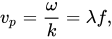
Where Is the wavelength .

Content
- 1 Special cases
- 2 Partially traveling wave
- 2.1 Characteristic
- 3 See also
- 4 notes
- 5 Links
Special cases
A standing wave is a special case of a traveling wave with where - group wave velocity.
That is, two identical periodic traveling waves (within the framework of the principle of superposition ), propagating in opposite directions, form a standing wave [2] .
Partially Running Wave
Occurs at different amplitudes.
Feature
It is characterized either by the coefficient of the traveling wave (KBW), or by the coefficient of the standing wave (KCB), or by the reflection coefficient Г equal to the ratio of the amplitudes of the opposing waves [2] :
KCB = 1 / KBV = (1+ | G | ²) / (1- | G | ²)
For transmission lines, the optimal transfer of energy requires coordination: obtaining the traveling wave mode in the line — KCB = 1, G = 0.
This mode for circuits with lumped parameters will correspond to the equality of the internal resistance of the source to the load resistance.
See also
- Wave
- Wave interference
- Soliton
Notes
- ↑ RUNNING WAVE
- ↑ 1 2 3 Physical Encyclopedia