Raushskaya embankment ( Roushskaya , until the 1870s. Zayaitskaya embankment ) - the embankment of the Moscow River in the Zamoskvorechye district of the Central Administrative District of Moscow . Lies between the street Baltschug and the Big Ustinsky bridge . House numbers are from Baltschug. It is connected with Sadovnicheskaya street 1st and 2nd Raushsky lanes.
| Raushskaya embankment | |
|---|---|
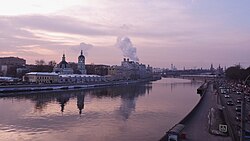 Church of St. Nicholas the Wonderworker in Zayaitsky, 1749-1759 | |
| general information | |
| A country | Russia |
| City | Moscow |
| County | TsAO |
| Area | Zamoskvorechye |
| Underground |  Novokuznetsk Novokuznetsk |
| Phone numbers | +7 (495) XXX ---- |


Content
Name Origin
It got its modern name in the 1st half of the 19th century according to the rovings located in this area from the 15th century - ditches that diverted water from the floodplain lands of Zamoskvorechye (filled up in 1835). There was also a form of Roush embankment [1] .
The origin of the former name - Zayaitskaya embankment - is unclear. Likely versions of the church of St. Nicholas the Wonderworker in Zayaitsky, known since the 16th century, [1] from trading guests who came “because of Yaik ” (from Central Asia), or from Yaik Cossacks who settled here in the Time of Troubles (see [1] ) Changing the names of Zamoskvoretsky embankments in the 1870s. associated with the construction of new bridges on the Moscow River, including the first built Ustinsky bridge.
History
In 1495, the sovereign garden was founded opposite the Kremlin . His workers settled in the settlements of Upper Gardeners ( Bersenevskaya Embankment ), Middle ( Sofiyskaya Embankment ) and Lower Gardeners (east of Baltschug). To the east of Baltschug, a canal was dug between the Moskva River and the old man, which was preserved during the construction of the Drainage Canal in the 1780s . and finally bombarded in 1876 .
At the end of the XIX century, the Raushskaya embankment was industrialized. In 1896, the power plant operating to this day (architect N.P. Basin ) was built on the embankment, later rebuilt by I.V. Zholtovsky and V.E. Dubovsky . Here today is the head office of Mosenergo .
Modern Raushskaya embankment is an “uninhabited island”: in the district there are only two residential buildings that stand apart, along Sadovnicheskaya Street. At the end of the embankment, near Bolshoi Ustinsky Bridge in 1928, a large residential building (No. 32) was built according to the project of architect B.V. Efimovich , but in the post-war years it fell into disrepair and was demolished in 1989; fenced area between the bridge and the church of St. Nikola Zayaitsky is still empty.
Power Station, photo 1896
Power plant, building 1911, photo of the 2000s.
House of the clergy of the Church of St. Nicholas the Wonderworker
Noteworthy buildings and structures
On the odd side is the Moscow River.
On the even side:
- No. 2 - Hotel Baltschug-Kempinski , formerly just Baltschug, until 1917 - Novo-Moskvoretsky Compound (completely rebuilt in the 1990s )
- No. 4 - The former Khrulevoi Hotel
- No. 8 - Power plant of the Society of Electric Lighting (1905-1907, architect R. I. Klein ) [1]
- No. 10, 12 - Moscow City Power Station (SHPP-1; "Raushskaya") of the "Electric Lighting Society of 1886" - HPP-1 named after P. G. Smidovich MOGES (end of XIX century. - 1st third of XX century., Architects N. P. Basin , N. N. Blagoveshchensky , I. V. Zholtovsky , V. E. Dubovsky , engineer-technologist A. G. Besson and others), an object of cultural heritage of regional importance. Nowadays - HPP-1 of Mosenergo OJSC
- No. 10, p. 1 - The main building with a machine room and boiler rooms (1896-1897, 1907, 1911, 1926, 1928, architects N.P. Basin, N.N. Blagoveshchensky , I.V. Zholtovsky , process engineer A G. Besson, civil engineer V.V. Nicolas, military engineer N.V. Smirnov);
- No. 10, p. 2 - Office with a pumping station (1896, 1911, architect N. P. Basin);
- No. 12 - Case with a machine room of synchronous converters (1925, 1928).
- No. 22/21 - a residential building of the 18th-19th centuries, a cultural heritage site identified. Nowadays - the building of the State Unitary Enterprise " Mosgortrans ".
- No. 24 - a two-story house of the XVIII — XIX centuries
- No. 26/4 - house of the clergy of the church of St. Nicholas Zayaitsky, mid- 18th century
- No. 26 / 1-3 - Church of St. Nicholas in Zayaitsky , 1749 - 1759
- No. 28 - Residential building of I.V. Tselibeev M.A. Arsentyev (1789, 1802, 1835, 1892), revealed object of cultural heritage.
Transport
Bus
- No. 158 - from Baltschug Street to the Bolshoi Ustyinsky Bridge.
- No. K - from Bolshoy Ustinsky Bridge to Baltschug Street.
Notes
- ↑ 1 2 3 Vostryshev M.I. Moscow: all streets, squares, boulevards, side streets. - M .: Algorithm , Eksmo, 2010 .-- S. 478. - 688 p. - ISBN 978-5-699-33874-0 .
Literature
- Sytin, P.V. From the history of Moscow streets. M., 1948.S. 155-160
Links
- History of St. Nicholas Church [2]
- Photo of house No. 32 of the 1970s and discussion of the circumstances of the demolition [3]
- Photos of all houses on Raushskaya [4]
- Photos of Raushskaya embankment on gorod-Moscow