Gibb, Livingston & Co. (Gibb, Livingston & Co., 仁 記, Renji [1] ) is one of the largest British trading companies operating in the second half of the XIX - the first half of the XX century in British Hong Kong and China . Founded in 1836 in Canton by merchants Thomas Gibb and William Livingston, the main areas of activity were wholesale of opium, fabrics and tea, shipping, ship agency services , warehousing and insurance. In addition to the economic Gibb, Livingston & Co. She also had political influence in Hong Kong, leading her representatives to the Legislative Council of the colony.
| Gibb, Livingston & Co. | |
|---|---|
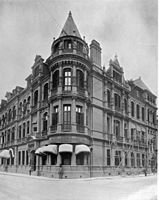 | |
| Type of | Trading house |
| Base | 1836 |
| Abolished | 1962 |
| Reason for Abolition | takeover by Borneo Company |
| Founders | Thomas Gibb and William Livingston |
| Location | Canton and hong kong |
| Industry | wholesale and shipping |
Content
- 1 Base and heyday
- 1.1 Political Impact
- 2 The first half of the XX century
- 3 Absorption
- 4 notes
- 5 Literature
- 6 References
Foundation and flowering
Gibb Trading House, Livingston & Co. It was founded on July 1, 1836 in Canton by Scottish merchants Thomas August Gibb (in some sources - Gibb) and William Potter Livingston, who previously worked for the British East India Company [2] [3] .
During the First Opium War (1840–1842) Gibb, Livingston & Co. was forced to relocate her head office from Canton to Portuguese Macau . After the British occupied Hong Kong and under the Nanking Treaty formally annexed it to the empire (1842), Gibb, Livingston & Co. moved its headquarters to a new colony, on Queens Road [4] .
Soon at Gibb, Livingston & Co. Four members of the Gibb family have already held senior positions. In 1844, John Darby Gibb opened a company office in Shanghai , on Jinki Road (at the Shanghai Gibb office, Livingston & Co. became known in China as “Jinkee”) [2] . After some time, the trading house acquired its own fleet of high-speed clippers and opened branches in the ports of Amoy and Fuzhou , which specialized in trading Chinese tea. In the mid-19th century, the main areas of activity of Gibb, Livingston & Co. there were deliveries to China of opium , cotton and woolen fabrics, as well as exports from the empire of tea and silk [2] [5] [6] [3] .

The main means of payment were silver bullion. Soon Gibb and Livingston began to expand their areas of activity: they sold ready-made clothes, velveteen , leather and tin, and also acted as agents for a large number of shipping companies and individual vessels [3] .
In the second half of the 19th century, , who became Gibb's senior partner, Livingston & Co., was at the helm of the company. in July 1855 [7] . In addition to managing a family business, he headed the Hong Kong Chamber of Commerce since 1864 and was director of the China Fire Insurance Company [8] [9] .
Hugh Gibb also actively participated in the political life of the colony. In 1866, he became a member of the Hong Kong Legislative Council during the absence of Thomas Sutherland [10] and held office until 1871 until he was succeeded by a partner at Holiday, Wise & Co. Richard Rowett [11] . In 1879, Hugh Gibb re-became a member of the council after the resignation of Henry Lowcock and remained in this post until 1880 [12] [13] .
In 1868, William Henry Gibb and Edward Ford Duncanson left the company, and instead Gibb, Livingston & Co. became the English businessman (left the trading house in 1882) [14] . In 1899, numerous steamboats Gibb, Livingston & Co. were merged under the supervision of the Gibb Line [3] .
At the turn of the XIX - XX centuries Gibb, Livingston & Co. Through its offices in Hong Kong, Shanghai, Fuzhou and Amoy, it maintained close economic ties with many companies operating in the Far East. In particular, she acted as an agent of insurance companies Allianz , , , United States Lloyds, Lloyds London, London Salvage Association, Liverpool Salvage Association, Maritime Insurance Company (Liverpool), Underwriting and Agency Association, China Fire Insurance Company, Indemnity Mutual Marine Insurance Company, Australian Alliance Association Company, North Queensland Insurance Company and Northern Fire and Life Assurance Company [15] [3] .
Political Influence
Since the founding of the new British colony of Gibb, Livingston & Co. played an important role in the political life of Hong Kong. In 1843, the Legislative Council was established under the governor , performing advisory functions. Initially, it included only officials of the colonial administration, but local merchants also claimed the right to participate in the administration of Hong Kong, whose well-being largely depended on their business activity. In 1850, the most influential people in Hong Kong's business world, including the executives of Jardine, Matheson & Co. , Dent & Co. and Gibb, Livingston & Co., on behalf of the justices of the peace, elected two of their representatives as unofficial members of the Legislative Council. These representatives influenced the administration’s policies and sought to prevent tax growth [16] .
Since 1865, the Hong Kong Legislative Council, in addition to the five officials who held their posts according to administrative posts, has included four unofficial members. Three of them represented the largest trading and shipping companies in the colony (Jardine, Matheson & Co., Dent & Co. and Peninsular and Oriental Steam Navigation Company ). After the ruin in 1867, the place of Dent & Co. was held by a representative of Gibb, Livingston & Co., and the remaining place was alternately claimed by seven other major homes in Hong Kong. Now the members of the Legislative Council have received more rights in the field of proposing bills and contesting the proposals of the governor [17] .
First Half of the 20th Century
Gibb, Livingston & Co. entered the new century by a successful and diversified trading company. By 1908, it was one of Hong Kong's largest business houses with a strong presence in Shanghai (at one time the Gibb, Livingston & Co. headquarters was located in the Hong Kong York Building; now it is replaced by the Chater House skyscraper). Insurance, construction and production of final products [15] [3] were added to trade operations, shipping and warehousing.
The company’s partners included the government of North Borneo , Peninsular and Oriental Steam Navigation Company , , , Shanghai Land Investment Company, Eastern and Australian Steamship Company and South African Line of Steamers (at Hongkong Electric , Shanghai Land and some other Gibb, Livingston & Co. companies had equity interests). In 1921, Gibb, Livingston & Co. acquired the trading house Gray, David & Co. [15] [3] .
Absorption
In 1962, Gibb Trading House, Livingston & Co. bought the British , based in Sarawak [18] . In 1967, Borneo Company Limited itself was acquired by the British Inchcape and Company [19] .
Notes
- ↑ Ivanov, 1990 , p. 273.
- ↑ 1 2 3 José Maria Braga. Hong Kong Business Symposium: A Compilation of Authoritative Views on the Administration, Commerce, and Resources of Britain's Far Eastern Outpost. - South China Morning Post Limited, 1957. - S. 431.
- ↑ 1 2 3 4 5 6 7 Dan Waters. Hong Kong Hongs with Long Histories and British Connections (231 pp .) . Hong Kong University, Journal of the Royal Asiatic Society Hong Kong Branch (June 1991).
- ↑ Colin N. Crisswell. The Taipans: Hong Kong's Merchant Princes. - Oxford University Press, 1981.- S. 103.
- ↑ Samuel Y. Liang. Mapping Modernity in Shanghai: Space, Gender, and Visual Culture in the Sojourners' City, 1853-98. - Routledge, 2010 .-- S. 90. - ISBN 9781136974434 .
- ↑ The China Directory for 1862 . A. Shortrede & Co., Hong Kong (1862).
- ↑ The Hongkong Government Gazette // The Hongkong Government Gazette. - July 28, 1855.
- ↑ Chamber Chairmen 1861-1870 (English) . The Hong Kong General Chamber of Commerce.
- ↑ Advertisement // North China Herald (Shanghai). - April 21, 1870.
- ↑ The Hongkong Government Gazette // The Hongkong Government. - 18 May 1866. - No. 74.
- ↑ The Hongkong Government Gazette // The Hongkong Government Gazette. - 13 July 1871. - No. 103.
- ↑ The Hongkong Government Gazette // The Hongkong Government Gazette. - 6 May 1879. - No. 111.
- ↑ The Hongkong Government Gazette // The Hongkong Government Gazette. - 29 May 1880. - No. 130.
- ↑ The Hongkong Government Gazette // The Hongkong Government Gazette. - October 10, 1868.
- ↑ 1 2 3 Arnold Wright. Twentieth century impressions of Hongkong, Shanghai, and other treaty ports of China: their history, people, commerce, industries, and resources. - Lloyds Greater Britain Publishing, 1908. - T. 1. - S. 216.
- ↑ Ivanov, 1990 , p. twenty.
- ↑ Ivanov, 1990 , p. 21.
- ↑ Geoffrey Jones. Merchants to Multinationals: British Trading Companies in the Nineteenth and Twentieth Centuries. - Oxford University Press, 2000 .-- S. 276. - ISBN 9780198294504 .
- ↑ Inchcape PLC History .
Literature
- Ivanov P.M. Hong Kong. History and modernity. - Moscow: “Science”, Main Edition of Oriental Literature, 1990. - ISBN 5-02-016958-7 .