The West European theater of operations of the Second World War ( 1939 - 1945 ) - military operations that took place during the Second World War in Western Europe and the Atlantic .
| West European War Theater | |||
|---|---|---|---|
| Main Conflict: World War II | |||
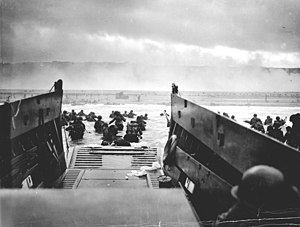 American soldiers landed in Normandy . June 6, 1944 | |||
| date | September 3, 1939 - May 8, 1945 | ||
| A place | West Germany , France , Belgium , Netherlands , Luxembourg , Great Britain , Norway , Denmark , Atlantic Ocean . | ||
| Total | Victory of the Anti-Hitler Coalition | ||
| Opponents | |||
| |||
| Commanders | |||
| |||


Content
The Strange War and the Beginning in the Atlantic (September 1939 - April 1940)
On September 3, 1939, Great Britain and France declared war on Germany . This was a response to the German invasion of Poland [3] . From September 1939 until the spring of 1940, the so-called Strange War was fought in Western Europe . The French army and the English expeditionary force landed in France, on the one hand, and the German army, on the other, languidly fired upon each other without taking any active action. The lull was false, because the Germans were simply afraid of waging a war on "two fronts."
At the beginning of the war, Great Britain and France had an overwhelming superiority over Germany both on land and at sea. Realizing the economic dependence of Great Britain on its vast possessions in different parts of the world, the German command detached considerable forces against the British cargo and merchant fleet. From the first days of the war, German ships “hunted” for British ships into the open ocean and even to the shores of Latin America and Africa . The first major naval battle took place on December 13, 1939 in La Plata Bay, off the coast of Argentina , where the Germans lost the cruiser Admiral Count Spee , which had previously destroyed 9 British ships. The battle is known as the Battle of La Plata .
Axis Offensive
The invasion of Denmark and Norway (April - June 1940)
On the morning of April 9, 1940, German troops invaded neutral Denmark and Norway with the aim of strengthening German positions in the Atlantic and Northern Europe, as a preventive measure to prevent similar actions from Great Britain and France and to seize iron ore deposits. The “ strange war ” ended, and the Allies began to move on to action. German forces landed in the harbor of Copenhagen , King Christian X and the Danish government under threat of bombing were forced to surrender. Denmark was declared a protectorate of Germany . In Norway, the Germans threw off the landing and captured the largest cities: Oslo , Trondheim , Narvik . However, the Norwegian government refused to capitulate and called on the people to fight the enemy. British troops arrived to the aid of a small Norwegian army. They managed to gain a foothold in the north and wage a desperate struggle against the superior army of Germany . Attempts by the Anglo-Norwegian forces to drive the Germans out of the points they occupied led to a series of battles in the areas of Narvik , Namsus , Molle (Molde) and others. British troops repelled Narvik from the Germans. But they failed to snatch a strategic initiative . In early June, they were evacuated from Narvik (See Battle of Narvik ).
The Invasion of France (May - June 1940)
On May 10, 1940, German troops launched an offensive on France , Belgium , the Netherlands, and Luxembourg . In a short time they managed to break the resistance of the Belgian army. Allied forces moved to their aid in Belgium . Meanwhile, the second group of German troops , which initially moved slowly, allowing large Anglo-French forces to enter Belgium, invaded the Netherlands and forced the Dutch army to surrender by May 14 . Large Anglo-Franco-Belgian forces were encircled near the city of Dunkirk . However, the Germans did not take swift action to destroy this group and the allies managed to evacuate their troops to the British Isles (see Dunkirk Operation ). On May 26, Belgium surrendered. The French army, located on the Maginot Line , did not expect the Germans to advance around the fortifications of the Maginot Line through the Ardennes and was not ready for defense. The Germans managed in a short time to defeat the two most powerful French armies located on this line and deploy an offensive in the center of France. The poorly equipped troops, hastily abandoned by the French command, could not contain the advance of the German army. On June 10, Italy declared war on France and Great Britain, and this led to the opening of a new theater of operations - the Mediterranean . Despite the numerical superiority, the Italian troops could not break through the French defenses in the south. On June 14, German troops occupied Paris . On June 21, France signed a surrender. 3/5 of the territory of France came under German control. The puppet government of General Peten was created on the remaining territory. A small part of the territory of France passed to Italy (see German military administration in France ).
Battle of Britain (July 1940 - May 1941)
Having defeated France , the Germans tried to force Britain to surrender, and for this began the massive bombing of the British Isles . From July 1940 to May 1941, the largest air battle in history in the sky over Britain continued. The Germans were not able to achieve their goals, gain air supremacy and destroy the British Air Force. Further, air battles between the Allies and the Luftwaffe took place in the sky over Western Europe and the western part of Germany (mainly the Ruhr industrial region ), especially strategic bombing. At the same time, the British sank the largest German battleship Bismarck , which entered the Atlantic, after which the German command was forced to abandon further cruising with the participation of large warships.
Lull on the Western Front (May 1941 - June 1943)
After May 1941, a relative lull occurred on the western front, the fighting was moved to North Africa. The Germans transferred a significant part of their troops to the east and attacked the USSR . Only aircraft occasionally bombed the British Isles . At the same time, the scale of submarine war was growing. The number of German submarines operating in the Atlantic reached 170 by the middle of 1941 , and by the end of the year - 280. Of these, approximately 40% were at bases for repair and maintenance at each moment, 30% were on the way to combat duty or returned to base, and only 30% directly participated in the hostilities.
At the same time, the tactics of their actions changed. Instead of single attacks, tactics of group attacks (“wolf pack”) began to be practiced, in which a submarine that discovered a caravan of enemy ships called up to 10-20 submarines in the detection area for a joint attack of the caravan from different directions. This tactic, supplemented by the actions of German aviation, led to heavy losses for the English merchant fleet.
After the United States entered World War II, the Joint Chiefs of Staff began to aggressively propose the earliest possible (in the first half of 1942) invasion of Europe across the English Channel. However, at that time the United States could not conduct such an operation on its own, and the United Kingdom did not support this proposal, considering it more rational - at that time - the start of hostilities in North Africa [4] .
Nevertheless, the plans of the US military were fully supported by the US government, which began to exert political pressure on Britain in order to obtain the British’s consent to invade Europe as soon as possible. In particular, in his letter of March 9, 1942, Roosevelt wrote to Churchill the following:
“I am becoming more and more interested in opening a new front this summer on the European continent ... From the point of view of transport and supplies, it will be infinitely easier for us to take part in this, since the maximum distance is only about three thousand miles. And although the losses will undoubtedly be high, they will be compensated at least by the same losses of Germany, as well as the fact that Germany will be forced to divert large forces of all the armed forces from the Russian front. ”
A month later, General J. Marshall and G. Hopkins arrived in England with the task of obtaining the consent of her leadership to implement one of the two landing plans prepared by the Americans in occupied France - the Operation Roundup or Operation Sledgehammer. The first provided for the landing no later than April 1943 by forces of 48 divisions, and the second provided for the beginning of active operations in the early autumn of 1942 if either Germany or the USSR were on the verge of defeat in the war [5] .
On August 19, 1942, British and Canadian forces unexpectedly attacked the French city of Dieppe . The Germans repelled this attack, inflicting heavy losses on the Allies, but they gained experience in conducting an amphibious operation, which helped them further in opening a second front.
In March 1943, submarines achieved particularly significant success. The successful attack of the combined convoys SC-122 and HX-229, in which 21 vessels were sunk (141,000 gb ), made the British leadership doubt the reliability of the convoy system, but already in May a turning point was reached in the battle for the Atlantic in favor of the Allies, associated with the strengthening The US and British Navy in the Central Atlantic (the general grouping of their fleets reached 3,000 ships and 2,700 aircraft), the emergence of a large number of escort aircraft carriers with aircraft carrying radars of a new type. The composition of German submarines in this area dropped to 100-150 units. In addition, the main efforts of the German fleet were transferred to the North Atlantic to combat the Allied shipping to the USSR , and the losses of their submarines increased sharply (only in the spring of 1943 67 German submarines were sunk).
The growing threat to the Mediterranean region and the West required an increase in Wehrmacht forces in these areas. This could only be done by weakening the Eastern theater of operations. During the period from July 1, 1943 to June 1, 1944, the number of German divisions on the Eastern Front decreased for the first time from 186 to 156, while during the same period in the West and in the Mediterranean region it increased from 66 to 106 divisions [6 ] .
The Allied Offensive (including the Second Front) (1943-1945)
The Italian Campaign , July 1943
On July 10, 1943, the Allies landed in Sicily , and on September 3 in Italy . The Sicilian operation or Operation Husky is one of the strategic military operations of World War II, during which the Allied forces defeated the troops of the Axis countries (Italy and Germany) in Sicily and captured the island. The landing was a large-scale military landing operation, followed by six weeks of battles on land. It is considered the beginning of the Italian Allied Campaign.
Operation Husky began at night on July 9 and ended on August 17, 1943; at the time it was the largest naval landing operation. The Allied command in the future used the experience of landing in Sicily to carry out the subsequent even more ambitious landing operation - the landing in Normandy, which still remains the largest landing operation in history.
The strategic operation achieved the goals set by the Allies: the ground, air and naval forces of the Axis countries were knocked out of the island, the Mediterranean sea routes were opened, the Italian dictator Benito Mussolini was removed from power, and the landing in Italy began.
Second Front: France, June 1944
June 6, 1944 American, British and Canadian troops under the command of General Eisenhower launched a landing in Normandy (Northern France ). This is commonly referred to as the "opening of a second front in Europe." By the end of July, the Allies occupied a bridgehead about 100 km wide and up to 50 km in depth. On July 25, the Allies went on the offensive, delivering a major strike from the Saint-Lo area. On August 7, the Germans tried to launch a counterattack in order to cut off the American units that had broken through to Brittany from supply bases, but it was not successful. US-Canadian forces defeated the main forces of the Norman group of Germans near Falez , defeating 6 divisions here. On August 15, US-French troops landed on the coast of southern France. The German troops showed little resistance and, since the general situation on the Western Front was unsuccessful for them, on August 19 they began to withdraw from the territory of Southern France. In the occupied territories, the actions of French partisans intensified. On August 25, the Allies, with the support of the partisans, liberated Paris .
On September 28, the Germans began to withdraw from Northern France to the fortified Siegfried Line . Unable to break through it on the move, the Allies tried to break through it by bypassing from the north through the Netherlands . September 17 during the Dutch operation (1944) in the Netherlands, airborne assaults were thrown. However, the Allied offensive was not progressing fast enough, and only on November 10 the troops of the 21st Army Group cleared the mouth of the Scheldt River and reached the Meuse from Grave to the mouth.
Operation in the Ardennes (December 1944 - January 1945)
In December, the German command attempted a counter-offensive in the Ardennes . It intended to strike at Antwerp to cut the Anglo-American troops and defeat them. On December 16, the German offensive began, which ended in failure by December 25 - the Germans were able to advance 90 km, but did not reach the river crossings of the Meuse . By this time, the weather, which had previously hindered the operations of the Allied aviation, had improved, and they immediately took advantage of it. American aviation began bombing the positions of German troops and their supply lines. Reinforcements were deployed to the Ardennes, on December 22, the 3rd American Army of General Patton launched a counterattack on the flank of the German group, and by December 24, 1944 the Germans were stopped. By December 27, part of the German troops was encircled, the rest began to retreat, and the Allies launched a counterattack. The strategic initiative irrevocably passed to the Allies. On January 1, 1945 , Nazi troops launched a local counterattack in the Strasbourg region with the aim of diverting the allied forces. But this not only did not help to rectify the situation, but even worsened the situation of the German troops. As a result of the Alsatian-Lorraine operation , the 19th German army, the Colmar "cauldron," was surrounded. By the end of January, the Allies liquidated the Ardennes "ledge" and began an invasion of German territory. On February 9, American and French forces liquidated this encircled group and occupied the entire west bank of the Rhine in Alsace ( Colmar operation ).
The end of the war, the defeat of Germany (January - May 1945)
In the first half of March 1945, German troops were forced to retreat beyond the Rhine . Pursuing them, American, English and French troops went to the Rhine and created bridgeheads near Remagen and south of Mainz . The Allied command decided to deliver two attacks in the general direction on Koblenz in order to encircle the fascist German Army Group B in the Ruhr . On the night of March 24, the Allies crossed the Rhine on a wide front, bypassed the southeast of the Ruhr and in early April surrounded 29 German divisions and one brigade. The German Western Front ceased to exist, and the Wehrmacht lost the most important military-industrial region of Germany - the Ruhr.
On April 12, the Americans went to Dessau , where the last two powder plants were located , which had to be blown up. Now German soldiers could only rely on old stockpiles of ammunition.
Anglo-American troops continued their rapid offensive in all directions. In the second half of April - early May, the allies reached the Elbe , occupied Erfurt , Nuremberg , entered Czechoslovakia and western Austria . On April 25, American units met with Soviet troops at Torgau . In early May, British troops reached Schwerin , Lübeck and Hamburg . The allies captured the entire south of Germany and the western part of Austria.
On May 4, 1945, the 7th American Army crossed the Alps and met on the Brenner Pass in Italy with the allies of the 5th American Army from the 15th Army Group, advancing from Northern Italy .
On May 8, German General Alfred Jodl signed the Preliminary Protocol on the Surrender of Germany . The war in Europe is over.
In Culture
- cinema
- “ The Longest Day ” (USA, 1962)
- “Battle of the Bulge” (USA, 1965)
- “ The Bridge is Too Far ” (USA, 1977)
- “ Saving Private Ryan ” (USA, 1998)
- “ When Fanfares Are Silent ” (USA, 1998)
- Brothers in Arms (TV series 2001)
- The Hart War (2002)
- Battlefield: The West Wall / Battlefield: The West Wall (USA, 2002)
- Second Front (film) (USA-Russia, 2005)
- Indigènes (France, 2006)
- Fury (USA, 2014)
- Dunkirk (2017)
Interesting Facts
- In 1942, Stalin invited the US ambassador Harriman and the assistant to the president, Harry Hopkins, who arrived in the USSR, to watch the film Volga, Volga with him. The guests liked the film, and Stalin, allegedly as a sign of special location, gave President Roosevelt a copy of the film through Hopkins. Roosevelt watched the film and did not understand why Stalin sent it to him. Then he asked me to translate the words of the songs. When the song dedicated to the Sevryuga steamboat sounded: “ America of Russia presented the steamboat: / From the nose of the steam, the wheels at the back, / And terrible and terrible, / And terribly quiet move ”, he exclaimed: “ Now it is clear! Stalin reproaches us for the quiet move, for the fact that we still have not opened a second front ” [7] .
See also
- Campaigns, battles and battles of the Second World War
Notes
- ↑ Italo-Greek war
- ↑ Battle of Rimini
- ↑
Neither the French nor the British would ever make Poland the cause of the war, if not for the constant incitement from Washington. In the summer of 1939, the president continually suggested that I put hot coals under the back of Chamberlain.
- American ambassador to England in 1938–39. Joseph Kennedy (The Forrestal Diaries, New York, 1951, p 121–122; “History of the Second World War” in 12 volumes, vol. 2, p. 345) - ↑ Mackenzie, SP The Second World War in Europe: Second Edition. . - 2nd ed. - Hoboken: Taylor and Francis, 2014 .-- 1 online resource (185 pages) p. - ISBN 1317864719 .
- ↑ Matloff, Maurice. Strategic Planning for Coalition Warfare 1943-1944. - Center of Military History United States Army, 1990.
- ↑ Muller-Gillebrand B. German Army 1933-1945, Izografus Publishing House Moscow, 2002 p. 389
- ↑ "Lyuba the Lover, the beauty of the people." Newspaper Vremya No. 159 (16107), September 4, 2008, p. 4