The Qatari-Bahraini War is an armed conflict that took place in the Persian Gulf in 1867-1868, between Bahrain and Abu Dhabi on the one hand and Qatar on the other. The war was a gross violation of the naval ceasefire of 1835, which required British intervention [2] . As a result, Bahrain and Qatar agreed on a cease-fire with the mediation of Great Britain , which meant the recognition by the British of the Al Thani family as semi-independent rulers of Qatar. The conflict resulted in widespread destruction in both countries.
| Qatari Bahraini War | |||
|---|---|---|---|
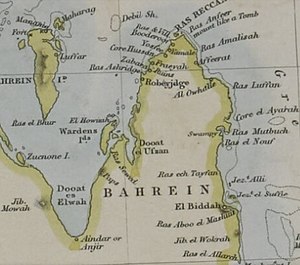 Bahrain and Qatar on the map of 1849 | |||
| date | October 1867 - September 1868 | ||
| A place | Persian Gulf | ||
| Total | British intervention, Qatar independence from Bahrain | ||
| Opponents | |||
| |||
| Commanders | |||
| |||
| Forces of the parties | |||
| |||
| Total losses | |||
| |||


Content
Background
In 1835, a maritime truce was concluded between the Arab state entities of the Persian Gulf, such as Abu Dhabi, Sharjah , the rest of the sheikhs of Treaty Oman , as well as Bahrain and Oman . The ceasefire was controlled by the British Royal Navy (in particular, the Bombay Flotilla ) [3] . In order to ensure compliance with the already existing peace agreement (General Marine Treaty of 1820), the Bombay Flotilla deployed a squadron in the Persian Gulf , based on the island of Qeshm . The treaty prohibited piracy in the Persian Gulf, but did not prevent the conduct of a naval war , as a result, the British acted differently in relation to pirates. Those pirates who attacked ships with a raised British flag were sent to judge in Bombay , and those who attacked ships with other flags were sent to their respective country [3] .
In 1835, coalition ships from Abu Dhabi, Ajman , Sharjah, and Ras Al Khaimah began to harass and rob vessels belonging to Oman. The British intervened when two ships under their flag were looted by Abu Dhabi. In response, April 16, 1835, the Bombay flotilla won, with the result that a significant part of the Abu Dhabi ships were destroyed [3] .
The armistice of 1835 was originally initiated by the British and limited to six months of the pearl season. It received approval from the sheikhs and was extended for another eight months. The truce was then extended annually until 1843, when Britain proposed a 10-year truce, which was agreed with the sheikhs [3] . During the ceasefire, the Arab states of the Persian Gulf experienced an economic boom, and in 1853, when Britain proposed a permanent peace, the treaties of Treaty of Oman agreed [3] .
Timeline
In the 1860s, relations between Qatar and Bahrain deteriorated as a result of a series of minor disputes [2] . Military action broke out after Bahrain arrested a Qatari Bedouin in Qatari territory in 1867 and sent him to Bahrain [4] . In response, the Qatari, led by the Naim tribe, defeated the Bahraini army, located on the Qatari Peninsula, successfully expelling them [4] . These events led to the attack of Bahrain in alliance with Abu Dhabi on Qatar [2] .
In October 1867, Bahrain’s hakim , Muhammad ibn Khalifa Al Khalifa, sent his brother Ali Al Khalifa at the head of a detachment of 500 soldiers and 24 vessels to attack Qatar. He was joined by a detachment of 200 people led by Ahmed Al Khalifa. In addition, the Bahraini ally of Abu Dhabi dispatched 2,000 warriors on 70 ships. [5] As a result of their joint actions, Bida ( Doha ) and Wakra [2] were sacked. The British report later said, “that the cities of Doha and Wakra temporarily ceased to exist at the end of 1867, the houses were destroyed, and their inhabitants expelled” [6] . The Qatari responded the following year, as a result of which most of the Bahraini military courts were destroyed. Total losses on both sides amounted to 1,000 people killed and 60 ships destroyed [2] .
1868 British-Bahrain Treaty
Until 1867, the British recognized Qatar as a territory dependent on Bahrain [2] . Lt. Col. Lewis Pelli, a British resident in Bahrain, ultimately accused Bahrain's hakim of violating the law of the sea and demanded reparations of 10,000 Iranian mists. [4] On September 6, 1868, Ali Al Khalifa was appointed Pelli as the Hakim of Bahrain and quickly took control of his power after [7] his brother Muhammad fled .
The conflict for the first time led to the British recognition of Al Thani as a separate political force in Qatar [2] . Lewis Pelly visited the peninsula, meeting with the sheikhs and signing the 1868 Treaty with Muhammad Al Thani [2] . This treaty ended the naval war [2] . Under the terms of this agreement, Bahrain was forced to abandon its claims to the sovereignty and territory of Qatar [4] .
Links
- ↑ Smart, JR New Arabian Studies, Volume 6 . - University of Exeter Press, 2004. - P. 54. - ISBN 0859897060 .
- ↑ 1 2 3 4 5 6 7 8 9 Jill, Crystal.
- ↑ 1 2 3 4 5 Commins, David (2012).
- ↑ 1 2 3 4 5 Reports of Judgments Advisory Opinions and Orders: 2001 Bound Volume .
- ↑ "'Persian Gulf Gazetteer, Part I Historical and Political Materials, Précis of Bahrein [Bahrain] Affairs, 1854-1904' [14] (33/204) . " qdl.qa.
- ↑ "'Gazetteer of the Persian Gulf.
- ↑ Mojtahed-Zadeh, Pirouz (1999).