
Harimise ( 張 見 世 ) is a fence of crossed rods in Japanese red light districts , behind which prostitutes ( yujo ) sat in a row waiting for customers from 6 o’clock in the evening to midnight [1] .
Harimise was located on the walls overlooking a crowded street, so that passers-by could speak with prostitutes before choosing any one [1] . Unlike Europe, where prostitutes were prohibited by law from publicly advertising their services, Yujou was expected to lure customers and come up with various tricks for this, although numerous onlookers and just passers-by, including with children, were walking in front of the harimise [ 1] [2] [3] .
Higher-level Yujou descended behind harimise from the second floor of the brothel; lower level prostitutes during the Edo period usually worked in buildings of the “long house” type ( 長 屋 屋 naked ) with a long corridor in the middle, so that directly behind the seated people were sliding partitions , hiding small rooms where prostitutes secluded themselves with clients [4] . All Yujou were seated after Harimise after a special signal; at the same time they were dressed up and dressed in their best clothes [1] . The pose in which the prostitute was sitting, as well as her outfit, allowed passersby to roughly estimate the cost of the services of a particular woman [3] .
Harimise is considered a dehumanizing practice; reviews of former prostitutes are known that reported that they felt like animals in a zoo, sitting behind a fence for the public’s needs [2] . Only Yujou of the highest rank [3] , who had personal maidservant students ( 新造 新造 :::) )) - Shinzo-tsuki-yobidashi ( . 付 き 呼出 し し ) - in Tokyo Yoshiwara in 1847, were about 1 , 7 percent of the total of 5111 people; payment for their services ranged from three golden itibubans to one . In 1871, in Yoshiwara, out of 1,648 prostitutes, there was not a single high enough rank to not sit at harimise [4] .
In the second half of the Meiji period, in all cities except Tokyo, it was forbidden to put prostitutes behind the fence, portraits took their place [3] . In 1916, harimise was finally banned, mainly as a result of the harsh criticism that Japanese authorities received from Europeans [2] .
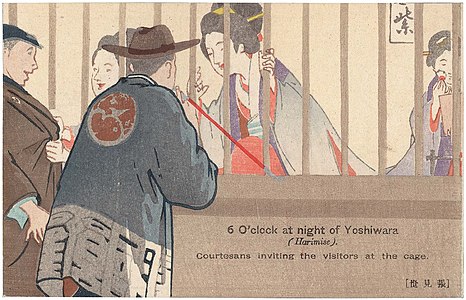
Postcard depicting prostitutes luring customers


Harimise from the inside out.


Notes
- ↑ 1 2 3 4 日立 .
- ↑ 1 2 3 Garon, 1998 , p. 97.
- ↑ 1 2 3 4 日本 大 百科全書 .
- ↑ 1 2 Suzuki, 2015 , p. 165.
Literature
- Suzuki H. Abolitions as a Global Experience: - NUS Press, 2015 .-- S. 165-166. - ISBN 9789971698607 .
- Garon S. Molding Japanese Minds: The State in Everyday Life . - Princeton University Press, 1998 .-- 97 p. - (Princeton Paperbacks). - ISBN 9780691001913 .
- 張 見 世 / 株式会社 日立 ソ リ ュ ー シ ョ ン ズ ・ ク リ エ イ ト (Japanese) (2015). Date of treatment November 7, 2016.
- 原 島 陽 一. 張 見 世 / 日本 大 百科全書 (Japanese) . Shogakukan . Date of treatment November 7, 2016.