Shapur I - the king of kings ( shahinshahs ) of Iran , ruled around 240/243 - 272/273 . From the Sassanid dynasty , son of Artashir I. He continued the strengthening of the state, begun by his father. He waged successful wars against the Romans .
| Shapur I | |||||||
|---|---|---|---|---|---|---|---|
| parf. šhypwhr; pehl. šhpwr-y ; Manichaean Middle Persian š'bwhr; Book Middle Persian šhpwhl; arm Շապուհ (šapowh) ; Syriac šbwhr; Sogd. š'p (') wr ; Greek Σαπώρης (Sapuris) ; lat Sapores, Sapor | |||||||
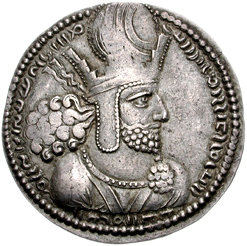 Image of Shapur I on silver drachma | |||||||
| |||||||
| Predecessor | Artashir Papakan | ||||||
| Successor | Hormizd I | ||||||
| Birth | |||||||
| Death | |||||||
| Kind | Sassanids | ||||||
| Father | Ardashir I | ||||||
| Mother | Myrōd | ||||||
| Children | , and | ||||||
| Religion | |||||||
Content
- 1 Biography
- 1.1 Legends associated with the birth and name of Shapur
- 1.2 Co-management with the father
- 1.3 Military campaigns
- 1.4 Domestic policy
- 1.5 Religious policy
- 1.6 Death
- 1.7 Family
- 2 See also
- 3 notes
- 4 Literature
- 5 Links
Biography
Legends associated with the birth and name of Shapur
Muhammad at-Tabari , an Islamic historian and theologian, author of The History of the Prophets and Kings, preserved the romantic legend of the birth of Shapur. According to her, Ardashir Papakan , despite the fact that he vowed to exterminate the entire Arshakid clan , married the daughter of Artaban V , since she hid her origin and impersonated a servant. She became pregnant from him and finally admitted to him that she belonged to the Arshak family. The king ordered her executed.
The nobleman, whom the king ordered to carry out the sentence, the woman admitted that she was pregnant. Then the nobleman imprisoned her in a dungeon, and he cut off his penis, placed it in a casket and sealed it. Returning to the king, the nobleman answered his question about the girl, that she was resting in the womb of the earth, and then handed over the casket and asked the king to put his seal on him and put it in one of the treasures. So the king did. But the girl stayed with the nobleman and in the end she was safely resolved by her son. The grandee did not want to name the tsar’s son a name lower than befitting his family, but he did not want to reveal the truth to the boy before he grew up and properly learned; in addition, at the hour of the baby’s birth, he examined his fate by horoscope and found out that he would come to power: therefore the nobleman gave him a speaking name so that when he finds out his meaning, he will make a choice (that is, he wanted to keep the name for himself); so, he called the boy Shapur, that is, "the son of the king, the prince." Some, however, believe that he called the boy Ashapur, that is, "a descendant of Arshak," in honor of his mother’s family.
A few years later, Ardashir began to repent of their deeds and lament because of loneliness. When he, complaining about the childlessness, revealed his feelings to the nobleman, he confessed to the tsar in violation of the order and said that both his mother and son were alive. And in confirmation of the fact that the boy could not be taken over by the rescued queen from him, he presented the one lying in the box. The rejoiced shah forgave his wife, adopted his son, and generously rewarded the loyal nobleman. When the king asked his son in Persian: “What is your name?” - he answered: “Shapur”, and Ardashir repeated: “Shah pur!” (Son of the king!). [one]
But this is only a legend. According to historical data, it is known that Shapur I was born long before the overthrow of the Parthian dynasty of Arshakids (before 210 ), which is confirmed by the reliefs of Ardashir in Firuzabad . His name may indeed come from Dr. Pers. xšayaθiya.puθra and mean "royal son", "prince". It was probably originally a title, but later (at least in the last decades of the 2nd century A.D.) it began to be used as a personal name. [2]
Co-government with father
Shapur I was the son of Ardashir I and his younger wife Mardut [3] . Before becoming a shahinshah, for fifteen years he was an active assistant to his father, participating in all his enterprises and conquests. He fought with his father against Artaban V at the Battle of Ormizdakan in 224 , where he clashed with the vizier of Artaban Darbendan and defeated, and later for a long time led the Western Persian company, proving himself a competent military commander. Ardashir "appreciated him more tender, wiser, braver and more capable of all his children" [4] and proclaimed Shapur co-ruler on April 12, 240 (on Sunday, the first day of Nisan, when the sun was in Aries), during the siege of the Roman city of Hatra . The Cologne Code of Mani says: In the 24th year of Mani's birth (that is, 240 ), Ardashir “conquered the city of Khatra and Tsar Shapur, planted a large (royal) diadem on his head”. Balami echoes him: "Ardashir, with his own hand, laid the crown on the head of Shapur . " Finally, at the end of 242, in his letter to the Senate, Emperor Gordian III claimed that he had removed the threat of “Persian kings” [5] over the city of Antioch in Syria. All this clearly indicates a period of co-government between the kings of Ardashir and Shapur I. The solemn coronation of Shapur as autocrat took place after the death of Ardashir in April 243 . [6]
At-Tabari thus characterizes this king:
“Even before Shapur came to power, during the life of his father, the Persians were convinced by many examples of his mind, generosity, knowledge, recognized his great courage, eloquence, mercy to his subjects and gentle meekness. When Shapur was crowned, nobles gathered around him, wished a long life and talked a lot about his father and his outstanding virtues. He replied that he was happy with their words about his father, and gave them good promises. Then the king sent to the treasury for money, endowed the gathered people with rich gifts and distributed the money among the venerable people, warriors and those poor people whom he considered worthy of it. He also wrote to the governors of different lands and countries to manage the money in the same way. So, his bounties and good deeds spread everywhere, to the noble and insignificant, high and low, and for all their life became easier. Then he elected governors for them, although he himself was much superior to them, as well as all his subjects. Shapur’s beautiful lifestyle has become widely known, his fame has spread far, and he has risen above all the kings. ” [7]
Under Shapur I, one of the most famous inscriptions of the Sassanid period was made - an inscription on the so-called “ Kaaba of Zoroaster ” (building in Naksha-Rustam )
Military Campaigns
Almost the entire reign of Shapur took place in hostilities against the Romans and eastern neighbors. The author of the Chronicle of Arbela notes the militancy of this king: “At that time Ardashir, the king of the Persians, died and Shapur entered after him, he was very cruel in nature. In the first year he had a war with the Khorezmians , with the Medes of the mountains, and in a cruel section he defeated them. From there he set off and conquered the Gilanians , Delemites , and Hyrcanians who live in distant mountains, near the last (Caspian) sea. And fear fell upon every man . ”
The main events at this time took place for Iran in the west. Neither the Romans nor the Persians gave each other respite for almost two decades. Three major wars fell on this time (242–244, 252–256, 258–260), and since the peace treaties were very fragile, the gaps between the campaigns were filled with minor conflicts that turned the territories near the Roman-Persian border into real “lamentable lands” ".
About 242 years , the Roman army led the young emperor Gordian III against Iran. The emperor marched on the Persians “with a huge army and so much gold that he could easily defeat the Persians with the help of either auxiliary troops (that is, mercenaries) or his warriors” [8] . According to Julius Kapitolin (however, disputed), thanks to the efforts of Gordian's advisers and commanders - mainly his father-in-law Timesifei , who was prefect - the Persians left the lands they had previously occupied, freeing many cities and not causing much damage to their inhabitants. The Romans lifted the siege from Antioch, recaptured Carra and Nisibin, and began to threaten Ctesiphon directly. However, military happiness betrayed the Romans, at first in 243 died from the illness of Timesipheus, and in the spring of 244 the emperor Gordian also died. Roman sources report the assassination of the emperor as a result of the machinations of Philip Arab , who took up the post of prefect of Pretoria after Timesipheus [9] [10] [11] . The inscription of Shapur I himself on the Kaaba of Zoroaster gives other information:
“And then, when I began to rule the country, Gordian, Caesar , gathered troops from the entire Roman Empire, from the Goths and Germans, and marched to Asurestan (Assyria) on Iranshahr and on us. And at the borders of Asurestan, at Mesih , a great battle took place. Gordian, Caesar, was killed. And the Roman army was scattered. And the Romans made Philip Caesar. And Philip, Caesar, came to us, asking for peace, and giving us 500 thousand dinars for the life of his friends, becoming our tributary. And we therefore called Mesih Peroz-Shapur ("Shapur Winner") . "
The later Byzantine chronicler Zonara also reports that “the young emperor was knocked down from a horse in battle, broke his hip and died from this wound” [12] . One way or another, Philip Arab, who became emperor, made peace, paid a large sum of money (2,750 kg of gold) to the Persians, and lost the disputed area. No wonder the Romans considered this world "the most shameful treaty." As the Roman Empire continued to be in a fever of rebellion and attacks by European barbarians, Philip Arab also lacked the strength to pursue a firm policy in the east. The Persians launched an offensive on Armenia , Caucasian Albania and Iberia , depriving Rome of hegemony in the Caucasus.
However, the loss of Armenia caused significant damage to Roman influence in the east, therefore, less than ten years later, a new Roman-Iranian war broke out, about which we have very little information. In 252 or 253, a large Roman army under the command of the legate of Syria invaded Mesopotamia. Shapur I intended to meet her, but serious troubles in the Khorasan area “required his presence there” [13] . Only a few years later the Persians were able to provide a worthy rebuff to the Romans. A decisive battle took place at the end of 255 at Barbalissa (modern Qalʿat al-Bālis on the left bank of the Euphrates in Syria), where the Persians defeated the 60 thousandth army of the Romans. Then Shapur divided his forces into two parts. One army under his personal command invaded Syria and ravaged it all the way to the coast. Persian sources list 36 cities and fortresses (including the capital of the Roman East, Antioch-on-Oronta ) captured in this campaign. The swiftness and suddenness of this Persian raid is best indicated by the words of Ammianus Marcelin :
“... when one day in Antioch, during a deep peace, a mimic actor and his wife portrayed scenes taken from life during a theatrical performance and the audience admired the grace of performance, his wife suddenly said:“ If this is not a dream, then the Persians. ” The audience turned their heads and, trying to escape from the cloud of arrows fired at her, scattered whoever could. The city was set on fire, many peacefully walking people were killed, terrible robberies and arsons were carried out in the vicinity, and enemies with huge booty went home without hindrance ... ” [14]
Another army under the command of the son of Shapur, Ormizd-Ardashir , who received the title of “Great King of the Armenians” [15] , invaded Lesser Armenia , Cilicia and Cappadocia . After three hundred years, Agathius of Mirineus described the horrors of this invasion in this way:
“The cursed Sapor ... advanced further and devastated Mesopotamia and then, invading neighboring regions, robbed the Cilicians and Syrians and, reaching Cappadocia, committed an immense number of murders, so that hollows and gorges in the mountains filled the corpses of those killed and separated from each other and he equalized the hills above each other so that he could lead the cavalry over the corpses, and the mountain ranges crossed like a plain. " [16]
The ruin and looting of the captured Roman possessions show that Shapur had no intention of annexing these lands to his state. Shapur removed the able-bodied population from the occupied territories and settled it in the deep regions of Iran (Pars, Parthia, Khuzistan, Babylonia). So, for example, for the captive inhabitants of Antioch-on-Oront, the shah laid the whole city, solemnly calling it Beh-az-Andev-i-Shapur (that is, “Shapurov is a city better than Antioch”; later - Gunde-Shapur ) [17 ] . Firdousi wrote that every migrant allegedly found in this city a copy of his former street and house. According to modern historians, the presence of such prisoners contributed to the multiplication of the Christian community of Iran, since by this time many of the Antiochs, despite all the persecution, professed this religion.
In 260, the emperor Valerian himself came out against Shapur with a huge army of 70,000 soldiers. In early autumn, the Romans suffered a disaster: surrounded by Edessa Valerian surrendered to the Persians. Zosim claims that Valerian tried to buy peace, but was treacherously captured by the Persians during negotiations on the conditions of this world [18] . Together with the emperor, the prefect of pretoria, senators, military leaders were captured, but most importantly - the troops, which Rome needed desperately. It is believed that the work of several tens of thousands of prisoners, led by Valerian, built the Band-e Kaisar Dam in Shushter on the Karun River [19] .
According to one legend, the emperor was forced to bend and substitute his back to the shah mounted on a horse. Both Lactantius and Agathius of Mirinei , referring to "many historical works", write that the emperor was skinned [20] [21] . Firdousi, on the other hand, claims that the shah showed great honor to Beranush (= Valerian). Apparently, the conditions of the captivity were really not too difficult for the emperor: according to contemporaries, he even participated in captivity in the politics of his state - received ambassadors, addressed letters to the Senate. Perhaps it was for Valerian in Bishapur that a palace was built, the ruins of which have survived to this day. Be that as it may, Emperor Valerian, the first and last sovereign in the history of the Roman Empire, captured by external enemies, died in captivity. In commemoration of his victories over the Romans, Shapur I ordered to knock out grandiose rocky reliefs; one near Bishapur , the other in Naksha Rustam , between the tombs of ancient Persian kings from the Achaemenid dynasty.
After the victory at Edessa, Shapur again began to devastate the eastern Roman territories. The son of Valerian, the emperor Gallien , attacked by hordes of German barbarians, exerted every effort to achieve peace, even in Europe, and could not help his eastern provinces with anything. In this difficult time for Rome, resistance to the Persians was led by Odenat , the semi-independent ruler of the kingdom of Palmyra . Back in 260, he was able, with the help of the Syrian legions, to intercept Shapur’s troops returning from the campaign and thoroughly pat them [16] . Then the Persians threw part of the spoils and cut many prisoners. Two years later, Odenat, who became the supreme commander of the Roman forces in the East, recaptured Nisibin and Carra from the Persians and reached Ctesiphon . The prey was enormous; rumors circulated that the Palmyra had even captured the shah himself with the harem. Gallienus sent to Rome captured captured nobles in his triumphal procession in 262 . At the same time, the Palmyrian ruler was already pursuing an independent policy, not paying attention to the distant and unauthorized Rome. Gallienus, recognizing the current state of affairs, granted Odenat (under whose authority almost the entire Roman Near East was by then ) the title of August . After receiving the Asian legions under his command, Odenat continued to defeat the Persians. After Odenat was killed in 266 or 267 , his widow Zenobia , suspecting the Romans of organizing an attempt on her husband, took the side of the Persians. Although Emperor Aurelian succeeded in crushing the kingdom of Zenobia in 271-272 and defeating the Iranian army in a hurry to help her, the position of the Persians in the west remained stable until the death of the Shah.
Шапур также воевал на северных и восточных рубежах своего царства и, прежде всего, с кушанами . Ещё около 250 года Шапур включил в состав государства Мешан, Сакастан , Гилян , а позже его армии достигли территории современной Туркмении (окончательное утверждение власти персов в Мерве ), под влиянием иранцев оказались области до Бактрии , Согдианы и Шаша (современный Ташкент ), а также юго-восточный берег Каспия . В Армении правил Ормизд-Ардашир , сын Шапура. При Шапуре I в основном определились границы Сасанидского Ирана; в дальнейшем они хотя и претерпевали изменения, однако незначительные и временные [22] .
Внутренняя политика
Шапур I продолжил политику своего отца, направленную на укрепление власти шаханшаха. Сократилось количество мелких вассальных царств, да и в оставшихся правили большей частью царевичи из рода Сасанидов. Всё меньше и меньше оставалось и свободных городов — Шапур присоединял их к своему дастакерту (владению), назначая наместников-шахрабов. Шапур также строил и новые города; в одной из своих надписей он упоминает о шестнадцати основанных им городах (вдвое больше, чем при Ардашире I), самыми известными из которых были Бишапур и Нишапур , возведённые трудом угнанных в рабство пленников. Говорили, что царь лично мог составить смету на строительство и начертить план будущего города. В официальных надписях (кроме монет) он величал себя уже царём «Ирана и не-Ирана». В близкой по времени надписи жреца Картира к «не-Ирану» отнесены следующие территории: Сирия , Киликия , Каппадокия «вплоть до страны Греция» (то есть вся Малая Азия ), Армения , Иберия , Албания , страна Баласакан «вплоть до Албанских ворот », то есть нынешнего Дербента . [23] [24]
Религиозная политика
Реконструкция событий III века исследователями предполагает, что в какой-то момент Шапур I начал колебаться в выборе одного из двух путей к идеологическому единству страны: первый — объединить религии завоёванных народов в одну общую, для которой главное — вера в единого бога, пусть и под разными именами. Второй — обращение завоёванных народов в старую зороастрийскую религию , сильно потесненную со времен эпохи эллинизма , и жестокое подавление не только иной веры, но и «неортодоксальной» религиозной практики внутри зороастризма. Первый путь был предоставлен пророком Мани , второй — жрецом Картиром .
Судя по всему, царь Шапур так и не определился, какую религию выбрать в качестве государственной — зороастризм или манихейство . Оба религиозных деятеля были приняты в свиту царя и сопровождали его в военных походах и путешествиях по стране. Мани поддерживали два обращённых в его веру брата царя, но кто из окружения царя поддерживал Картира — неизвестно. Все 30 лет правления Шапура между двумя соперничающими религиями существовал выверенный баланс. Судя по собственной надписи Шапура на «Каабе Зороастра», сам шах придерживался зороастризма и верил в Ахура Мазду (Ормазда):
«Я — поклоняющийся Мазде, владыка Шапур, царь Ирана и не-Ирана, происходящий от богов, сын поклоняющегося Мазде владыки Ардашира, царя царей Ирана, происходящего от богов, внук владыки Папака, царя. Я — господин Ираншахра.»
Видимо, этой религии Шапур придерживался по привычке и в своей политике отличался большой веротерпимостью, не мешая распространению в своей стране не только манихейства, но и других религий — христианства , иудаизма , буддизма , индуизма . Еврейские источники характеризовали его как доброжелательного правителя, который был доступен для посещений главами их общин. Позже греческие хроники писали, что во время своего вторжения в Сирию, Шапур уничтожал всё, кроме важных святилищ. Христианам своей державы он дал свободу вероисповедания и разрешал им строить церкви без необходимости согласия со стороны чиновников шаха. Мани присутствовал на коронации Шапура I и преподнёс ему книгу своих сочинений, названную в честь монарха «Шапуракан». [25]
Известно также, что при Шапуре в Иране распространялись идеи иноземной науки и философии, литература и искусство западных и восточных соседей. Во всяком случае, позднеперсидское предание приписывает именно ему дополнение текстов « Авесты » сведениями из римских, греческих и индийских научных и философских трудов. [24]
Death
Даже в преклонном возрасте Шапур I оставался активным и полным сил. Близ Хаджиабада сохранилась краткая двуязычная наскальная надпись, гласящая что на данном месте во время праздника Тираган шах пустил из лука стрелу, и его сила была засвидетельствована присутствующими знатными людьми.
Шапур I скончался в Бишапуре в конце 272 или начале 273 года . Будучи при смерти, Шапур провозгласил царём своего сына Ормизда и в завещании дал наставления, как ему вести себя. Есть разные мнения о том, как долго он правил: одни считают, что 30 лет и 15 дней, другие — что 31 год, 6 месяцев и 19 дней [26] [27] [28] [24] .
Family
- У Шапура I были, по крайней мере, одна дочь и четверо сыновей. Сыновья при жизни отца были царями (шахами) разных областей его державы.
- Атур-Анахит — дочь Шапура I, а затем его жена, царица цариц
- Ормизд-Ардашир — « великий царь армян ».
- Бахрам — первоначально царь Гиляна , затем получил другой удел — Керман (после 260 года )
- Шапур — царь Месены . Умер раньше своего отца, но оставил шесть сыновей и одну дочь, впоследствии достигших высоких положений.
- Нарсе — царь «Индии», Сакастана и Турана вплоть до Оманского моря .
See also
- Шапур (имя)
Notes
- ↑ Мухаммад ат-Табари . Истории пророков и царей. N26—N30
- ↑ Дашков С. Б. Цари царей — Сасаниды. — С. 63.
- ↑ ŠKZ, Gk. l. 49
- ↑ Масуди. Moruj II, p. 159
- ↑ Авторы жизнеописаний августов. XX. Юлий Капитолин . Трое Гордианов, XXVII, 5
- ↑ Дашков С. Б. Цари царей — Сасаниды. — С. 63—64.
- ↑ Мухаммад ат-Табари . Истории пророков и царей. N30
- ↑ Авторы жизнеописаний августов. XX. Юлий Капитолин. Трое Гордианов, XXVI, 3
- ↑ Авторы жизнеописаний августов. XX. Юлий Капитолин . Трое Гордианов, XXVIII—XXX
- ↑ Аврелий Виктор . О цезарях. Глава XXVII, Гордиан — Младший
- ↑ Зосим . Новая история. Книга I, 19 (1)
- ↑ Зонара, 12, 17
- ↑ Мухаммад ат-Табари . Истории пророков и царей. N32
- ↑ Аммиан Марцелин . Деяния. Книга XXIII, 5, 3
- ↑ Надпись Шапура I на «Каабе Зороастра» в Накше-Рустаме
- ↑ 1 2 Агафий Миринейский . О царствовании Юстиниана. Книга IV, 24
- ↑ Мухаммад ат-Табари . Истории пророков и царей. N41
- ↑ Зосим . Новая история. Книга I, 36
- ↑ Мухаммад ат-Табари . Истории пророков и царей. N33
- ↑ Лактанций . Книга к исповеднику Донату о смертях гонителей. V
- ↑ Агафий Миринейский . О царствовании Юстиниана. Книга IV, 23
- ↑ Дашков С. Б. Цари царей — Сасаниды. — С. 63—69.
- ↑ Надпись Картира на «Каабе Зороастра» в Накше-Рустаме, 12
- ↑ 1 2 3 Дашков С. Б. Цари царей — Сасаниды. — С. 69.
- ↑ Аль-Бируни . Памятники минувших поколений. Часть 9. 212
- ↑ Мухаммад ат-Табари . Истории пророков и царей. N42
- ↑ Аль-Бируни Памятники минувших поколений. Часть 5. 121—129
- ↑ Абу Ханифа ад-Динавари . Книга связных рассказов. III
Literature
- Дашков С. Б. Цари царей — Сасаниды. История Ирана III — VII вв. в легендах, исторических хрониках и современных исследованиях. — М. : СМИ-АЗИЯ, 2008. — 352 с. — 4000 экз. — ISBN 978-5-91660-001-8 .
- Мирзоев Е. Б. Шапур I. Триумф над Римом. — СПб.: Нестор-История, 2016. — 352 с.
Links
- Сапор // Энциклопедический словарь Брокгауза и Ефрона : в 86 т. (82 т. и 4 доп.). - SPb. , 1890-1907.
- Энциклопедия Ираника: Шапур I
- Скальные рельефы Сасанидов