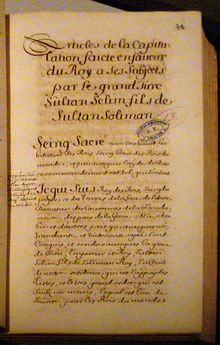
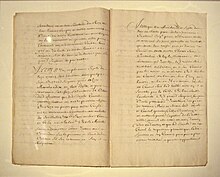

The surrender of the Ottoman Empire ( tour. Osmanlı İmparatorluğu kapitülasyonları ) - a series of treaties between the Ottoman Empire and the European powers , primarily with France .
Surrender , or ahadnam , as a rule, were bilateral acts providing for agreements in relation to each other, and not just concessions. Surrenders were gifts from the sultans to Christian states: they were granted rights and privileges in relation to their subjects living or trading in the empire. The same policy towards European states was carried out by Byzantium . According to the provisions of these surrenders, merchants trading on the territory of the Ottoman Empire were exempted from any oppression, local taxation, conscription and formal formalization of their place of residence. Surrender was originally adopted during the military rule of the Ottoman Empire in order to stimulate trade with Western merchants. However, then they increasingly began to be used to carry out significant economic and political abuses by the European powers [1] .
History
Initially, surrenders were made separately with each Christian state, starting with Genoa in 1453, which entered into peaceful relations with the Ottoman Empire. In later surrenders, all previously accepted concessions were made in relation to various states, and special concessions were also added to them in relation to certain states: thus, articles on the most favored nation treatment appeared in contracts.
Around 1535, Suleiman the Magnificent signed a surrender against France .
France signed a surrender with the Mamluk Sultan in Cairo in 1500, during the reign of Louis XII [2] [3] . After the Turks conquered Egypt after the Ottoman-Mamluk war (1516–1517) , they upheld the surrender concluded with the French and spread their effect throughout the empire.
Surrender Status
The term "surrender" means what is usually meant by slightly different concepts: in the Ottoman language, "surrender" is translated as " ahid nameh" , while "contract" is " mouahed" . The last of the two concepts implies mutual participation, the first - no.
According to the provisions of the surrender, and the agreements between the Porta and other states that confirm the validity of surrender, the subjects of these states living in Turkey were subject to the laws of their countries.
Denunciation of surrender
In 1914, the government, led by the Unity and Progress group, denounced the Ottoman Empire’s surrender and began to pursue a new economic policy that was supposed to be beneficial for the Ottoman economy.
As for Turkey, surrender was canceled in accordance with the Lausanne Treaty (1923), in particular, in Article 28.
Surrender in Egypt ended in 1949 in accordance with the Montreux Convention on the abolition of surrender in Egypt, signed in 1937 [4] .
Surrender List
Surrenders were signed with the following countries: [5] [6]
- Venice (1454)
- France (1535, 1673, 1740)
- England (1579, 1675, 1809)
- Netherlands (1579, 1680)
- Austria (1615)
- Russia (1711, 1783)
- Sweden (1737)
- Sardinia (1740, 1825)
- Denmark (1746 and 1756)
- Prussia (1761)
- Spain (1782)
- USA (1830)
- Belgium (1838)
- Hanseatic League (1839)
- Portugal (1843)
- Greece (1854 or 1855)
- Brazil (1858)
- Bavaria (1870)
Notes
- ↑ Cleveland, William; Bunton, Martin (2009).
- ↑ Three years in Constantinople by Charles White p. 139
- ↑ Three years in Constantinople by Charles White p. 147
- ↑ Convention regarding the Abolition of the Capitulations in Egypt, Protocol, and Declaration by the Royal Egyptian Government (Montreux, 8 May 1936) Art 1.
- ↑ Lucius Ellsworth Thayer, "The Capitulations of the Ottoman Empire and the Question of their Abrogation as it Affects the United States", The American Journal of International Law , 17 , 2 (1923): 207–33.
- ↑ Philip Marshall Brown, Foreigners in Turkey: Their Juridical Status (Princeton University Press, 1914), p. 41.
Literature
- Hoyle, Mark SW (1991). Mixed courts of Egypt . London : Graham & Trotman. xxvii, 206p.
- F. Ahmad, "Ottoman perceptions of the capitulations 1800-1914," Journal of Islamic Studies , 11.1 (2000), 1-20.
- Maurits H. van den Boogert and Kate Fleet (eds.), Ed. (2003). The Ottoman capitulations: text and context . Rome : Istituto per l'Oriente CA Nallino. pp. vii, [575] -727, 14p. of plates: ill., facsims.
- Boogert, Maurits H. van den (2005). The capitulations and the Ottoman legal system: qadis, consuls, and beraths in the 18th century . Leiden : Brill. xvi, 323p.
- Ahidname. - Islamansiklopedisi. - 1988.- T. I. - P. 536-540. (tour.)
- Papp S. Ahdname (ahitname) // Encyclopedia of the Ottoman Empire / Gabor Ágoston; Bruce Masters. - New York, NY: Facts on File, 2009 .-- P. 21-22. - ISSN 0-8160-6259-5 .
- Theunissen HPA Ottoman-venetian Diplomatics: The Ahd-names; the Historical Background and the Development of a Category of Political-commercial Instruments Together with an Annotated Edition of a Corpus of Relevant Documents // Electronic journal of oriental studies: EJOS. - 1998. - No. 2 . - P. 1-698. - ISSN 0928-6802 .