Third Bulgarian kingdom ( Bulgarian Kingdom of Bulgaria ) is a Bulgarian state that existed from the declaration of independence in 1908 to the abolition of the institution of the monarchy in 1946. It was a constitutional monarchy ( Tarnovo Constitution of 1879 as amended). The head of state was the king (in Western languages the title is also translated as “king”), the reigning dynasty - Saxe-Coburg-Gotha . Collective regency was envisaged in the event of the king's incapacity.
| Historical state | |||||
| Kingdom of Bulgaria | |||||
|---|---|---|---|---|---|
| bulg. Kingdom of Bulgaria | |||||
| |||||
| Anthem : | |||||
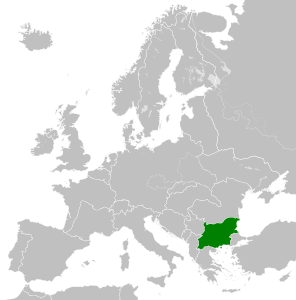 Third Bulgarian Kingdom in 1942 | |||||
←  ←  ←  ←  ←  → → → → → → → →September 22, 1908 - September 15, 1946 | |||||
| Capital | Sofia | ||||
| Languages) | Bulgarian | ||||
| Religion | Orthodoxy | ||||
| Currency unit | |||||
| Area | 153,459.6 km² | ||||
| Population | |||||
| Form of government | constitutional monarchy [1] | ||||
| Dynasty | Saxe-Coburg-Gotha | ||||
| Official language | |||||
| King | |||||
| • 1908 - 1918 | Ferdinand I | ||||
| • 1918 - 1943 | Boris III | ||||
| • 1943 - 1946 | Simeon II | ||||


History
Era of King Ferdinand I
Taking advantage of the acute crisis in the Ottoman Empire , the Bulgarian prince Ferdinand I announced the annexation of Eastern Rumelia and declared himself king on September 22 (October 5, according to a new style) in 1908. Under Ferdinand, amendments were made to the constitution, expanding the powers of the king and limiting the democratic norms adopted in 1879.
Striving for an audit of the territorial results enshrined in the Berlin Congress (1878), Bulgaria embarked on the path of militarization, acquiring the nickname "Prussia in the Balkans" [2]
First Balkan War
In October 1912 - May 1913, during the First Balkan War , Bulgaria, fighting against the Ottoman Empire in alliance with 3 other Balkan powers , was militarily the most powerful country in the Allied camp, mobilizing about 600 thousand people. Entering the war against the Ottoman Empire on October 18 (n.st.), the Bulgarian army, under the command of General Radko-Dmitriev, soon began to advance to Constantinople , on March 26, 1913 captured Adrianople and came close to the capital of the Ottoman Empire, Constantinople. As a result of the war, Bulgaria received from the Ottoman Empire almost all of Thrace (except Constantinople ) with Adrianople (Odrin) and extensive access to the Aegean Sea .
Second Balkan War
However, the division of the Ottoman possessions in the Balkans did not satisfy Serbia and Greece, which refused to withdraw troops to previously agreed borders. The stumbling block between Bulgaria and Serbia was Macedonia , a region with a multi-ethnic population, which in the 1890s became a rivalry mainly between Greece (and the Greeks in general) and Bulgaria. The transient Second Balkan War began less than a month after the first. On June 29, 1913, Bulgarian troops invaded Macedonia. At the same time, Bulgarian troops invaded Greece ( Battle of Kilkis ). Serbia and Greece were supported by Romania ( Romanian intervention in Bulgaria (1913) ) and the Ottoman Empire ( Turkish intervention in Bulgaria (1913) ). Bulgaria lost this war and lost Adrianople and Dobrudja , but retained access to the Aegean Sea.
World War I
In 1915, the Bulgarian kingdom, following the pro-German orientation of Ferdinand and trying to annex all of Macedonia, entered the First World War on the side of Germany, Austria-Hungary and Turkey. Bulgaria began to be considered in the Entente countries a "traitor to the Slavs."
The era of Tsar Boris III
After the defeat in the war, King Ferdinand abdicated and returned to Germany, and his eldest son Boris III became his successor in 1918 . In 1919, as part of the Versailles Peace Process, the Neuilly Treaty was signed, according to which Bulgaria lost access to the Aegean Sea (in favor of Greece).
In the 1920s, Bulgaria developed relations with the countries of the Entente, actively received Russian emigrants. Against the background of the weakening of Bulgaria, the prime minister was Alexander of Istanbul , who pursued a policy in the interests of the victorious countries, which caused dissatisfaction with conservative circles.
On the night of June 9, 1923, a coup took place in Bulgaria, which was carried out by soldiers of the capital's garrison and cadet of the Sofia Military School. Members of the government and parliament were arrested, and Alexander Tsankov became prime minister. Tsar Boris supported the coup. In response to the arrival of the new government, the September uprising broke out , which was brutally crushed. Left-wing extremists continued the terror ( explosion at Holy Week Cathedral on April 16, 1925 ). Old revanchist sentiments allowed the new Bulgarian government to establish relations with fascist Italy. Nevertheless, elections continued to be held in the country and a multi-party structure was maintained.
On May 19, 1934, another coup d'etat took place in Bulgaria, as a result of which the military from the Link group, led by Kimon Georgiev, seized power. The Tarnovo Constitution was suspended, and political parties were banned. In domestic politics, centralization and nationalization of the economy was carried out. The pro-fascist foreign policy orientation remained. This kind of regime was called monarchofascism.
After the military coup of May 19, 1934, the rapprochement of Bulgaria and the Third Reich intensified [3] .
On August 1, 1938, Thessaloniki agreements were signed, according to which the restrictions on the increase in the army were lifted from Bulgaria, and they were also allowed to send Bulgarian troops into the previously demilitarized zones on the borders with Greece and Turkey.
In 1938, Germany provided Bulgaria with a loan of 30 million Reichsmarks for the purchase of weapons [4] .
In 1940, Tsar Boris achieved the return of Bulgaria to Southern Dobrudja .
Bulgaria in World War II
On February 2, 1941, Bulgaria and Germany signed a protocol on the deployment of German troops in Bulgaria [5] .
On March 1, 1941, Vienna signed documents on the accession of Bulgaria to the Rome-Berlin-Tokyo pact .
In April 1941, Bulgaria, together with Germany and Italy, took part in the Greek operation and in the Yugoslav operation , as a result of which it received a part of the Aegean coast (western part of Western Thrace ) equal to 14,466 km² and part of Vardar Macedonia ) equal to 28,000 km² [6 ] . Although Bulgaria claimed, it received neither the city of Thessaloniki nor the Holy Mount Athos . Already in September 1941, in the area of the city of Drama , populated by Greek repatriates from Turkey, the Bulgarian occupation forces used terror, unequivocal with genocide [6] [7] . Then the Third Reich reduced the territory of Central Macedonia , which was owned by the Bulgarians [8] .
After June 22, 1941, large-scale resistance unfolded in Bulgaria.
On November 25, 1941, Bulgaria joined the Anti-Comintern Pact [9] .
On December 13, 1941, Bulgaria declared war on Great Britain and the USA, although active hostilities did not follow. However, Bulgarian cities began to be subjected to allied air raids. The country did not declare war on the USSR. In addition to providing its territory for the deployment of German troops and the supply of raw materials, discriminatory measures were introduced in Bulgaria against a small Jewish population, but not a single Jew was deported from Bulgaria.
During the war years, the Bulgarian army totaled up to half a million soldiers and officers, armed mainly with German weapons.
On September 5, 1944, after the surrender of Romania, the USSR declared war on Bulgaria. However, the Bulgarians did not show the Red Army almost no resistance. On September 9, as a result of the uprising prepared by the forces of the Patriotic Front, the pro-German government was overthrown, and the new authorities declared war on Germany. In 1944-1945, the Bulgarian army fought against the Germans on the front in Yugoslavia, Hungary and Austria. As a rule, most of the Bulgarian people and politicians of the Patriotic Front supported the USSR. The Goryansk movement was defeated by the Bulgarian National Army and the State Security Departments of the Ministry of Internal Affairs of Bulgaria.
End of the Third Bulgarian Kingdom
The monarchy persisted after the end of World War II, with a new regency. On September 8, 1946, a referendum took place, in which 91.63% of voters (4,132,007 out of 4,509,354 people) took part, of which 92.72% voted for the republic.
Simeon emigrated; Many years later, he returned to his homeland, was engaged in politics, and eight years was the Prime Minister of the Republic.
Of the territorial acquisitions, Bulgaria was able to retain only Southern Dobrudja. 150 thousand Bulgarians were deported from Western Thrace, from 1920 located in Greece, and from the Greek part of Macedonia . At the same time, almost the entire Greek population, living for thousands of years on the Black Sea coast, was deported from Bulgaria [6] .
See also
- States and dependent territories of Europe in 1914
Notes
- ↑ From 1934 to 1944, it was actually an absolute monarchy .
- ↑ Pinon, Rene. L'Europe et la Jeune Turquie: les aspects nouveaux de la question d'Orient : [] . - Paris: Perrin et cie, 1913. - “On a dit souvent de la Bulgarie qu'elle est la Prusse des Balkans”. - ISBN 978-1-144-41381-9 .
- ↑ V.V. Aleksandrov. Recent history of the countries of Europe and America, 1918-1945. Textbook for students of historical faculties. - M .: Higher school , 1986. - S. 250—251.
- ↑ Liberation mission of the Soviet armed forces in the Balkans. / Ans. ed. A. G. Khorkov . - M .: Nauka , 1989 .-- S. 37. - ISBN 5-02-008474-3
- ↑ Liberation mission of the Soviet armed forces in the Balkans. / Ans. ed. A. G. Khorkov. M .: Nauka, 1989 .-- S. 39.
- ↑ 1 2 3 University teamwork Εμείς οι Έλληνες, Σκαϊ Βιβλίο, Athens 2008.
- ↑ Γριγοριάδης Σ.Ν. Ιστορία της σύγχρονης Ελλάδας 1941-1974. T. 1. Athens: Polaris, 2009, s. 106-107. ISBN 978-960-6829-10-9
- ↑ See map of the occupation zones in Greece 1941-1944
- ↑ Great Soviet Encyclopedia. / redkoll., ch. ed. S. I. Vavilov. 2nd ed. volume 5. M .: State Scientific Publishing House "Great Soviet Encyclopedia", 1950. p. 424-423