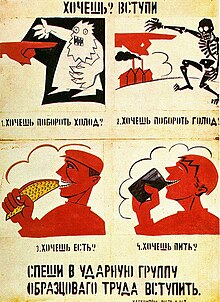
ROSTA Satire Windows ( ROSTA Windows ) is a series of posters created in 1919-1921 by Soviet poets and artists who worked in the Russian Telegraph Agency (ROSTA) system. “WINDOWS OF GROWTH” is a specific form of mass propaganda art that arose during the period of the Civil War and intervention ( 1918 - 1920 ).
Content
Feature
Satirical posters, made in a sharp and accessible manner, equipped with concise poetic texts, exposed the opponents of the young republic of the Soviets . “WINDOWS OF ROSTA” was devoted to topical events, were illustrations for telegrams that were transmitted by the agency to newspapers. Vladimir Mayakovsky in his work “Terrible laughter” wrote about them like this: “This is a protocol record of the largest three years of the revolutionary struggle, conveyed by spots of color and the sound of slogans. (...) These are telegraphic news that were instantly transmitted to the poster, these are decrees immediately published on the ditties, this is a new form brought directly by life, these are the posters that the Red Army watched before the battle, attacking, not with prayer, but with singing ditties ” [1] .
Except for the first ones, hand-drawn, posters were made and reproduced using a stencil [2] up to 150 or more copies, and then were displayed in windows in the capital and other cities - usually in empty grocery stores. In his memoirs, V. B. Shklovsky argued that:
The “GROWTH WINDOWS” correctly existed and ended when the shops reappeared.
- “V. Mayakovsky in the memoirs of contemporaries ” [3]
Satire windows appeared in the autumn of 1919, the first poster with the text Gramen and drawings of Cheremnykh was exhibited in Moscow in early September [4] , by 1920, “ROSTA Windows” had reached Baku, Saratov, Kharkov, Odessa, Rostov-on-Don, they went out until 1921. The topics of the posters were the fight against Wrangel and typhoid lice, starving, etc.
In the “WINDOWS OF GROWTH” traditions of lubok [5] and rashnik were actively used. The technique of drawing in “WINDOWS OF GROWTH” was distinguished by accented simplicity and laconicism of the used graphic means (coloring in 2-3 colors, expressiveness of silhouettes).
“Their specificity was an immediate reaction to the most pressing issues and facts. The texts of the “WINDOWS OF GROWTH” were distinguished by the simplicity and accuracy of the characteristics, coming from the traditions of folk lubok and ditties. In these texts, the talent of Mayakovsky-publicist found his vivid expression. (...) GROWTH posters are usually multi-story. They formed and typified a certain spirit of the characters, passing from poster to poster: worker, Red Army soldier, peasant, capitalist, pop, fist ” [6] .
Opposing creative organizations
The windows of GROWTH, according to historian Vladlen Sirotkin , were opposed by OSAG :
“From the height of the past years, reading the memoirs of the participants of the Civil War from the“ red ”and“ white ”sides, you begin to understand that both“ agitprops ”- in Moscow and Rostov-on-Don - were mirror images of each other, only with opposite signs . In Moscow hung “Windows of ROSTA” with verses by Mayakovsky and Demyan Poor, in Rostov - “Windows of OSVAG” with verses of Nazhivin or “white Demyan” rhymes A. Gridin. There the Red Army man pierces with a bayonet the bourgeois and the white general, here the red-haired volunteer is the "Jew" of Trotsky.
- Vladlen Sirotkin "Foreign Klondike of Russia"
Artists
The first "Window of GROWTH" was performed in October 1919 by M. M. Cheremnykh . Subsequently , V.V. Mayakovsky joined him, creating both drawings and signatures, as well as D. S. Moor , I. A. Malyutin , A. M. Nurenberg , M. D. Volpin , P. P. Sokolov- Skalya , B. N. Timofeev , V. V. Khvostenko , etc. Similar “windows” were also produced in Petrograd ( L. G. Brodaty , V. V. Lebedev , A. A. Radakov , etc.), in Ukraine ( B. E. Efimov and others), in Saratov , Baku and other cities.
Kazimir Malevich , Aristarkh Lentulov , Ilya Mashkov and Kukryniksy also participated in the creation of the “GROWTH Windows”. “WINDOWS OF GROWTH” were essential for the formation of Soviet fine art.
Mayakovsky’s personal exhibition “20 years of work”, which was guided by Mayakovsky himself, and whose exposition was based on “ROSTA Satire Windows”, was not visited by representatives of the creative intelligentsia or leading people [7] .
See also
- Windows TASS
- OSAG
Notes
- ↑ Lebedev, 1949 .
- ↑ “Terrible weapons” , “Smena” magazine , published in issue No. 280, April 1936: “First, the“ Windows of Growth “were made in one or two copies. Then they learned to propagate them using a stencil cut out of cardboard”.
- ↑ "V. Mayakovsky in the memoirs of contemporaries"
- ↑ Art. The book for reading "Alpatov M.V. et al. P. 468" Enlightenment "1969.
- ↑ “Old Russian Comics” “Smena” magazine, published in issue No. 1755, January 2011: “The last spike in“ popular activity ”occurred in“ WINDOWS OF GROWTH ””.
- ↑ History of Russian and Soviet art. Ed. D.V. Sarabyanova. Higher School, 1979.P. 302
- ↑ Marina Cherkashina. The death of the "screaming Zarathustra . " The version of Mayakovsky’s death in the refraction of the Bulgakov’s novel (Essay from the series “Parallels of Fate”) . " Russian newspaper . " - “He (Mayakovsky) tried to remind about his merits:“ The windows of the satire ROSTA ”, posters of performances, stands with books, albums with clippings from periodicals. But the writers invited to that exhibition did not come, nor did the leaders come. ” Date of treatment October 9, 2016. Archived January 5, 2002.
Literature
- Mikhalenko N.V. Biblical images and motives in the "Windows of GROWTH" by V.V. Mayakovsky // Russian Literature. Original research. - 2014. (unavailable link)
- Mikhalenko N.V. Posters of V.V. Mayakovsky - the unity of the visual and verbal: from “Today's popular print” to “Windows of GROWTH” // Rusistica Latviensis 5. Slavica - 2015: filoloģijas pētījumi. LU Akadēmiskais apgāds. Latvijas Universitāte. - Riga, 2015 .-- S. 20-28 .
- Inshakova E. Yu. Collection “Windows of GROWTH and GPP” in the collection of the State Museum of V.V. Mayakovsky // Creativity of V.V. Mayakovsky. - M .: IMLI RAS , 2015. - Issue. 3: Problems of textology and biography . - S. 379-386 .
- Lebedev P.I. Soviet art during the period of foreign military intervention and civil war. - M .: Art , 1949. - (Soviet fine art: monographs and studies).