Polyommatus charcoal [1] ( Pseudophilotes anthracias ) - diurnal butterfly from the family Lycaenidae .
Polyommatus charcoal | ||||||||||||||
|---|---|---|---|---|---|---|---|---|---|---|---|---|---|---|
 | ||||||||||||||
| Scientific classification | ||||||||||||||
| ||||||||||||||
| Latin name | ||||||||||||||
| Pseudophilotes anthracias ( Christoph , 1877) |
Content
- 1 Origin of the name
- 2 Description
- 3 Range and habitat
- 4 Biology
- 5 notes
- 6 References
Name Origin
Anthracias (Latin) - "coal". The name reflects the dark color of the wings of butterflies [1] .
Description
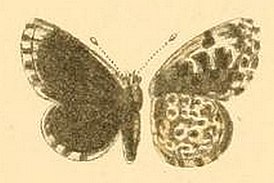
The length of the front wing is 11-15 mm. The wings of both sexes are soot-brown. The underside of the wings with a characteristic white-brown pattern. The fringe of the wings is motley. The outer edge of the wings is rounded. Head with bare eyes. Sexual dimorphism is weakly expressed [1] .
Habitat and habitat
Kazakhstan (the desert massifs of the Atyrau region, Southern Altai, the vicinity of Lake Zaysan, the south of the Ili river valley, Baigakum), Uzbekistan (the Syr-Darya river valley), Turkmenistan (Krasnovodsk, Ashkhabad, Maly Balkhan), Tajikistan (Vakhsh valley, Kafirnigan), Western China. The northernmost habitat is known from the vicinity of Lake Elton [1] .
Directions for the South of Russia - Astrakhan Region , where the species was first found only in 1999. Now several populations from the sand massifs of Bolkhun and Batpaysagyr are known. In the western part of the Batpaysagyr desert, the species is found in many settlements: Dosang, Aksaraysky, Komsomolsky, etc. In habitats, it can be common.
It inhabits the fixed and semi-fixed sand dunes with thickets of vegetation represented by dzhuzguna, wormwood, scorpion and other psammophytes. Butterflies prefer elevated, hilly areas [1] .
Biology
Develops per year in one generation. The flight time of butterflies is from late April to mid-May, in more southern areas - from early April. In sunny weather they fly from the leeward side of the hills. Butterflies sit on twigs of dzhuzgun and tops of stems of wormwood. The flight time of the butterflies ends almost completely with the beginning of the flowering of the feed plant of the caterpillars. In late April - early May, the female lays one egg at a time on the shoots of juzgun. Caterpillars feed on the buds and flowers of different species of juzgun (kandyma) ( Calligonum spp.). A chrysalis overwinter. The possibility of myrmecophilia is not ruled out. The connection of the species with rare species of ants can explain its locality and stenotopicity [1] .
Notes
- ↑ 1 2 3 4 5 6 Lvovsky A.L., Morgun D.V. - Lepidoptera Lepidoptera in Eastern Europe (Guidelines for the Flora and Fauna of Russia), Moscow: KMK, 2007