“Baikal” (the old spelling “Baikal”) is a two-masted sailing transport vessel of the Siberian military flotilla , which participated in the study of the Far East . Passing on it from the Sea of Okhotsk to the south, G.I. Nevelskoy proved that Sakhalin is an island .
| "Baikal" | |
|---|---|
| Baikal | |
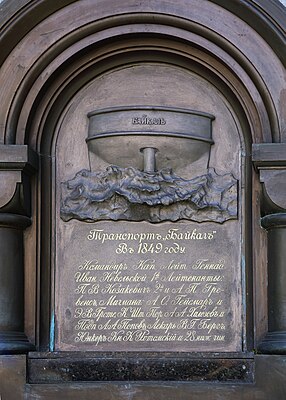 A bronze plate in the northern niche of the monument to G.I. Nevelsky, which was opened on October 26, 1891 in Vladivostok. This plate depicts the Baikal feed and the names of participants-officers of the transport crew who conducted research on the Amur Estuary in 1849. | |
| Service | |
 Russia Russia | |
| Class and type of vessel | transport ship |
| Type of sailing weapon | Brigantine |
| Organization |  Siberian flotilla Siberian flotilla |
| Manufacturer | shipyard "Borgetrem and Co." |
| Construction started | September 1847 |
| Launched | July 10, 1848 |
| Commissioned | 1848 year |
| Status | Sank on the night of March 30 to 31, 1871 |
| Main characteristics | |
| Displacement | 477 t |
| Length between perpendiculars | 28.5 m |
| Upper Deck Length | 28.65 meters |
| Width | 7.38 m |
| Draft | 3.87 m (full load) |
| Mover | Sail |
| Speed | up to 8.5 knots |
| Crew | 47 people (9 officers, 4 non-commissioned officers and 34 sailors) |
| Armament | |
| Artillery | 6 × three pound guns |
Construction
Captain-Lieutenant G. I. Nevelskaya , who was appointed commander of the Baikal under construction as early as December 1847, obtained an audience with the chief of the Main Naval Staff, Prince A. S. Menshikov . He was able to convince him to change his campaign plan, bypassing the tsarist resolution “Put the question of the Amur River as a useless river!” , And sign the paper, which instructed to expedite the construction and equipment of the vessel. But Gennady Ivanovich got permission for research and scientific research at the expense of time that could be saved during the construction and transition of the ship from Kronstadt to the Peter and Paul Port [1] .
By order of the Maritime Department, transport was laid down in September 1847 at the shipyard Borgetrem and Co. in Helsingfors (now Helsinki ). The drawing was based on the Sukhum-Kale military transport built in Sevastopol in 1840-1842. During the construction of the hull, pine was used, the fastenings were made of metal, and the bottom sheathing below the waterline was made of copper [2] . At the direction of G.I. Nevelsky, stability was increased, controllability was improved, outer skin was strengthened, and changes were made in the layout of the interior of the vehicle. Also G.I. Nevelskaya personally controlled the crew recruitment. Despite the fact that under the contract the completion of construction was planned for September 1848, already on July 10 (according to other sources - 5 [2] ), the ship was launched on July [18] [1] . The final equipment took place in Kronstadt [3] .
Design
The Baikal was a small two-deck vessel with brigantine sailing weapons with full hull contours and an almost flat bottom. Light and similar hatches, a windlass , a winch , a cargo hatch , a helm and a wheelhouse were located on the upper deck . On the lower (residential) deck there were forlyuk , similar hatches, pumps , lockers , a galley , a mess room , a crew hut for sailors, a captain’s cabin and officers. Below the living deck were a cargo hold with fresh water tanks, a kruite chamber , food storage rooms, a skipper storage room and a chain box. On board there was one 6-row boat , 4-row boat, whaleboat and kayak [3] .
- Upper Deck Length - 28.65 meters (94 feet)
- Length between perpendiculars - 28.5 meters
- Width - 7.38 meters
- Largest Width with Sheathing - 7.5 Meters (24 Feet 6 Inches)
- Depth - 5.1 meters
- Displacement - 477 tons
- Carrying capacity - 250 tons (estimated)
- Full draft - 3.87 meters (12 ft 9 in)
- Speed - up to 8.5 knots
- Armament - 6 × three-pound guns (76 mm)
- Crew - 9 officers, 4 non-commissioned officers and 34 sailors, only 47 people "(in the future its number was constantly changing)
Service
Transition to the Far East
On August 21 ( September 2 ), 1848 , Baikal, under the command of the 10th naval crew of the Baltic Fleet G.I. Nevelsky, was loaded with the cargo and the 14th artisans for the Peter and Paul Harbor (now Petropavlovsk-Kamchatsky ) by the Izhora steamer from the Small Kronstadt raid for Tolbukhin lighthouse , after which he headed for Copenhagen (September 8), and from there to Portsmouth (September 16). Then, having traveled across the Atlantic, Baikal crossed the equator on October 30, and dropped anchor in the Rio de Janeiro raid (November 15). Then the transport was docked to inspect the hull. On December 1, Baikal continued its journey, accompanied by a severe storm, through Cape Horn , which circled on January 10 ( 22 ), 1849 . Entering the Pacific Ocean , the storm subsided, and the transport headed for Valparaiso (February 2). March 31 (April 2 [4] ) “Baikal” arrived in Honolulu , where it met the Russian ship “Irtysh”. After minor repairs and restocking, vehicles left the raid on April 10, and on May 12 arrived at their destination. The transition took 8 months and 23 days [5] .
1849 Expedition
After the delivery of the goods, G.I. Nevelskaya did not wait for the highest permission for the expedition, but received only a copy of the instructions drawn up by the Governor of Eastern Siberia Count N.N. Muravyov on November 12 ( 24 ), 1848 , which was sent for approval to the emperor. It instructed Gennady Ivanovich to go to the northern part of Sakhalin to find a closed harbor or a good raid; identify the northern entrance to the Amur estuary ; explore the northern part of the estuary and the mouth of the Amur River; determine the state of the southern part of the estuary; describe the banks of the Amur and the estuary; explore the coast of the Sea of Okhotsk and the Konstantinovsky Gulf; establish the Sakhalin Peninsula or not; explore the strait separating Sakhalin from the mainland, if it is an island, or find a place convenient for protecting the entrance to the estuary from the south [6] .
Having passed through the 4th Kuril Strait , on June 7 the transport reached the Sea of Okhotsk and on June 12 approached the eastern coast of Sakhalin at a latitude of 51 ° 37 ' [7] . G. I. Nevelskoy decided to record the coast from here to the north, identifying for this purpose one long boat for this day. On June 13 and 14, a longboat and a canoe were sent to describe the numerous bays under the control of the midshipmen A.F. Geismar and E.V. Grote. Following on, Cape Icy was discovered and named. On the 17th, Baikal circled around Cape Elizabeth and examined in detail the bay (now the North Bay), which lies before Cape Mary. On the 19th, inventory of the coast continued southwest of Cape Mary [8] . On the 20th of the year, a longboat and a kayak were sent under the command of Lieutenant A.K. Grevens and second lieutenant of the KFSh L.A. Popov, who returned to the transport on the 21st. They discovered the bay, mistakenly assuming that it connects with the Amur estuary. Having determined its approximate coordinates, G.I. Nevelskoy realized that this gulf had previously been lieutenant P.V. Gavrilov named the Gulf of Deception, and renamed it in honor of his transport - Baykal Bay . On the 23rd, the expedition went to Cape Golovacheva (now Cape Tamlavo). On the 25th of the cape, a whaleboat and longboat were sent under the control of Lieutenant A.K. Grevens and Midshipman A.F. Geismar to search for the entrance to the Amur Liman. Not finding the entrance, the transport approached the mainland and went to the northwest along the shallow, sending forward the longboat under the control of the warrant officer E.V. Grote.
Having reached the Cape Romberg on the 26th, G. I. Nevelskaya noticed a cone-shaped mountain, which he called the mountain of Prince Menshikov. From her, the expedition turned east-southeast, and on the 27th entered the Amur estuary. For examination of the estuary, a six-wheeled longboat under the control of Lieutenant A.K. Grevens, a four-saddle longboat under the control of Midshipman E.V. Grote, and a whaleboat under the control of Midshipman A.F. Geismar were sent. Gennady Ivanovich continued to study the estuary with ten sailors remaining in the transport, and called it part - Northern Liman raid [9] .
Meanwhile, the weather turned bad and one longboat was thrown onto the laida , and the whaleboat was carried to the Gilyak village Tamlevo on the Sakhalin coast. Michman A.F. Geismar with sailors spent the night on the shallows, hanging wet clothes to dry. Waking up in the morning, the detachment found that the clothes had been stolen, and the ghilyaks were hostile. The sailors had to hurry back to transport. Gilyaks also went to Baikal, then Gennady Ivanovich, not wishing to open fire, ordered them to quietly lower the whaleboat from the starboard side. Coming out of transport, he headed for the nearest boat and overturned it with his nose. The sailors picked up two people from the water and returned with them to transport. After negotiations, the ghilyaks returned their belongings, and as a sign of goodwill received gifts from the crew. Thus, Gennady Ivanovich managed to establish friendly relations with the indigenous population [10] .
From the Northern Liman raid, the senior Baikal officer, lieutenant P.V. Kazakevich, took the boat along the mainland to the south, and warrant officer A.F. Geismar (in other sources, warrant officer E.V. Grote [10] ) along the west coast of Sakhalin. When he reached the shallows that blocked his path, he was forced to return to Baikal. Later, P.V. Kazakevich also returned, who said that he had reached the cape called by the natives of Tebach (Tabakh) [11] , and that there was a strong current from the south along the coast. Then continued the measurement of the depths in the Northern estuary raid [12] . Upon completion of the measurements, on July 10, Gennady Ivanovich, with three officers, a doctor and fifteen sailors, went to the mouth of the Amur River in two longboats, a whale boat and a kayak along the path of P.V. Kazakevich. On July 11, rounding Cape Tebach, the expedition entered Amur and, following the left bank of the river with a measure of the depths, reached the Kuezhda Peninsula, which G.I. Nevelskaya called Konstantinovsky (now Nikolaevsk-on-Amur is located on the peninsula). On July 13, the detachment crossed to Cape Meo on the opposite side of the river, and headed to Cape Prong . The detachment turned south from him on the 15th of July, and on July 22 reached an approximate latitude of 52 ° 22 'Not far from this point, G. I. Nevelskaya named two rocky capes in honor of Lazarev and Muravyov . After passing south of Cape Pogibi , a strait of 4 miles wide was discovered (in a narrow place about two miles), thereby G.I. Nevelskaya proved that Sakhalin is an island. Following some time further south, Gennady Ivanovich turned to Sakhalin and walking along the coast, on August 1 returned to Baikal, which is located in the Northern Amur estuary [13] . Also, measurements of the depths allowed G.I. Nevelsky to establish that the mouth of the Amur River can be accessible for ship traffic and from it one can go north to the Sea of Okhotsk, or south to the Strait of the Sea of Japan [1] .
On August 3, the expedition began an inventory of the coast from the mountain of Prince Menshikov to the northeast, during which G. I. Nevelskaya called one of the bays the Bay of Happiness . Having reached Cape Mukhtel, a longboat sent under the control of warrant officer E.V. Grote to the Ulmanskaya Bay was sent for inventory, and transport went to the Konstantinovsky Bay. Having completed the study of the bay, the transport moved to Ulman Bay. Studies by E.V. Grothe showed that this lip is the only place where ships could hide from the weather. She was called St. Nicholas Bay.
At the exit at Cape Mukhtel, the expedition met with a detachment of the ensign of the KFSh D.I. Orlov on two kayaks that were sent from Ayan to establish trade with the local population and with an order to G.I. Nevelsky to urgently go to Ayan. Having taken on board the detachment of D. I. Orlov, transport came there on September 3 [14] . After meeting with the Governor General of Eastern Siberia N. N. Muravyov and M. S. Korsakov , G. I. Nevelskaya returned to Baikal and moved to Okhotsk (September 6, 1849), where he handed over the transport to the port authorities [15] . Then G. I. Nevelskaya with his officers went through Siberia to St. Petersburg to report on the results of their research and discoveries [16] . For the "model flight" , safe delivery of goods and the preservation of the health of the team, according to the marine department, G. I. Nevelskaya was promoted to captain of the 2nd rank, and transport officers in the following ranks were awarded orders [10] . Baikal and the team were transferred to the Okhotsk military flotilla (the flotilla consisted of Baikal and Irtysh transports, the Kamchadal tender and the Kodiak bot), and KFS conductor A. S. Kuzmin was temporarily assigned to command the transport [ 15] .
1850-1852 Service
In 1850-1852, Baikal participated in the transfer of the flotilla base from Okhotsk to the Peter and Paul Port. And the Okhotsk flotilla was reorganized into the Kamchatka flotilla, where Baikal was also included.
On June 5 ( 17 ), 1850 , G. I. Nevelskaya, who returned through Siberia to the Far East on Baikal under the command of the KFSh conductor A. S. Kuzmina, left Ayan and went to Happiness Bay [15] , bringing D. I. Orlov there to begin the construction of a new settlement, called the Petrovsky winter hut [17] .
On July 6 (9 [17] ), 1851, Baikal, already under the command of Lieutenant Commander P. I. Garnovsky, again set off for Happiness Bay through Ayan [15] . The goal was to deliver cargo from Okhotsk, builders, immigrants and the military to the Petrovsky winterhouse under construction. The detachment was personally formed by G.I. Nevelskaya, it included: lieutenant N.K. Boshnyak , ensign Pyotr Popov, doctor E.G. Orlov , mining foreman Ivan Blinnikov, fifty of the best sailors and Cossacks, several artisans with their families. In Ayan, the port's chief captain-lieutenant A. F. Kashevarov , the ensign of the KFSh A. I. Voronin and A. P. Berezin also prepared the cargo and the people who were supposed to be sent on the Okhotsk transport. Since the transport had not yet arrived in Ayan, it was decided to use the Shelekhov barque owned by the Russian-American Company (RAC). On July 16, the detachment passed the Shantar Islands [17] and, in the morning of July 22, with heavy fog [18], the Baikal ran aground before reaching the entrance to the Happiness Bay for ten miles. A strong leak opened at the Shelekhov who came to the rescue, and in order to avoid complete flooding of the vessel, it was put on the ground near the Baikal. The whole team and passengers were saved. During the day, cargo from the half-sunken Shelekhov was loaded onto Baikal. At night, from 22 to 23, the wind rose and a storm started, which washed away the loose cargo from the Baikal. That night, the waves of the bark were finally broken. On the morning of July 23, at a high tide, the Baikal independently took aground. Going closer to the settlement, he was met by two boats, on which there were D. I. Orlov and the captain of the Okhotsk P. F. Gavrilov [17] . On July 30, the Olivutz corvette arrived under the command of Lieutenant Commander I. N. Suschev, cruising in the Pacific Ocean. Some of the Olivutsy officers, together with the officers of Baikal and Shelekhov, formed a commission to investigate the crash. The Commission found that the crash occurred due to structural flaws in the underwater part of the ship's hull and poor attachment of the bottom boards during the construction of the barge in San Francisco - two boards at the stem moved away from the pitching, thereby opening a significant leak [10] . After the Baikal returned to Ayan. Further, on one of the flights between the Sea of Okhotsk and the Port of Peter and Paul, a flurry of flurry was thrown at the Staroport cat in Okhotsk, although the damage was significant, the transport was repaired, and he later returned to service [18] .
In 1852, the first hydrographic work in the Amur basin and research in the Nevelsky Strait were carried out from Baikal [1] .
On September 11 ( 23 ), 1852 , Baikal took the last property of the flotilla base to the Peter and Paul Port, where it borrowed [19] .
1853 Expedition
At the beginning of 1853, the lieutenant of the KFSh A. P. Semenov was appointed commander of Baikal [19] .
On May 20, the transport left for Ayan, where it took passengers on board with cargo and went to the Petrovsky winter hut, where it arrived on July 11 [19] . The transport delivered 12 Cossacks and 5 sailors who arrived on the expedition, mail, supplies, as well as the order of Governor General N. N. Muravyov on the need to occupy Sakhalin. The development of Sakhalin was led by N. V. Busse [17] .
On July 17, G. I. Nevelskaya, D. I. Orlov, with a detachment of 15 sailors and Cossacks, arrived at Baikal. On the same day, transport reached Sakhalin. Only on the 29th day the transport approached Cape Aniva, and from there, passing the Laperouse Strait, on August 3 anchored in one of the bays of the Imperial Harbor (now Sovetskaya Gavan Bay). On August 4, G. I. Nevelskaya on the shore of the bay laid the foundation of the Konstantinovsky post, leaving nine Cossacks there. The next day, the transport began moving to the Gulf of De-Kastri (now Chikhachev Bay ), where it arrived on the morning of August 7 [19] . Gennady Ivanovich ordered DI Orlov to follow a small detachment on Baikal to the western coast of Sakhalin, establish a post in a bay about 50 ° north latitude and find a bay suitable for wintering of ships, and he went ashore [17] .
On August 13 (August 18), a detachment was landed near the village of Ento (Wendu-esi), and on August 30, near the Aboriginal village of Kusunnai, the detachment established the first Russian military post on the island, called Ilyinskoe [19] . After the landing of the detachment of D.I. Orlov, Baikal cruised in the Tatar Strait in search of the ships of the American scientific expedition of Commodore ( Eng. Cadwalader Ringgold ) until September 5th. But not meeting with them, he arrived at the Alexander post, where four sailors from the team strengthened him [17] . Further, "Baikal" went to Ayan, from where it went on board with cargo for the Peter and Paul Port. On October 6, Baikal anchored at its destination. During the winter, the transport was corrected and fully prepared for navigation in 1854 [20] .
Crimean War of 1854-1856
In April 1854, the lieutenant of the KFSh N. I. Sharypov [21] , who had previously commanded the Kodiak bot, was appointed commander. April 24, transport left the Peter and Paul port with cargo on board. On Baikal there were two officers, one conductor and twenty-five non-commissioned officers and sailors. For almost two weeks the transport was accompanied by bad weather, and the crew suffered from colds and scurvy - only ten people could perform their duties. On May 10, good weather set in, the transport passed through the Bussol Strait to the Sea of Okhotsk and headed south. On May 14, Baikal anchored at the Muravyovsky post. Then part of the cargo was unloaded from the transport, and seriously ill crew members went ashore to improve their health. On May 21, the transport dropped anchor and began the transition to the village of Siranusi , and then to the Alexander post in De Kastri Bay, where he arrived in the evening of May 31. Two days later, meeting with G.I. Nevelsky, N.I. Sharypov handed him the official money. Having finished unloading materials and food for the post, on June 18 the transport went to sea. “Baikal” was ordered to meet the frigate “ Pallas ” at the Imperial Harbor and hand over the remaining cargo there. Having met the “Pallada” on the way to the bay, the ships crossed to Cape Lazarev, and on May 12 they dropped anchors at the entrance to the Amursky Liman [21] .
On June 24, Baikal delivered to De Kastri supplies for the Irtysh and Dvina transports from the captain’s detachment over the Peter and Paul port of Captain 1st Rank A.P. Arbuzov .
On July 26, Governor-General of Eastern Siberia N. N. Muravyov boarded the Baikal and discussed with Nikita Ilyich the possibility of the passage of transport by the Sakhalin fairway to the Sea of Okhotsk. And already on August 5, Nikita Ilyich received a written order from N. N. Muravyov to follow the Bay of Happiness to the Petrovsky wintering through the Amursky Liman. Having accepted from the Pallas 15 sailors to help and two whaleboats for conducting measurements, Nikita Ilyich left the raid. Transport went along the western coast of Sakhalin, with two whale boats in front of them, from which the depths were measured. From "Baikal" they also measured the depths, and all the data was recorded in a log. Baikal was the first sailing vessel to pass the Amur Estuary from south to north. The Baikal approached the Petrovsky post on August 13, where he caught the Vostok screw schooner and the Irtysh transport, which greeted the transport with cannon shots [22] . Later N.I. Sharypov in his letter writes:
“His Excellency General N. N. Muravyov, having just seen me in the hallway, ran up to me with Mr. Nevelsky. Firstly, he asked if everything was safe, and kissed me three times, then asked how many times they got aground while walking along the estuary, I answered - not once; kissed again three times, and finally, to the question - how many days was sailing, I answered - from August 5 to 13, several hours a day - kissed three more times; after this, Mr. Nevelskaya also began to kiss me. In the hall where this was happening, there were up to 15 people, including two ladies, and everyone was in the greatest delight, and in particular the general and Mr. Nevelskaya, that Baikal passed through the estuary safely ... ”
- From a letter from Nikita Ilyich Sharypov [23]
.
The next day, "Baikal" went to Ayan for food for the port of Peter and Paul. Having loaded and passing the 4th Kuril Strait, on the meridian of Cape Lopatka the schooner “Vostok” met, with whom they warned about the outbreak of war, and that there were six Anglo-French ships in the Avacha Bay in order to capture Russian ships and destroy the Peter and Paul Port. Mail was transferred from the schooner to transport, and Baikal headed for Bolsheretsk . On September 12, there the mail was sent to the Peter and Paul Port by land, and the transport remained until September 22, until news came about the victory of the defenders of the Peter and Paul Fortress . In October, at the end of navigation [24] , Baikal arrived at the port of Peter and Paul, where it remained for the winter [25] . Since that time, the Baikal transport became part of the squadron of Kamchatka Governor Rear Admiral V. S. Zavoyko [1]
At the beginning of 1855, Yesaul Martynov delivered an order to Governor General N. N. Muravyov, which ordered V. S. Zavoyko to evacuate the Peter and Paul Port to the mouth of the Amur River in Nikolaev post, as the war continued, and the port could not effectively defend and withstand the siege land communication [10] . At the disposal of V. S. Zavoyko was the squadron that wintered here: the frigate " Aurora ", the corvette " Olivutz ", the transport "Baikal", "Dvina", "Irtysh", bots No. 1 and "Kodiak", they were soon armed, and loaded with property of the garrison, as well as soldiers with families and civil servants (a total of 282 passengers [25] ) [26] . On April 4, Baikal and Irtysh were the first to enter clean water through a canal cut in ice. On April 6, the remaining ships left with the last members of the garrison [25] . Literally everything was taken with him - boards and beams of military buildings, even part of windows and doors. The buildings that remained were burnt down, and the earthworks were torn down - the military infrastructure of the port virtually ceased to exist. Yesaul Martynov, some of the inhabitants, a detachment of Cossacks and militias remained in the village [10] . The first to arrive in De Kastri (now Chikhachev Bay ) were the Irtysh, Baikal and Dvina transports, followed by bots, and on May 5, Olivuta and Aurora arrived with V. S. Zavoyko on board [10 ] . The ships lingered in the bay for several days [27] after unloading the ships and bringing ashore 236 people. They were supposed to arrive at the Mariinsky post on the shore across Lake Kesey . Anticipating the attacks of the enemy’s ships, V. S. Zavoyko ordered Aurora, Olivutz and Dvina to stand at the shallows by releasing chains, while Baikal and Irtysh were to be ashore, and transport commanders - in the case of an irresistible attack, burn ships, and bring teams with weapons to shore [17] . On May 8, on the approach to the bay, a detachment of ships without national flags was spotted. These were the English frigate Sibill ( English HMS Sybille ), the screw corvette ( English HSM Hornet ) and the Brig Bittern ( English HMS Bittern ) under the command of Commodore Charles Elliot ). Unaware of the combat capabilities of the Russian ships, Elliot still sent the Hornet to approach the Olivuta. Aurora also became a disposition for battle. After a short artduel, the Hornet retreated, and the next day the English detachment moved south, where the Sybill and Bittern blocked, as they saw it, the only exit [28] , and the Hornet went for reinforcements. When V.S. Zavoiko received news that the strait was clear of ice, on May 15, ships hidden by fog began the transition to the Amur estuary. On the same day, Stirling's ships approached Elliott. Further, the combined English detachment set off after the Russian ships, but not finding them, left [25] . By May 24, Russian ships were under cover of an artillery battery at Cape Lazarev. Then, having removed the battery, they entered the mouth of the Amur River by the end of June [27] . In the Nikolaev post, V. S. Zavoyko was appointed chief of naval forces located at the mouth of the Amur River, called the Siberian Military Flotilla, which included the Kamchatka Flotilla [10] . Here the ships stayed for the winter [29] .
On March 18, 1856, a peace treaty was signed in Paris , and the squadron of Rear Admiral V.S. Zavoyko was disbanded. Aurora, Olivuta and Dvina went to Kronstadt, and the rest are listed in the Siberian Military Flotilla , which has been forming since the previous year. In June, the new commander P. N. Popov came to transport [29] .
Further Service
In 1857, " America " took the Baikal transport to De Kastri Bay [30] . From the same year, the commander-lieutenant V. M. Sukhomlinov became the commander of the transport [31] .
In 1858, N. K. Derper was appointed commander of the Baikal [29] . “Baikal” under his command was sent to the Tikhaya Pristan harbor in the bay of St. Olga for the foundation and construction of a military post, called the post of St. Olga (now the village of Olga ), he also became the first head of the new post. Baikal spent the winter from 1858 to 1859 in this bay, where the Voevoda corvette joined it. The crews of both ships were engaged in the construction of the post as well as measurements, survey and inventory of the bay and coastal parties [32] .
In 1859 (in various sources - in 1860), Lieutenant A. S. Manevsky was appointed to the post of commander of the Baikal, and the transport itself was put at the post of St. Olga on a firewall . The transport team continued to equip the post [33] .
From June 21, 1861 to August 20, 1862, Alexander Stepanovich, while remaining in the post of Baikal commander, also held the post of St. Olga’s post, while Baikal himself was at the post, although in October 1860 he was recognized as “unfit for sailing " . For navigation, transport remained on a firewall at the post of St. Olga, and also transported people and goods in the interests of the Naval and Military departments in the Far East. Only in 1862, Baikal was transferred to the Golden Horn Bay and left as a floating warehouse ( blocking ) [16] .
On the night of March 30–31, 1871, both sides of the Baikal broke through ice, and he sat down on the ground, at the place where the 37th pier is now located, almost opposite the monument to its first commander G. I. Nevelsky. We managed to take the bulk of the cargo stored on it from the transport. Later, two divers with equipment arrived from Nikolaevsk and completed the lifting of the flooded cargo. The work was supervised by the commander of the screw schooner " Aleut " Lieutenant V. M. Lavrov . He led the investigation into the crash of transport. According to one version - the transport was blown up to penetrate the interior during the lifting of the cargo [34] , according to another - so that it did not interfere with shipping [1] .
Memory
- In honor of Baikal, G. I. Nevelskaya named the bay in the Sea of Okhotsk (the northwestern coast of Sakhalin, formerly the Gulf of Deception).
- The remains of the keel and stem raised from the bottom were subsequently transferred to the museum of the Society for the Study of the Amur Region [1] .
- From 1965 to 1994, the Baikal oceanographic research vessel was part of the Pacific Fleet.
- The image of Baikal is painted on a bronze plate in the northern niche of the monument to G. I. Nevelsky, which was opened on October 26, 1891 in Vladivostok. This plate lists the names of the participants in the research of the Amur estuary in 1849.
- In 2013, with the image of G. I. Nevelsky and the Baikal transport, a gold commemorative coin of 100 rubles was issued from the geographical series of coins “Expeditions of G. I. Nevelsky to the Far East in 1848–1849 and 1850–1855”
- Drawings of the Baikal transport, approved in August 1847 by Major General KKI A. A. Popov, were preserved in the Navy RGA.
Notes
- ↑ 1 2 3 4 5 6 7 A. Zhigalsky, 1986 , p. 17-20.
- ↑ 1 2 V.R. Chepelev, 2014 , p. 354.
- ↑ 1 2 V.R. Chepelev, 2014 , p. 355.
- ↑ V.R. Chepelev, 2014 , p. 357.
- ↑ Compiled by scientific researcher KIEP FEB RAS A. Tokranov “Baikal” (Russian) (neopr.) ? . Internet Encyclopedia North Pacific. Date of treatment October 8, 2016.
- ↑ B.P. Polevoy, 1968 , p. 68-85.
- ↑ G.I. Nevelskaya, 2009 , p. 90.
- ↑ G.I. Nevelskaya, 2009 , p. 91-92.
- ↑ G.I. Nevelskaya, 2009 , p. 93-94.
- ↑ 1 2 3 4 5 6 7 8 V.K. Trenev, 1958 .
- ↑ on the coast there were two settlements - Chabdah and Chyaarrah
- ↑ G.I. Nevelskaya, 2009 , p. 95.
- ↑ G.I. Nevelskaya, 2009 , p. 96-97.
- ↑ G.I. Nevelskaya, 2009 , p. 98-99.
- ↑ 1 2 3 4 V.R. Chepelev, 2014 , p. 360.
- ↑ 1 2 Gruzdev A. I. Names on the map of the Pacific Ocean. "Baikal" (Russian) (neopr.) ? . Navigation book. Date of treatment October 10, 2016.
- ↑ 1 2 3 4 5 6 7 8 N.A. Veryuzhsky, 2013 .
- ↑ 1 2 V.R. Chepelev, 2014 , p. 360-361.
- ↑ 1 2 3 4 5 V.R. Chepelev, 2014 , p. 361.
- ↑ V.R. Chepelev, 2014 , p. 361-362.
- ↑ 1 2 V.R. Chepelev, 2014 , p. 362.
- ↑ V.R. Chepelev, 2014 , p. 362-363.
- ↑ Bolgurtsev B. Near Nevelsky. L., 1990.S. 85
- ↑ V.R. Chepelev, 2014 , p. 363.
- ↑ 1 2 3 4 Alexander Strelov. The frigate "Aurora", the defense of Petropavlovsk-Kamchatsky and the secret map of Nevelsky (Russian) (neopr.) ? . Central Naval Portal. Date of treatment October 12, 2016. Archived November 20, 2012.
- ↑ V. Infantiev, 1972 , p. 180-250.
- ↑ 1 2 Voyage of Izylmetiev on the frigate "Aurora" (1853 - 1854) (Russian) (neopr.) ? . The navy of Russia. Date of treatment October 12, 2016. Archived November 20, 2012.
- ↑ The fact that Sakhalin is an island, at that moment the British did not yet know, considering the Tatar Strait a bay
- ↑ 1 2 3 V.R. Chepelev, 2014 , p. 364.
- ↑ Nevelskaya G.I., 1878 , p. 420-421.
- ↑ Foundation 870, List 1-3
- ↑ A.I. Stepanov, 1976 , Quiet Quay Harbor .
- ↑ Discoverers and explorers of Primorye
- ↑ A.I. Alekseev, 1985 .
Literature
- A. Zhigalsky. The Riddle of the Amur Estuary (Russian) // Model-Designer: Magazine. - 1986. - No. 1 . - S. 17-20 .
- Polevoy B.P. Countries and peoples of the East / Under the general editorship of Olderogge D. A. .. - M .: Nauka, 1968. - 264 p.
- Nevelskoy G.I.The exploits of Russian naval officers in the extreme East of Russia. 1849-1855 4th edition, revised / edited by V. Vakhtin. - M .: Kuchkovo Field, 2009 .-- 544 p. - ISBN 978-5-9950-0069-3 .
- Nevelskoy G. I. Feats of Russian naval officers in the extreme East of Russia 1849-55. - SPb. : Russian early printing, 1878. - 518 p.
- Stepanov A.I. Russian coast. Marine toponymic reference. - Vladivostok: Far Eastern Book Publishing House, 1976. - 190 p.
- V. Infantiev. Flags on the posts. - M .: Children's literature, 1972. - 238 p.
- Chepelev V. R. Military transport “Baikal” (Russian) // Bulletin of the Sakhalin Museum: Annual Journal. - Yuzhno-Sakhalinsk: Sakhalin Regional Museum of Local Lore, 2014. - No. 21 .
- Trenev V.K. Path to the ocean. - M .: Soviet writer, 1958. - 98 p.
- Veryuzhsky N.A. Amur expedition // On the occasion of the 200th anniversary of the birth of Admiral of the Russian Navy G.I. Nevelsky. To the madness of the brave we sing glory. - 2013.
- Alekseev A.I. How Vladivostok began. - Vladivostok: Far Eastern Book Publishing House, 1985. - S. 224. - 10,000 copies.
- Overview of overseas voyages of the ships of the Russian Navy in 1850-1868. - SPb. : Printing Office of the Maritime Office in the Main Admiralty, 1871. - T. I. - 702 p.