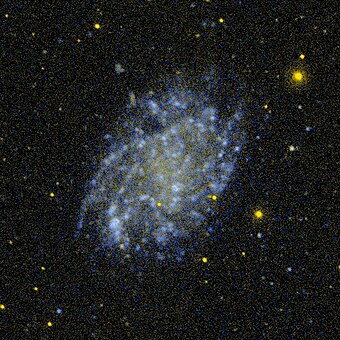
A low-surface-brightness galaxy (LSB galaxy ) is a diffuse galaxy with such surface brightness that, for an observer on Earth, the galaxy has a visible stellar magnitude at least one less than that of the surrounding sky background.
Most of these galaxies are dwarf galaxies , a significant proportion of the baryonic matter of which is neutral hydrogen . About 95% of the mass of dwarf galaxies is enclosed in dark matter .
The rotation curve measurements show extremely high mass – luminosity ratios . This means that stars and luminous gas make up a very small fraction of the total mass of the galaxy. In the central regions of such galaxies, there is no increased density of stars, such as a bulge of normal spiral galaxies . Therefore, dark matter dominates in LSB galaxies even in the central regions.
LSB galaxies are mainly isolated galaxies that survived fewer tidal interactions and mergers with other galaxies, which contributed to the intensification of star formation .
LSB galaxies were theoretically predicted in 1976 by Michael Disney. The first open galaxy of this type was the Malin 1 galaxy, discovered in 1986, which is a giant LSB galaxy. At the time of the discovery, it was the largest known spiral galaxy. [1] [2]
Examples
|
Gallery
Galaxy UGC 477 is located at approximately 110 million St. years in the constellation Pisces . [3]
Notes
- ↑ Scientific American, "The Ghostliest Galaxies", GD Bothun , Vol. 276, No. 2, February 1997 , pp.40-45,
- ↑ Ken Crosswell , "Malin 1: A Bizarre Galaxy Gets Slightly Less So" , January 22, 2007
- ↑ Hiding in the night sky . Date of treatment April 4, 2016.
- K. O'Neil, The HI Content and Extent of Low Surface Brightness Galaxies - Could LSB Galaxies be Responsible for Damped Ly-alpha Absorption? . For publication in Extragalactic Gas at Low Redshift , by Mulchaey, et al., Eds (2001).
- SD Rosenbaum and DJ Bomans, The environment of Low Surface Brightness Galaxies . Astronomy & Astrophysics Letters , 422, 5-8 (2004).
- AJ Barth, A normal stellar disk in the galaxy Malin 1 . Astronomical Journal 133, 1085-1091 (2007).