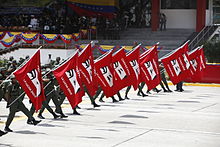
The Bolivarian Revolution is a massive social and political movement in Venezuela , created after the election of Hugo Chávez as president of this country in 1998. This movement is based on the ideology of the implementation of the political program of Simon Bolivar and socialism . The stated goal of the Bolivarian Revolution is a fundamental economic and political transformation, as well as the replacement of capitalism with a system known as “ socialism of the 21st century ” [1] .
Content
Ideology
Bolivarianism is attributed by its ideologues to socialism; Chavez has repeatedly declared his respect for the ideology and admiration for some revolutionaries (mostly Leon Trotsky ) who are similar to him, in his opinion. However, at the same time, he spoke out against change through a violent social upheaval, preferring to achieve this through parliamentary methods. He criticized the USSR for distorting left-wing ideals and stressed that Venezuela intends to create another form of social organization based on social justice (“ socialism of the 21st century ”).
At the same time, Bolivarian socialism is combined with strong accents on Christianity . Chavez referred to the interpretation of the Gospel in the spirit of liberation theology , emphasizing the role of Jesus as the liberator of society (and not just the savior of every person as an individual), who proclaimed the social activity of Christians in order to protect social justice [2] .
An important component of the idea was also the very figure of Chavez; in accordance with the Latin American traditions of leadership, he was an icon of the movement and had a great influence on its development, which led to the emergence of authoritarian elements in Bolivarism.
According to Chavez, by 2019, the third stage of the Bolivarian revolution was to be completed in Venezuela - the transition to full-fledged socialism. [3]
History
1998—2002
The presidential elections in Venezuela in 1998 ended with the victory of Hugo Chávez, a former lieutenant colonel of the airborne troops, the organizer of the failed coup in 1992. Chavez began the election campaign with an announcement of intentions to change the name of the state, carry out extensive reforms of the political system and start activities aimed at eliminating property stratification in society, as well as fighting poverty and illiteracy and received 56.2% of the vote. His followers began to organize themselves into local councils called Bolivarian circles .
In 1999, a new referendum was approved by the new Constitution of Venezuela .
From the very beginning of his reign, Chavez faced a strong opposition , mainly from the richest segments of society and private media, which accounted for more than 90% of the total number of media. In April 2002, the opposition tried to seize power by means of a coup, appointing an interim government headed by Pedro Carmona ; however, the immediate attack by supporters of Chávez led to his downfall (supporters of Chávez accuse the CIA of actively supporting the coup, which US officials have consistently denied [4] ).
In January 2008, Chavez officially pardoned the coup organizers [5] .
2002—2009
After the defeat of the coup, at the turn of 2002 and 2003, the opposition organized a general strike, which forced the authorities to temporarily close the main state-owned company PDVSA . In August 2004, after the opposition had collected the necessary number of signatures under the constitution, a general referendum was held on the question of the removal of the president from power. Chavez, however, got on him 59% of the vote in his support and remained president. After the election of the statistics bureau of Robert Rigobona and Ricardo Hausmann, it was claimed that the leaders of the election commission manipulated the election results [6] ; these allegations were not confirmed by observers from the Organization of American States .
In 2006, Chavez won the presidential election, beating a candidate from all opposition forces, Manuel Rosales [7] . Compliance with democratic procedures during the elections was confirmed by outside observers [8] .
In December 2007, Chavez put to the vote in the form of a referendum a question on constitutional amendments, which would give the president the right to an unlimited number of elections for this position, expanding the powers of local governments and maintaining the ability to dismiss the president after half a term. The proposed amendments, however, were rejected because of very low voter turnout [9] . In February 2009, a second referendum was held on the same issue, this time culminating in the adoption of amendments [10] .
Social Policy / Missions
Bolivar 2000 Plan
The Bolivar 2000 Plan was the first of the Bolivarian missions undertaken under the administration of Venezuelan President Hugo Chávez. According to the US State Department , Chavez wanted to "send a signal that the military is not a force of anti-people repression, but rather a force of development and security." The State Department also suggested that this happened, that he wanted to show his closest supporters, "he did not forget them."
The plan envisaged the participation of about 40,000 Venezuelan soldiers in door-to-door activities to combat poverty, including mass vaccinations, food distribution in slums and schools. Several scandals have affected the program, as corruption allegations were formulated against the generals participating in the program, claiming that large sums of money had been stolen.
Mission Barrio Adentro
The purpose of the mission was to provide comprehensive state-funded medical care , dental care and sports training to the lower strata of society. The mission of Barrio Adentro is an attempt to organize quality medicine for all citizens of the country.
During the mission, thousands of medical centers were built. As of 2006, the staff included 31,439 specialists, technicians and medical specialists, of whom 3,556 were Cuban doctors and 1,234 Venezuelan doctors. The Latin American office of the World Health Organization and UNICEF commended this program. Despite the fact that the mission brought positive results, there were some difficulties. In July 2007, Douglas Leon Natera, chairman of the Venezuelan Federation of Medicine, reported that up to 70% of clinics either stopped working or were left unfinished. In 2014, residents of Caracas also complained about medicine, despite the large funding from the Venezuelan government.
Habitat Mission
The goal of the Habitat mission is to build thousands of new apartments for the poor ( social housing ). The program also aims to develop affordable and integrated housing areas that provide a full range of social services - from education to health care - that fit the modern standards of urbanization. According to the organization El Universal in Venezuela, one of the main shortcomings of the Chavez administration is its inability to achieve this goal: Chavez promised to build 150,000 homes in 2006, but in the first half of the year he fulfilled only 24% of this figure, having built 35,000 homes.
Robinson Mission
As part of this program, volunteers teach literacy millions of adult citizens of Venezuela. The program is a military-civilian type. When volunteers travel to remote parts of the country, they are accompanied by the military. Trips to remote parts of the country are necessary in order to give people in those regions regular school education and lessons. On October 28, 2005, Venezuela declared itself “a territory free from illiteracy”, raising, in its initial estimates, the literacy rate to about 99 percent, although the statistics were changed to 96 percent. According to UNESCO standards, a country can be declared “literate” if 96% of its population over 15 years can read and write. [eleven]
Foreign Policy
The Bolivarian movement, based on socialism, emphasized the role of the policy of international support for countries with leftist governments and the opposition to neo - colonialism and neoliberalism , as well as the efforts of the United States aimed at preserving the economic dependence of Latin America on this country. This was reflected in the broad assistance to the countries of Allied Bolivarianism ( Ecuador , Nicaragua , Bolivia , Cuba ) and the conclusion of trade agreements with countries hostile to the United States ( Iran , Belarus ). Hugo Chavez was also one of the most critical (and aggressively speaking) critics of US policy and George W. Bush . In September 2008, after showing a report on Venezuelan television reporting the attempt to organize a new coup in Venezuela [12] , Chavez expelled the US ambassador from the country [13] .
Hugo Chavez was also accused of providing financial support to the terrorist organization FARC [14] , which the Venezuelan government has consistently denied.
Notes
- ↑ Hugo Chavez. La Revolución Bolivariana y el Socialismo del siglo XXI (isp.) (Not available link) (18 july 2009). The appeal date was July 18, 2009. Archived January 25, 2009.
- ↑ Venezuela's Chavez Closes World Social Forum
- ↑ [1] // View , Jan 2019
- ↑ USA denies backing Chavez plotters
- ↑ Wenezuela: Amnestia dla puczystów z 2002 roku
- ↑ Academics' Study Backs Fraud Claim In Chavez Election - WSJ.com
- ↑ Results of the presidential elections in Venezuela in 2006. Archived December 6, 2006.
- ↑ Archived copy (inaccessible link) . The date of circulation is October 5, 2016. Archived February 6, 2012.
- ↑ International Socialism: Lessons from Venezuela's referendum
- ↑ Chavez can rule after 2012
- ↑ Bolivarian Revolution .
- ↑ Coup Plot Against Chavez Disclosed on Venezuelan TV
- Ave Chavez Orders US Ambassador to Leave Venezuela Within 72 Hours
- ↑ Kolumbia: Chavez wspiera ludobójstwo Neopr .