Ureli Corelli Hill ( Eng. Ureli Corelli Hill ; 1802 , New York , USA - September 2, 1875 , Paterson , USA ) - American musician, founder and chief conductor of the New York Philharmonic Orchestra in 1842 - 1847.
| Yureli Corelli Hill Ureli corelli hill | |
|---|---|
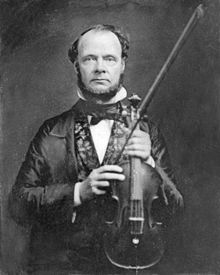 | |
| basic information | |
| Date of Birth | 1802 |
| Place of Birth | New York , USA |
| Date of death | September 2, 1875 |
| Place of death | Paterson , New Jersey |
| A country |  USA USA |
| Professions | conductor , violinist |
| Instruments | |
| Genres | symphonic music , opera |
Biography
Yureli Corelli Hill was born in 1802 in New York . His grandfather, Frederick Hill, was an army musician, and his father, Uri Keeler Hill, was a music teacher and composer. Yureli’s only brother, George Handel “Yankee” Hill, was a writer and actor known for his theater roles dedicated to American characters.
In the period 1828 - 1835, Hill combined the posts of violinist and conductor in the New York Sacred Music Orchestra. In 1838, under his control, for the first time in America, the cantata St. Paul ( St. Paul ) of Felix Mendelssohn was performed [1] . For two years, Hill studied in Germany with one of the first representatives of the romantic style in music, composer, conductor and violinist Louis Spur . Upon his return to New York, on April 2, 1842, he organized a meeting of musicians, during which the New York Philharmonic Orchestra was founded [2] . Yureli Corelli Hill became his first chief conductor. [2]
On December 7, 1842, the inaugural concert of the orchestra took place, in which Beethoven 's Fifth Symphony was performed under the direction of Hill [3] . The concert, the program of which was composed in the spirit of that era, was attended by several conductors and fragments from operas, orchestral works and chamber music were performed. In the same concert, Hill played the violin in the Hummel Piano Quintet [3] . Hill invited Louis Spur and Felix Mendelssohn to conduct the third season, but none of them could come to the United States. Subsequently, they were awarded the title of honorary members of the Philharmonic. Until 1849, Hill continued to lead the New York Philharmonic Orchestra, which also performed under the direction of six other conductors. [4]
From 1847 to 1850, Hill was in Ohio . Returning to New York, he signed a contract as a violinist and member of the orchestra council. Hill actively participated in discussions about the nature of American music and the role the orchestra should play in stimulating and promoting American composers such as George Bristow and Henry Fry .
During his professional career, Hill experienced a number of failures related to the implementation of art and commercial projects. Among them is the invention of the piano, which never fakes due to the use of small bells instead of wire strings. In order to commercialize the instrument, he went to London, however, he was not able to implement his plans [2] . In addition, in New Jersey, he made unsuccessful real estate investments [2] . These difficulties, combined with the forced resignation of the violinist of the Philharmonic due to their advanced age, are believed to have influenced Hill's state of health. He died of an overdose of morphine on September 2, 1875, at his home in Paterson. [2] In his farewell note, he wrote: "How and why should a person live, powerless to earn money for his family?" [5] .
Notes
- ↑ Ritter (1883), p. 228
- ↑ 1 2 3 4 5 Ritter (1883), p. 267
- ↑ 1 2 Grove (1908), p. 804.
- ↑ Ritter, p. 348
- ↑ Blumenthal, Ralph. Philharmonic Gets Diary Of a Savvy Music Man , The New York Times , July 29, 2002.
Literature
- Grove, George. Grove's Dictionary of Music and Musicians / JA Fuller-Maitland. - 2nd. - London: Macmillan, 1908. - Vol. iv.
- Ritter, Frédéric Louis. Music in America . - New York: Charles Scribner's Sons, 1883.