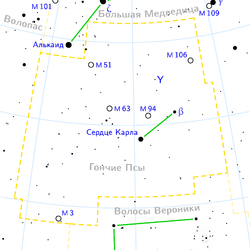
The AM Beagles ( AM Canum Venaticorum , AM CVn ) is a cataclysmic variable double star in the constellation of the Beagles . She became the progenitor of a whole class of variable stars . Based on parallax measurements using the Hubble Space Telescope , it can be calculated that the system is about 2000 light years away (610 parsecs ) from Earth, that it has its own motion 34.25 ± 0.88 mas • year −1 at position angle 67 , 0 ± 1.7 [2] .
| AM Hounds Dogs | |||
|---|---|---|---|
| Double star | |||
| Observational data ( Epoch J2000.0 ) | |||
| Type of | Cataclysmic variable | ||
| Right ascension | |||
| Declination | |||
| Distance | 1976 ++ 440 −-300 | ||
| Visible magnitude ( V ) | V max = +14.02 m , V min = +13.7 m , P = +0.28 d [2] | ||
| Constellation | Hounds Dogs | ||
| Astrometry | |||
| Proper motion (μ) | RA: 36.6 [3] mas per year Dec: 25.5 [3] mas per year | ||
| Parallax (π) | 1.65 ± 0.30 [2] mas | ||
| Specifications | |||
| Spectral class | DBp [4] | ||
| Color Indicator ( B - V ) | −0.23 [5] | ||
| Color Index ( U - B ) | −1.01 [5] | ||
| Variability | AM CVn [6] | ||
| Orbit elements | |||
| Period ( P ) | 1,028.7322 ± 0.0003 s. (17: 08.732 ± 0.018 min) [6] years | ||
| Inclination ( i ) | 43 ± 2 ° [6] ° v | ||
| |||
| Information in databases | |||
| SIMBAD | data | ||
| The star has 2 components Their parameters are presented below: | |||

In the years 1939-1940, there were studies of weak white dwarfs using the 18-inch (46 cm) Schmidt telescope at the Palomar Observatory . Part of the research was done around the north pole of the galaxy to exclude stars of spectral classes O, B, and A, since these massive short-lived stars are usually concentrated along the plane of the Milky Way , where star formation takes place.
In 1947, a list of faint blue stars was compiled for observable objects by Milton L. Humason and Fritz Zwicky [7] . Their blue tint indicates a relatively high effective temperature . The 29 star on their list (HZ 29) had the most specific spectrum from the set. It shows the absence of hydrogen lines in the spectrum , but broad, diffuse lines of neutral ( non-ionized ) helium [8] . So poor white dwarfs were found by hydrogen . In 1962 , this star was observed by a photoelectric detector and it was found that the luminosity varies in magnitude with a period of 18 minutes. The light curve showed variations that are displayed by a double sinusoid [9] . Later, flickering was observed, which forced us to offer mass transfer in the system [2] .

The model developed to explain the observations was that AM Beagles was a binary system consisting of a pair of white dwarfs in a very tight orbit. The main one is a more massive white dwarf consisting of carbon / oxygen , while the secondary is a less massive white dwarf of helium , without hydrogen , but with traces of heavy elements [2] . (In some variables of the AM Hounds Dog type , a secondary can be a semi-degenerate object , such as a subdwarf of spectral class B instead of a helium white dwarf ). The system emits gravitational waves during rotation, which reduce the stress-energy stress tensor , causing a decrease in the orbit [10] [11] . This transmission occurs because the secondary star fills the Roche lobe , created by the gravitational interaction between two stars [2] .
The mass transfer rate between white dwarfs is estimated at about 7⋅10 -9 solar masses per year, which leads to the creation of an accretion disk around the white dwarf [6] . The energy output from the mass flow to this accretion disk makes the main contribution to the visual luminosity of the entire system; the disc eclipses both white dwarfs . The temperature of this disk is about 30 000 K [6] .
High-speed photometry of the system shows several periods of change in the luminosity of a variable. The main period 1,028.73 seconds (17min. 8.73s) is the orbital period of the pair [12] . The secondary period of 1,051 seconds (17min 31s) is believed to be caused by superhumps on the light curve, which has a period slightly longer than the orbital period. Superhorbs can be the result of relative lengthening of an accretion disk in combination with precession. An elliptical disk precesses around a white dwarf for a period of time slightly longer than the orbital period, resulting in a small change in the orientation of the disk along each element of the orbit [13] .
Usually this star system exhibits only luminosity variations of 0.05 m . However, the AM Hounds Dogs star systems are also new-like objects that can randomly generate intense flashes. AM Hounds Dogs demonstrated this behavior twice from 1985 to 1987 . In 1986, the flash caused an increase in luminosity of Δm = 1.07 ± 0.03 m and lasted 212 seconds. The amount of energy released during this event is estimated at 2.7⋅10 36 Erg . [14] . These flashes are caused by short-term thermonuclear helium synthesis, which accumulates along the outer shell of the primary star [15] .
Links
- Video tour of the stars AM type Hounds Dogs (Video from the Chandra telescope) Rus.
Notes
- ↑ 1 2 Cutri, RM; Skrutskie, MF; van Dyk, S. & Beichman, CA (March 2003), 2MASS All-Sky Catalog Point Sources , vol. 2246, p. 0
- ↑ 1 2 3 4 5 6 7 8 Roelofs, GHA; Groot, PJ; Benedict, GF & McArthur, BE (September 2007), " Hubble Space Telescope Parallaxes of AM CVn Stars and Astrophysical Consequences ", The Astrophysical Journal T. 666 (2): 1174–1188 , DOI 10.1086 / 520491
- ↑ 1 2 AM; Mickaelian; Sinamyan, PK Byrkan Survey blue stellar objects (English) // Monthly Notices of the Royal Astronomical Society : journal. - Oxford University Press , 2010. - Vol. 407 . - P. 681 . - DOI : 10.1111 / j.1365-2966.2010.16959.x . - .
- ↑ WF; Van Altena; Lee, JT; Hoffleit, ed. Understanding the Trigonometric [stellar] parallaxes (Unknown) // New Haven. - 1995. - .
- ↑ 1 2 J.-C .; Mermilliod. Compilation of Eggen's UBV data, transformed to UBV (unpublished) (Eng.) // Catalog of Eggen's UBV data: journal. - 1986. - P. 0 . - .
- ↑ 1 2 3 4 5 Roelofs, GHA; Groot, PJ; Nelemans, G. & Marsh, TR (September 2006), " Kinematics of the ultracompact helium accretor AM Canum Venaticorum ", Monthly Notices of the Royal Astronomical Society T. 371 (3): 1231–1242 , DOI 10.1111 / j.1365- 2966.2006.10718.x
- ↑ Humason, ML & Zwicky, F. (January 1947), " A Search for Faint Blue Stars ", Astrophysical Journal T. 105: 85 , DOI 10.1086 / 144884
- ↑ Greenstein, Jesse L. & Matthews, Mildred S. (July 1957), " Studies of the White Dwarfs. I. Broad Features in White Dwarf Spectra ", Astrophysical Journal T. 126: 14 , DOI 10.1086 / 146364
- ↑ Smak, J. (February 1967), "18-min. Light-Variations of HZ 29", Information Bulletin on Variable Stars T. 182: 1
- ↑ Peters, P .. Gravitational Radiation from Point Masses in a Keplerian Orbit (1963), p. 435–440.
- ↑ Peters, P .. Gravitational Radiation of the Two Point Masses (1964), pp. B1224 – B1232.
- ↑ Nelemans, G .; Steeghs, D. & Groot, PJ (September 2001), " Spectroscopic evidence for the nature of AM CVn ", Monthly Notices of the Royal Astronomical Society T. 326 (2): 621–627 , DOI 10.1046 / j.1365- 8711.2001.04614.x
- ↑ Pearson, KJ (July 2007), “ Royal Astronomical Society T. 379 (1): 183–189 , DOI 10.1111 / j.1365- 2966.2007.11932.x
- ↑ Marar, TMK; Padmini, VN; Seetha, S. & Narayanan Kutty, KR (January 1988), "Flares on AM Canum Venaticorum", Astronomy and Astrophysics T. 189 (1–2): 119–123
- ↑ Bildsten, Lars; Shen, Ken J .; Weinberg, Nevin N. & Nelemans, Gijs (June 2007), " Faint Thermonuclear Supernovae from AM Canum Venaticorum Binaries ", The Astrophysical Journal T. 662 (2): L95 – L98 , DOI 10.1086 / 519489