The Cypriot dialect of the Greek language ( Greek κυπριακή διάλεκτος της ελληνικής γλώσσας ), also the Cypriot Greek language ( κυπριακή ελληνική of the Greek island of the abroad, mainly in Greece, the UK, USA, Australia and Russia. The Cypriot dialect differs from the standard modern Greek language at all levels: in vocabulary [1] , phonetics, phonology, morphology, syntax, phraseology, as well as in pragmatics [2] . The reasons for the discrepancies are historical, geographical (island isolation), as well as the connection with typologically distinct basic languages within the Greek group of languages.
| Cypriot dialect of the Greek language | |
|---|---|
| Total number of speakers | |
| Classification | |
| |
| Writing | |
| IETF | |
| Glottolog | |
History
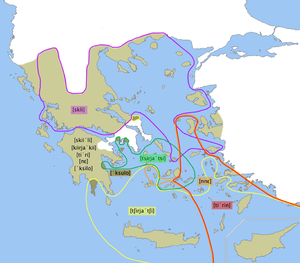
In the course of the ancient Greek colonization of Cyprus by the Greeks, the island was dominated by the Arcadokypriotic dialect brought by immigrants from the internal regions of the Peloponnese . However, its features were almost completely leveled by the middle Greek Koine of a Byzantine character. After isolation at the end of the 12th century, the Cypriot dialect experienced the greater influence of foreign-language systems than the dialects of modern Greece. The greatest influence on him had the Arabic, Turkish, French, Italian and English. The Cypriot dialect itself influenced the local island varieties of Cypriot Arabic and Turkish .
Vocabulary
The lexical similarity between the Cypriot dialect and Dimotics (New Greek language) is in the range 84–93% [3] , which complicates the understanding of Cypriots by unprepared Greeks. Carriers of the Cypriot dialect itself usually use it in a diglossia with dimotics, with the norms of which they are usually well acquainted. Nevertheless, the Cypriot dialect itself is a dialect continuum of several dialects , on the basis of which, after massive population movements in the 1970s, a local Cypriot Koin formed .
The vocabulary of the Cypriot dialect is very diverse compared to continental Greece. Along with archaisms, a greater number of borrowings from other languages stand out here.
- Archaisms include: άφτω “ανάβω” (<άπτω), φτείρα “ψείρα” (<αρχ. Φθείρ, -ρός), šοίρος (<χοίρος), ποζέγνωω (<αρχ. ), καμμώ «κλείνω τα μάτια» (<αρχ. καμμύω), κίλλης «μικρόσωμος γάιδαρος» (λ. τής αρχ. Κυπριακής), ροθέσιν (<αρχ. ὁροθέσιον), ορτσούμαι «χορεύω» (<αρχ. ὀρχοῦμαι), ξαργκώ « μένω αδρανής "(<αρχ. ἐξαργῶ).
- During the era of Venetian rule , many Italo-Venetian borrowings entered the local Cypriot dialect of the Greek language: βαντζάρω "προχωρώ" (<avanzare), γάρπος "καμάρι" (<garbo), ζόππος "αδέξοάοςς castigo), κουρτέλ-λα "μαχαίρι" (<coltella), πιννιάδα "πήλινη χύτρα" (<pignada).
Notes
- ↑ Ammon, Ulrich, ed. (2006). Sociolinguistics / Soziolinguistik 3: An International Handbook of the Science of Language and Society / Ein Internationales Handbuch Zur Wissenschaft Von Sprache und Gesellschaft (2 ed.). Walter de Gruyter. ISBN 978-3-11-018418-1 .
- ↑ Themistocleous, Charalambos; Katsoyannou, Marianna; Armosti, Spyros; Christodoulou, Kyriaci (August 7-11, 2012). "Cypriot Greek Lexicography: A Reverse Dictionary of Cypriot Greek." 15th European Association for Lexicography (EURALEX) Conference. Oslo, Norway. (inaccessible link) . Date of treatment October 3, 2016. Archived on August 6, 2016.
- ↑ Greek in Ethnologue. Languages of the World (18th ed., 2015)