Neoraja (lat.) - a genus of slopes of the rhombic order squire group. These are cartilaginous fishes with a bottom lifestyle, with large, flattened, diamond-shaped pectoral fins and a protruding or rounded snout. On the ventral side of the disc are 5 gill slits, nostrils and mouth. The tail is long and thin. They live on the continental shelf and the continental slope of the Atlantic Ocean. Reach 35 cm in length. They are found at a depth of 1565 m. They multiply by laying eggs, enclosed in a solid horn capsule with protrusions at the corners [1] [2] [3] .
| Neoraja |
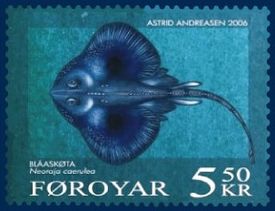
Neoraja caerulea |
| Scientific classification |
|---|
| No rank : | Bilateral symmetric |
|
| International Scientific Name |
|---|
Neoraja McEachran & Compagno , 1982 |
|
Ventral surface densely covered with small, densely located spines. larger spines form a longitudinal row that begins below the shoulder girdle and runs along the disc and tail, breaking approximately 2/3 of the tail length and not reaching the first dorsal fin. The tail is longer than the disc (up to 60%) [4] .
The name of the genus comes from the ancient-Greek. νέος - "new" and lat. raja - "tail".
