Pulsar in Sails ( born Vela Pulsar , PSR J0835-4510, PSR B0833-45) is a pulsar emitting in the optical, x-ray, gamma and radio bands of electromagnetic radiation associated with the supernova remnant in Sails .
| Vela pulsar | |||
|---|---|---|---|
| Star | |||
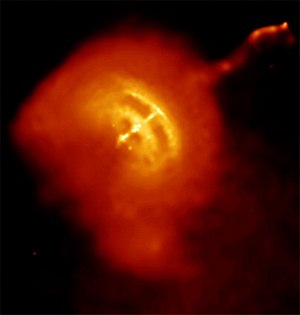 Pulsar in Sails and pleurion . | |||
| Research history | |||
| opening date | |||
| Observational data ( Age J2000.0 ) | |||
| Type of | Pulsar | ||
| Right ascension | 08 h 35 m 20.65525 s | ||
| Declination | -45 ° 10 ′ 35.1545 ″ [1] | ||
| Distance | 959 St. years (294 pc ) [2] | ||
| Visible magnitude ( V ) | 23.6 | ||
| Constellation | Sail | ||
| |||
| Database Information | |||
| SIMBAD | |||
Content
Features
It makes 11.195 revolutions per second [3] (it has a revolution period of 89.33 milliseconds - the least known at the time of opening). It has the third brightest optical component among known pulsars (V = 23.6 m ) [4] , which performs two pulses during each radio pulse. The Pulsar in Sails is the brightest object of the sky when observed in the gamma range of the spectrum.
Observations
The relationship of the pulsar with the supernova remnant in Sails, established by astronomers of the University of Sydney in 1968, [5] was direct observational evidence that neutron stars are formed during supernova bursts.
Studies by E. Kellogg ( Eng. E. Kellogg ) and colleagues in 1970-71 using data from the Uhuru satellite, it was shown that the pulsar in Sails and the source of Vela X are different objects, but spatially related. The term Vela X applied to the entire supernova remnant as a whole [6] . KW Weiler and N. Panagia in 1980 established that Vela X is a pleurion located inside the weaker supernova remnant and supplied with energy from a pulsar. [7]
May 12, 2015 in Alice Springs , Australia, a research balloon was launched, equipped with equipment for measuring gamma radiation from a pulsar; This project is a joint project for Nagoya University and Kobe University . The flight was supposed to end after sunset at Longreach in Queensland . [eight]
Often the pulsar in Parusa is called Vela X, but the latter should be separated from the pulsar in Parusa and the Vela X nebula. A radio survey of the sky in the constellations Parusa and Korma conducted on the Mills Cross telescope in 1956-57 revealed three powerful radio sources: Vela X, Vela Y, Vela Z. These sources are located close to the remnant of Supernova Feed A , which is also a strong source of X-ray and radio emission. [9]
Neither the pulsar nor the nebula surrounding it should be confused with the Sail object X-1 , which is a massive X-ray binary star located near the pulsar in the celestial sphere, but not physically connected with it.
In music
The radiation of the pulsar in Sails and the pulsar PSR B0329 + 54 was converted into sound by the French composer Gerard Griset and used in Le noir de l'étoile (1989-90). [10] [11] [12] This pulsar was also mentioned in Goodbye's album, Sol [13] from NǽnøĉÿbbŒrğ VbëřřĦōlökäävsŦ , in the track Incoming Starquake From The Vela Pulsar (959 ly).
Gallery
Gamma Ripple
The location of the pulsar in the Milky Way galaxy
- Play media file
Jet pulsar
Notes
- ↑ Vela pulsar . SIMBAD Date of treatment January 9, 2013.
- ↑ Caraveo, PA ; De Luca, A .; Mignani, RP; Bignami, GF The Distance to the Vela Pulsar Gauged with Hubble Space Telescope Parallax Observations // The Astrophysical Journal : journal. - IOP Publishing 2001 .-- November ( vol. 561 , no. 2 ). - P. 930-937 . - DOI : 10.1086 / 323377 . - . - arXiv : astro-ph / 0107282 .
- ↑ Manchester, RN; Hobbs, GB; Teoh, A .; Hobbs, M. ATNF Pulsar Catalog: J0835-4510 (unknown) // VizieR Online Data Catalog. - 2005. - August. - .
- ↑ Mignani, RP; Zharikov, RP; Caraveo, PA . The Optical Spectrum of the Vela Pulsar (Eng.) // Astronomy and Astrophysics . - EDP Sciences 2007 .-- October ( vol. 473 , no. 3 ). - P. 891 . - DOI : 10.1051 / 0004-6361: 20077774 . - . - arXiv : 0707.2036 .
- ↑ Large, MI; Vaughan, AE; Mills, BY A Pulsar Supernova Association? (Eng.) // Nature . - 1968. - October ( vol. 20 , no. 5165 ). - P. 340—341 . - DOI : 10.1038 / 220340a0 . - .
- ↑ Kellogg, E .; Tananbaum, H .; Harnden, FR, Jr .; Gursky, H .; Giacconi, R .; Grindlay, J. The X-ray Structure of the Vela X Region Observed from Uhuru // The Astrophysical Journal : journal. - IOP Publishing 1973.August ( vol. 183 ). - P. 935-940 . - DOI : 10.1086 / 152279 . - .
- ↑ Weiler, KW; Panagia, N. Vela X and the Evolution of Plerions (Eng.) // Astronomy and Astrophysics . - EDP Sciences 1980 .-- October ( vol. 90 , no. 3 ). - P. 269-282 . - .
- ↑ Huge research ball launched in Alice Springs to observe neutron star Vela Pulsar , ABC News (May 12, 2015). Date of treatment May 12, 2015.
- ↑ Rishbeth, H. Radio Emission from the Vela-Puppis Region (unknown) // Australian Journal of Physics. - 1958. - December ( t. 11 , No. 4 ). - S. 550-563 . - DOI : 10.1071 / PH580550 . - .
- ↑ Del Re, Giuseppe. The Cosmic Dance: Science Discovers the Mysterious Harmony of the Universe. - Philadelphia: Templeton Foundation, 2000. - P. 24–25. - ISBN 978-1-890151-25-6 .
- ↑ Luminet, Jean-Pierre. Illuminations: Cosmos et esthétique: [ fr. ] . - Paris: Odile Jacob, 2011 .-- P. 419-420. - ISBN 978-2-7381-2562-0 .
- ↑ Gérard Grisey (1946-1998): Le Noir de l'Étoile (1989-1990) (French) . IRCAM Date of treatment January 12, 2016.
- ↑ (31st July 2014) Goodbye, Sol: A Voyage To The End Of Spacetime And Back
Links
- Vela Pulsar at SIMBAD
- Vela Pulsar at NASA / IPAC Extragalactic Database