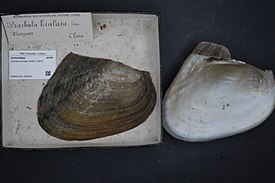
The mollusk shell is very large, up to 25-30 cm long and weighing up to 1 kg. and more. It has an irregular rhombic-oval shape. The shell is relatively flat, moderately thick-walled. Coloring is yellow-brown. The dorsal margin of the shell is strongly inclined forward, passes into a high pterygoid crest, which is often broken off in adult mollusks. The posterior margin of the shell is wide, in the lower part it is rounded, and then passes into a curved or straightened abdominal margin. The lock of the shell is formed from the rear short, straight or slightly curved plates, one in each casement. The front muscular prints are large, while they are relatively deep, clearly pronounced; the hind ones, on the contrary, are shallow, and slightly expressed. The mother -of- pearl is thick pink-blue with olive spots.
Distribution of the species includes the Amur basin, Ussuri, Lake Khanka, lakes on Iturup Island, Lake Buir-Nur (Mongolia). In the Trans-Baikal Territory, the species is found in the rivers Onon, Nercha, Shilka, Argun and in the Kharanorsk reservoir.
It lives in river and lake bodies of water, preferring silty-sandy soils. Shellfish lead a predominantly sedentary lifestyle. Unlike pearl mussel and pearl barley , also belonging to the Unionidae family, this species is characterized by summer reproduction and a very short ripening period of glochids, with a long branchial pregnancy. The process of fertilization and the release of eggs into the gills begins in the fall with a decrease in water temperature. With the onset of the winter period, mollusks from coastal areas of water bodies usually migrate to deep-sea areas. Mollusks winter with ripened larvae-glochidia, located in the gills and in early spring, while heating the water, sweep them. For further metamorphosis, they parasitize on host fish until they become adult mollusks, with the help of which they also settle. The species of fish on which they parasitize is unknown. On silty soil, mollusks are able to tolerate short-term drying and freezing of a reservoir. Life expectancy reaches 30-40 years.
It is included in the Red Book of the Russian Federation. It is protected in the Khankai state reserve.