Mountain Socroscopic Larva [1] ( lat. Coracina analis ) is a bird from the family of larvae that is endemic to New Caledonia [2] . Distributed in subtropical and tropical moist flat forests, as well as in subtropical and tropical mountain forests.
| Mountain Shrike Larva |
 |
| Scientific classification |
|---|
| No rank : | Bilateral symmetrical |
| View: | Mountain Shrike Larva |
|
| International scientific name |
|---|
Coracina analis ( Verreaux & Des Murs , 1860) |
| Area |
|---|
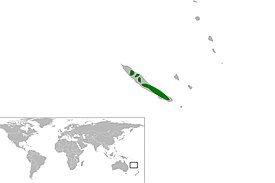 Year-round area |
| Security status |
|---|
Close to vulnerableIUCN 3.1 Near Threatened : 22706535 |
|
Appearance
A small bird is 24–28 cm long. The weight of the males is approximately 97 g, while the females weigh about 70 g [3] . It has an elongated body. The plumage is nondescript, dark gray-brown in color, with the exception of the lower tail coverts, which have a relatively bright brown tint. The species name analis is associated with them as a characteristic feature of the appearance of the bird [3] .
Voice
Like other larvae, it is a songbird. The voice of the mountain magpie larva is quite expressive and distinct, vocalization is a sharp loud whistle [3] .
The distribution area covers the islands of Grand Ter and Pen , related to New Caledonia. The highest preference for mountain shrubby larvae is given to dense forests. It is mainly found at an altitude of 600 m, but also up to 200 m above sea level [2] .
According to the results of studies conducted in 2003-2006, the number is estimated at 10-20 thousand individuals [2] . The species is classified as close to a vulnerable position due to the relatively small total number of individuals, which, presumably, decreases due to the loss of the natural habitat and its fragmentation . There is a danger that in the future the mountain shrike larva will cross the threshold for assigning the status of a vulnerable species [2] .