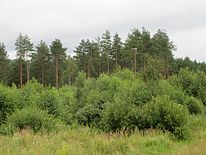

The empty land is desolate (empty), abandoned, not owned by anyone, land on which there was once a settlement [1] , but where people left because of wars, famine, death of the last owners , disappearance of water sources. Close in meaning to the term " tract ". The wasteland was also called the site farthest from the main village, not part of the allotment [2] . The word “ desert ”, similar in sound and meaning, means a remote monastic monastery , which once again emphasizes the remoteness of the wasteland from the inhabited places [3] . In addition, the wasteland was called an wasteland - a site cultivated by burning and cutting down forests [4] [5] .
Most of the famous wastelands formed in the Time of Troubles (“Lithuanian ruin”) [6] [6] [7] and, earlier, during the feudal fragmentation and the Tatar-Mongol yoke [8] . In the XX century, wastelands appeared on the site of burned and devastated settlements during the Great Patriotic War.
From the settlements in the wastelands, used cemeteries and hayfields, overgrown roads, ponds, apple and pear orchards [9] , lilac overgrows and linden alleys [10] remained. In the place thrown by man, certain plants and trees grew - nettles , ivan tea [10] [11] , plantain , wormwood , elderberry , birch ( for illumination ). The remnants of houses were called “courtyards” [12] , villages - “ settlements ”, and stoves and hearths - “stoves” [13] [14] [15] [16] . Inspection of such residues was used to establish the boundaries of the wasteland. Untreated plots the main owner of the territory ( prince , governor or king) could pick up or transfer free of charge to the new owner [17] . Wastelands without an owner were cultivated collectively, for example, overgrown arable land was used for haying.

For a long time, the wastelands retained the names of the former villages [18] , which often revived in a convenient place under the old or new name. Plots of land, which were long empty, were re-settled, cleared, handed out or leased out [6] . Non- cultivated lands for many years became unsuitable for agriculture, overgrown with forest and required clearing. Landowners exempted from taxes the peasants who pledged to restore arable land in the wasteland [19] .
Often, remote wastelands plowed by collisions, irregularly [20] , without permanent residence on the wasteland [21] and payment of taxes [19] . Wastes were acquired for joining ("allowance") to the main site in order to plow them in those years when the main land remained under steam .
Content
- 1 References in the sources
- 2 Usage Examples
- 3 See also
- 4 notes
Mentioned sources
- Abandoned Kirillov monastery in the wasteland in the Vologda district ( 1543 ). Wasteland is referred to as the possession of a monastery between villages [22] .
- The right letter to the controversial case between the Ferapontov monastery and the peasants of the southern volost in the wasteland (late XVI beginning of the XVI century) [23]
Use
“In that one of their monastic estates, it’s only one wasteland that the present village of Chernetskoye was prescribed, because the monastery was empty at that time and there were no peasants from that patrimony of the Lithuanian and German people, and about the land there was no one to tell the scribe. And they own their patrimonial wastelands from time immemorial, until the ruin of the Lithuanian and German people and after the ruin, and for the time being, and there was no one from the argument and petition ” [24] .
“And then the wasteland for quitrent for the pink ranks of people, and the quitrent with all the wasteland for the wasteland to your treasury shall be paid fifteen altyn at a rate of two money for a year. Yes, in the same way, our deserts lie in vain, nobody owns ... ” [25]
See also
- Village
- Village
- Seltso
- Fiefdom
- Pogost
- Suhodol
- Fallow
Notes
- ↑ Semyon G. Tomsinsky. Essays on the history of feudal serfdom in Russia . - Gos. social. Publishing House, Leningrad Branch, 1934-01-01. - 328 p.
- ↑ Dahl's Explanatory Dictionary online . slovardalja.net. Date of appeal September 13, 2016.
- ↑ Gleb Zapalsky. Optina deserts and her pupils in the years 1825-1917 . - Litres, 2014-10-24. - 225 p. - ISBN 9785457365537 .
- ↑ Anton Platov. Mites and Magis of Indo-Europe . - Manager, 1997-01-01. - 186 p.
- ↑ Vasilij Preodraženskij. Opisanie Tverskoj gubernii v sel'sko-chozjastvennom otnoženii: Sočinenie Vasilija Preodraženskago . - Ministerstvo Gos. Imuščestv, 1854-01-01. - 610 s.
- ↑ 1 2 3 Konstantin Aleksandrovich Averyanov, Evgeny Nikolaevich Machulsky, Z. V. Rubtsova, All-Russian Volunteer Research and Cultural and Educational Society “Encyclopedia of Russian Villages”. Materials for the study of the villages of Moscow and Moscow region: reports and reports of the fourth regional scientific-practical conference "Moscow and Moscow Region", Moscow, December 20-21, 1995 . - “Encyclopedia of Russian villages”, 1996-01-01. - 228 p.
- ↑ Collective of authors. Moscow. History of the districts . - Litres, 2015-04-22. - 1213 s. - ISBN 9785457658608 .
- ↑ Association “Russian Political Encyclopedia”. The economic history of Russia from ancient times until 1917: N — I. - ROSSPEN, 2008-01-01. - 1328 s.
- ↑ I. A. Gubanov, I. L. Krylova, V. L. Tikhonova. Wild useful plants of the USSR . - Ripol Classic, 1976-01-01. - 440 s. - ISBN 9785458273879 .
- ↑ 1 2 Vera Perminova. Bulavinsky chronicles: life in an amazing village: [about the village of Porkhovsky district of the Pskov region ]. - Publishing House "Peter", 2012-04-12. - 256 s. - ISBN 9785459011685 .
- ↑ Far East . - Khabarovsk Knight Publishing House., 2004-01-01. - 474 p.
- ↑ Efimenko A. Ya. Southern Russia: essays, studies, and notes . - Directmedia, 2015-03-10. - 452 p. - ISBN 9785998990984 .
- ↑ Ethnographie soviétique . - Publishing House of the Academy of Sciences of the USSR, 1955-01-01. - 1630 s.
- ↑ Cherepnin Leo. § 3. Settlement of wastelands and clearing of forest land for arable land - Formation of the Russian centralized state in the XIV – XV centuries. Essays on the socio-economic and political history of Russia . www.e-reading.club. Date of appeal September 13, 2016.
- ↑ Vyacheslav Stepanovich Kulikov, Russian Academy of Sciences Karelian Scientific Center, Vodlozersky State Natural National Park (Russia). The natural and cultural heritage of Vodlozersky National Park . - Russian Academy of Sciences, Karelian Scientific. Center, 1995-01-01. - 250 p. - ISBN 9785201077617 .
- ↑ Drevnosti .... - 1900-01-01. - 392 p.
- ↑ Materials on the study of the economy of the settled indigenous population in the Turkestan Territory: Sartovsky economy in the Chimkent district of the Syr-Darya region . - Directmedia, 2014-10-06. - 346 p. - ISBN 9785447512569 .
- ↑ A.A. Fedorov. Plant life. In 6 volumes . - Ripol Classic. - 551 p. - ISBN 9785458270724 .
- ↑ 1 2 Vladimir Ivanovich Kuznetsov. From the history of feudal land tenure in Russia . - Publishing house of Moscow University, 1993-01-01. - 188 p.
- ↑ Nadezhda Konstantinovna Gavrilova. Agricultural development and dynamics of forest cover in the non-chernozem zone of the RSFSR . - Science, 1983-01-01. - 116 p.
- ↑ Notes of the Leningrad Agricultural Institute . - Printing house of the Main Artillery Directorate, 1924-01-01. - 774 s.
- ↑ Arkheograficheskai︠a︡ Komissii︠a︡ (LENINGRAD), Yakov Ivanovich BEREDNIKOV. Acts Legal or collection form of old business. [Edited by-Berednikov. (Pointer.).]. - 1838-01-01. - 598 p.
- ↑ Legal acts, or a collection of forms of ancient production . - Archaeographic Commission, 1838-01-01. - 522 s.
- ↑ Readings at the Imperial Society of History and Antiquities of Russia at Moscow University. 1902 . - Directmedia, 2013-03-14. - 665 s. - ISBN 9785446029655 .
- ↑ Historical acts compiled and published by the Archaeographic Commission . - Directmedia, 2013-03-12. - 595 s. - ISBN 9785998988332 .