The Odessa operation of 1944 is a military operation of the troops of the 3rd Ukrainian Front under the command of Army General R. Ya. Malinovsky (with the assistance of the forces of the Black Sea Fleet under the command of Admiral F. S. Oktyabrsky ), which took place in March - April 1944 as part of the Dnieper-Carpathian strategic offensive operation (December 24, 1943 - April 17, 1944). The purpose of the operation was the defeat of the enemy’s coastal group between the Southern Bug and Dniester rivers , the liberation of the northwestern coast of the Black Sea , including the port city of Odessa and access to the USSR state border with Romania .
| Odessa liberation operation | |||
|---|---|---|---|
| The main conflict: the Dnieper-Carpathian operation | |||
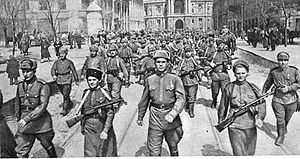 Parts of the Red Army pass through the streets of liberated Odessa on April 10, 1944 | |||
| date of | March 26 - April 14, 1944 | ||
| A place | Ukraine | ||
| Total | USSR victory, moving the front line in Bessarabia to the left bank of the Dniester | ||
| Opponents | |||
| |||
| Commanders | |||
| |||
| Forces of the parties | |||
| |||
| Losses | |||
| |||


Content
- 1 situation before the operation
- 2 Forces of the parties
- 2.1 USSR
- 2.2 Wehrmacht and Romania
- 3 Events
- 3.1 Forcing the Southern Bug
- 3.2 The release of Nikolaev
- 3.3 The liberation of Odessa
- 3.4 Capture of the left bank of the Dniester
- 4 Summary
- 5 See also
- 6 notes
- 7 Sources
- 8 References
Situation before the operation
After the successful Bereznegovatno-Snigirevsky operation of 1944, the troops of the 3rd Ukrainian Front immediately raided the Southern Bug River in separate places and captured bridgeheads on its western shore. It was extremely important to liberate Odessa as a large port through which reinforcements and deliveries to the German troops came actively.
The forces of the parties
USSR
The troops of the Red Army made up for the losses incurred during the Breznegovatno-Snigirevskaya operation. On March 30, 1944, the commander of the 28th Army (on March 29, the army was withdrawn to the Reserve of the Supreme High Command ) A. A. Grechkin was seconded to the participants in the operation. By March 26, the troops of the 3rd Ukrainian Front consisted of seven combined arms armies ( 5th shock , 8th guards , 6th , 28th , 37th , 46th and 57th ), horse-mechanized groups (guards 4th cavalry and 4th mechanized corps), 23rd tank corps , 17th air army , a total of 57 infantry and 3 cavalry divisions. Total: 470,000 soldiers, equipped with 435 tanks and self-propelled guns, artillery and mortars, there were 12 678 (of which there are more than 3000 trophy), 436 aircraft.
Wehrmacht and Romania
Despite heavy losses in previous battles, the 6th German Army was still a significant force. By the beginning of the offensive operation of the Soviet troops, the German-Romanian forces in the region totaled 16 German and 4 Romanian divisions, including 2 tank corps and one self-propelled artillery regiment; a total of about 350 thousand troops, with 160 tanks and self-propelled guns, 3200 guns and mortars, 400 aircraft of the 4th air group (Germany) and 150 air forces (Romania).
The main line of defense of the Germans and Romanians is concentrated on the rivers Southern Bug and Dniester. On the banks of the small rivers Tiligul , Big Kuyalnik , Small Kuyalnik fortifications were also created. Odessa is also a strong defense center, where the so-called "The Fuhrer Fortress." Tanks and artillery regiments were deployed in Odessa, Berezovka and Nikolaev . Infantry regiments are located along rivers, lagoons, bays. The private sector of the Ochakov fortress is also reinforced by an infantry regiment. Minefields and obstacles are located along the western bank of the Southern Bug River and around Odessa.
Events
Boosting the Southern Bug
The offensive began in early March. The troops of the 3rd Ukrainian Front were opposed by the 6th Wehrmacht Army and the 3rd Romanian Army . By mid-March, Soviet troops approached the Southern Bug River , and on March 18 began to force it. It was here that the Germans hoped to detain the Soviet troops, however, the swift offensive of the 3rd Ukrainian Front frustrated their plans. The crossing was completed on March 27-28, after which a rapid offensive to the south began.
The Liberation of Nikolaev
On March 28, Soviet troops liberated Nikolaev. Under the circumstances, the command of the 6th Army had no choice but to begin the withdrawal. Meanwhile, the Soviet army in early April occupied the Razdelnaya station, then Ochakov was liberated. The enemy forces were surrounded.
The Liberation of Odessa
On the evening of April 9, Soviet troops liberated the northern quarters of Odessa. By night assault with the assistance of the partisans, by the morning of April 10, Odessa was liberated. The offensive was continued to the west, to the Dniester.
Capture of the left bank of the Dniester
The Ukrainian fronts were able to move to the liberation of Transnistria , and then Moldova . According to Soviet data, the Germans lost 26,800 killed, 10,680 prisoners, 443 tanks and 952 guns. [2]
Below is a report by the Sovinformburo on German crimes in the village of Kirpichny Zavod and the village of Kuyalnik, Odessa Region: “Retreating under the blows of the Red Army, the Nazis vented their anger on civilians. On April 9, German soldiers and officers drove women, children and the elderly into an earthen quarry and committed brutal reprisals against them. Fascist executioners shot innocent peaceful Soviet people with machine guns and pistols. German monsters killed up to 400 inhabitants during this day. “More than 30 young children died at the hands of the fascist executioners.” [3]
Summary
As a result, the troops of the 3rd Ukrainian Front, in collaboration with the 2nd Ukrainian Front, inflicted a heavy defeat on the 6th German and 3rd Romanian armies. Advancing 180 km, Soviet troops liberated the Nikolaev and Odessa regions and captured a significant part of Moldova. The conditions were created for the complete capture of Moldova, advancement into the depths of Romania and the Balkans. The Black Sea Fleet was able to relocate light fleet forces and aircraft to the northwestern region of the Black Sea basin, which created a threat of isolation from the sea of the Crimean enemy grouping, already blocked by land from Soviet troops.
See also
- Odessa defense (1941)
Notes
Sources
- The history of the second world war. 1939-1945. T. 8. - M., 1977, p. 93—95
- Grylev A.N. Dnieper - Carpathians - Crimea. - M., 1970
- Chuikov V. I. From Stalingrad to Berlin ". - M.: Military Publishing House, 1980. - pp. 413-421
- Immortal glory. - Odessa, 1975
- Odessa Red Banner. - Chisinau, 1985, p. 164-170
Links
- Odessa offensive operation (March 26 - April 14, 1944) on the website of the Ministry of Defense of Russia
- Odessa operation 1944 - an article from the Great Soviet Encyclopedia .
- Odessa operation of 1944