

Shares in% of various sources in world electricity production in 2015 ( IEA , 2017) [1]
Coal / Peat (39.3%)
Natural gas (22.9%)
Hydro (16.0%)
Nuclear (10.6%)
Oil (4.1%)
Other ( Renewed ) (7.1%)
Energy is an area of human economic activity, a set of large natural and artificial subsystems that serve to transform, distribute and use all types of energy resources. Its purpose is to ensure the production of energy by converting primary, natural energy into secondary, for example, into electric or thermal energy. Moreover, energy production most often occurs in several stages:
- production and concentration of energy resources, an example is the production, processing and enrichment of nuclear fuel ;
- transfer of resources to power plants, for example, the delivery of gas, coal, fuel oil to a thermal power plant ;
- conversion of primary energy into secondary energy by means of power plants , for example, chemical energy of coal into electrical and thermal energy;
- the transfer of secondary energy to consumers, for example through power lines [2] .
Electricity
Electricity is a subsystem of energy that covers the production of electricity at power plants and its delivery to consumers through power lines. Its central elements are power plants, which are usually classified according to the type of primary energy used and the type of converters used for this. It should be noted that the predominance of a particular type of power plant in a particular state depends primarily on the availability of appropriate resources. Electricity is usually divided into traditional and non-traditional .
| Share of various sources in world electricity production [1] | Coal | Natural gas | Hydroelectric power station | NPP | Oil | Other | Total |
|---|---|---|---|---|---|---|---|
| 1973 year | 38.3% | 12.1% | 20.9% | 3.3% | 24.8% | 0.6% | 6 131 TW * h |
| 2015 year | 39.3% | 22.9% | 16.0% | 10.6% | 4.1% | 7.1% | 24,255 TWh |
Conventional Electricity
A characteristic feature of the traditional electric power industry is its long-standing and good development; it has undergone a lengthy test under various operating conditions. The main share of electricity in the whole world is received at traditional power plants, their unit [3] electric power very often exceeds 1000 MW . Traditional electricity is divided into several areas [4] .
Thermal Power
In this industry, electricity is produced at thermal power plants ( TPPs ) that use the chemical energy of fossil fuels for this. They are divided into:
- Steam turbine power plants in which energy is converted using a steam turbine installation ;
- Gas turbine power plants in which energy is converted using a gas turbine plant ;
- Combined cycle power plants where energy is converted using a combined cycle plant [5] .
Thermal energy prevails among traditional types on a global scale, 46% of the world's electricity is generated on the basis of coal , 18% on the basis of gas , about 3% on the basis of biomass burning, oil is used for 0.2%. In total, thermal stations provide about 2/3 of the total generation of all power plants in the world [6] [7]
The energy industry in countries such as Poland and South Africa is almost entirely based on the use of coal, and the Netherlands on gas . The share of heat power in China , Australia , Mexico is very high.
Hydropower
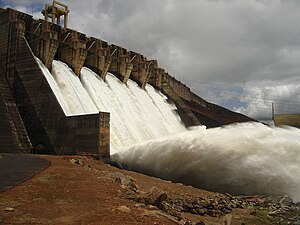
In this industry, electricity is produced at hydroelectric power plants ( HPPs ) that use water flow energy for this.
Hydroelectric power plants prevail in a number of countries - in Norway and Brazil, all power generation occurs on them. The list of countries in which the share of hydroelectric power generation exceeds 70% includes several dozen.
Nuclear Power
An industry in which electricity is produced at nuclear power plants ( NPPs ) that use the energy of a controlled nuclear chain reaction , most often uranium and plutonium .
France excels in the share of nuclear power in electricity generation [8] , about 70%. It also prevails in Belgium , the Republic of Korea and some other countries. The world leaders in the production of electricity at nuclear power plants are the United States , France and Japan [9] [10] .
Alternative Power
Most areas of non-traditional electric power industry are based on completely traditional principles, but the primary energy in them is either sources of local importance, for example, wind, geothermal, or sources that are under development, for example, fuel cells or sources that can be used in the future, such as thermonuclear power. Characteristic features of alternative energy are their environmental friendliness , extremely high costs of capital construction (for example, for a solar power plant with a capacity of 1000 MW it is required to cover an area of about 4 km² with very expensive mirrors) and a small unit capacity [2] . Directions of alternative energy [4] :
- Small hydropower plants
- Wind power
- Geothermal Energy
- Solar power
- Bioenergy
- Fuel cell installations
- Hydrogen power
- Thermonuclear energy .
It is also possible to single out an important concept because of its mass character - small energy , this term is not currently generally accepted, along with it the terms local energy , distributed energy , autonomous energy , etc. are used [11] . Most often this is called power plants with a capacity of up to 30 MW with units with a unit capacity of up to 10 MW. These include both the environmentally friendly types of energy listed above, and small fossil-fueled power plants, such as diesel power plants (the vast majority of small power plants, for example, in Russia — about 96% [12] ), gas piston power plants , small gas turbine plants power on diesel and gas fuel [13] .
Electric Networks
Electric network - a set of substations , switchgears and power lines connecting them, designed to transmit and distribute electric energy [14] . The electric network provides the ability to issue power to power plants, transmit it to a distance, convert the parameters of electricity ( voltage , current ) at substations and distribute it throughout the territory up to direct power receivers.
The electric networks of modern energy systems are multistage , that is, electricity undergoes a large number of transformations on the way from sources of electricity to its consumers. Also, modern electric networks are characterized by multi-mode , which is understood as the variety of load of network elements in daily and annual cuts, as well as the abundance of modes that occur when various network elements are brought out for scheduled repair and during emergency outages. These and other characteristic features of modern electric networks make their structures and configurations very complex and diverse [15] .
Heat Supply
The life of a modern person is associated with the widespread use of not only electric , but also thermal energy . In order for a person to feel comfortable at home, at work, in any public place, all rooms must be heated and supplied with hot water for domestic purposes. Since this is directly related to human health, in developed countries, suitable temperature conditions in various rooms are regulated by sanitary rules and standards [16] . Such conditions can be realized in most countries of the world [17] only with a constant supply of a certain amount of heat to the heating object ( heat sink ), which depends on the temperature of the outside air, for which hot water is most often used with consumers having a final temperature of about 80-90 ° C. Also, various technological processes of industrial enterprises may require the so-called production steam with a pressure of 1-3 MPa . In the General case, the supply of any object with heat is provided by a system consisting of:
- a heat source, such as a boiler room ;
- heating network , for example from pipelines of hot water or steam ;
- a heat sink, such as a hot water heater .
District Heating
A characteristic feature of district heating is the presence of an extensive heating network, from which numerous consumers ( factories , buildings , residential premises , etc.) are fed. For district heating, two types of sources are used:
- Cogeneration plants ( CHP );
- Boiler rooms , which are divided into:
- Water heating;
- Steam.
Decentralized Heat Supply
A heat supply system is called decentralized if the heat source and the heat sink are practically combined, that is, the heat network is either very small or absent. Such heat supply can be individual when separate heating devices, for example electric ones, are used in each room, or local, for example, heating a building using its own small boiler room. Typically, the heating capacity of such boiler houses does not exceed 1 Gcal / h (1.163 MW). The capacity of heat sources for individual heat supply is usually quite small and is determined by the needs of their owners. Types of decentralized heating:
- Small boiler rooms;
- Electrical, which is divided into:
- Direct;
- Accumulative;
- Heat pump ;
- Stove .
Heating networks
A heat network is a complex engineering and construction structure that serves to transport heat using a heat carrier, water or steam, from a source, thermal power plant or boiler room, to heat consumers.
From the collectors of direct network water, with the help of heat pipes, hot water is supplied to settlements. The main heat pipelines have branches, to which the wiring is connected to the heat points , in which there is heat exchange equipment with regulators , which provide heat and hot water consumers. To increase the reliability of heat supply, the heating mains of neighboring thermal power plants and boiler rooms are connected by jumpers with shutoff valves , which make it possible to ensure uninterrupted heat supply even in case of accidents and repairs of certain sections of heating networks and heat supply sources. Thus, the heat network of any city is a complex complex of heat pipes, heat sources and its consumers [2] .
Energy Fuels
Since most of the traditional power plants and sources of heat supply energy from non-renewable resources, issues of extraction, processing and delivery of fuel are extremely important in the energy sector. In traditional energy, two fundamentally different types of fuel are used.
Fossil fuels
Depending on the state of aggregation, organic fuel is divided into gaseous , liquid and solid, each of them in turn is divided into natural and artificial. The share of such fuel in the global energy balance in 2000 was about 65%, of which 39% were coal, 16% natural gas, 9% liquid fuel (2000). In 2010, according to BP, the share of fossil fossil fuels is 87%, including: oil 33.6%, coal 29.6% gas 23.8% [18] . The same according to "Renewable21" 80.6%, not considering traditional biomass 8.5% [19] .
Gaseous
Natural fuel is natural gas , artificial:
- Generator gas ;
- Coke oven gas ;
- Blast furnace gas;
- Oil distillation products;
- Gas underground gasification;
- Biogas ;
- Synthesis gas .
Liquid
Oil is a natural fuel, artificial products are called its distillation:
- Gasoline ;
- Kerosene ;
- Solar oil ;
- Fuel oil .
Hard
Natural fuels are:
- Fossil fuels :
- Peat ;
- Brown coal ;
- Coal ;
- Anthracite
- Oil shale ;
- Vegetable fuel:
- Firewood ;
- Wood waste;
- Fuel briquettes ;
- Fuel granules .
Artificial solid fuels are:
- Charcoal ;
- Coke and semi-coke ;
- Coal briquettes;
- Coal preparation waste [2] [10] .
Nuclear fuel
The use of nuclear fuel instead of organic consists of the main and fundamental difference between nuclear power plants and thermal power plants. Nuclear fuel is obtained from natural uranium , which is mined:
- In mines ( France , Niger , South Africa );
- In open pits ( Australia , Namibia );
- Underground leaching method ( Kazakhstan , USA , Canada , Russia ).
Uranium enrichment is required for use at nuclear power plants ; therefore, after mining, it is sent to a concentration plant, after processing at which 90% of the by-product depleted uranium is sent for storage, and 10% is enriched to several percent (3-5% for power reactors ). Enriched uranium dioxide is sent to a special plant, where cylindrical tablets [20] are made from it, which are placed in sealed zirconium tubes with a length of almost 4 m, fuel elements ( fuel elements ). Several hundreds of fuel rods for convenience of use are combined into fuel assemblies, fuel assemblies [2] [21] .
Energy Systems
An energy system (energy system) is, in a general sense, a combination of energy resources of all types, as well as methods and means for their receipt, conversion, distribution and use, which provide consumers with all types of energy. The power system includes electric power, oil and gas supply , coal industry , nuclear energy and others. Usually, all these systems are combined nationwide into a single energy system , and across several regions into integrated energy systems . The combination of individual energy supply systems into a single system is also called the interindustry fuel and energy complex , it is due primarily to the interchangeability of various types of energy and energy resources [22] .
Often, a power system in a narrower sense is understood as a combination of power plants, electric and thermal networks, which are interconnected and connected by common modes of continuous production processes of conversion, transmission and distribution of electric and thermal energy, which allows centralized control of such a system [23] . In the modern world, consumers are supplied with electricity from power plants, which can be located close to consumers or can be removed from them at considerable distances. In both cases, electricity is transmitted through power lines. However, in the case of remoteness of consumers from the power plant, the transmission has to be carried out at an increased voltage, and step-up and step-down substations should be built between them. Через эти подстанции с помощью электрических линий электростанции связывают друг с другом для параллельной работы на общую нагрузку, также через тепловые пункты с помощью теплопроводов, только на гораздо меньших расстояниях [24] связывают между собой ТЭЦ и котельные. Совокупность всех этих элементов называют энергосистемой , при таком объединении возникают существенные технико—экономические преимущества:
- существенное снижение стоимости электро- и теплоэнергии;
- значительное повышение надёжности электро- и теплоснабжения потребителей;
- повышение экономичности работы различных типов электростанций;
- снижение необходимой резервной мощности электростанций.
Такие огромные преимущества в использовании энергосистем привели к тому, что уже к 1974 году лишь менее 3 % всего количества электроэнергии мира было выработано отдельно работавшими электростанциями. С тех пор мощность энергетических систем непрерывно возрастала, а из более мелких создавались мощные объединённые системы [15] [25] .
See also
- alternative energy
- Мировое потребление энергии
Notes
- ↑ 1 2 2017 Key World Energy Statistics (PDF). http://www.iea.org/publications/freepublications/ 30. IEA (2017).
- ↑ 1 2 3 4 5 Под общей редакцией чл.-корр. РАН Е. В. Аметистова . том 1 под редакцией проф. А. Д. Трухния // Основы современной энергетики. In 2 volumes. — Москва: Издательский дом МЭИ , 2008. — ISBN 978 5 383 00162 2 .
- ↑ То есть мощность одной установки (или энергоблока ).
- ↑ 1 2 Классификация Российской Академии Наук , которая ей всё же считается достаточно условной
- ↑ Это самое молодое направление традиционной электроэнергетики, возраст которого немногим более 20 лет.
- ↑ Данные за 2011 год.
- ↑ World Energy Perspective Cost of Energy Technologies (англ.) . ISBN 978 0 94612 130 4 11. WORLD ENERGY COUNCIL, Bloomberg (2013). Date of treatment July 29, 2015.
- ↑ До недавнего закрытия своей единственной Игналинской АЭС , наряду с Францией по этому показателю также лидировала Литва .
- ↑ В.А.Веников, Е.В.Путятин. Введение в специальность: Электроэнергетика. — Москва: Высшая школа, 1988.
- ↑ 1 2 Энергетика в России и в мире: проблемы и перспективы. М.:МАИК «Наука/Интерпереодика», 2001.
- ↑ Эти понятия могут различно трактоваться.
- ↑ Данные за 2005 год
- ↑ А.Михайлов, д.т.н., проф., А.Агафонов, д.т.н., проф., В.Сайданов, к.т.н., доц. Малая энергетика России. Классификация, задачи, применение // Новости Электротехники : Информационно-справочное издание. — Санкт-Петербург, 2005. — № 5 .
- ↑ ГОСТ 24291-90 Электрическая часть электростанции и электрической сети. Terms and Definitions
- ↑ 1 2 Под общей редакцией чл.-корр. РАН Е.В. Аметистова . том 2 по редакцией проф.А.П.Бурмана и проф.В.А.Строева // Основы современной энергетики. In 2 volumes. — Москва: Издательский дом МЭИ , 2008. — ISBN 978 5 383 00163 9 .
- ↑ Например СНИП 2.08.01-89: Жилые здания или ГОСТ Р 51617-2000: Жилищно-коммунальные услуги. Общие технические условия. в России
- ↑ В зависимости от климата в некоторых странах нет такой необходимости.
- ↑ https://web.archive.org/web/20110626032546/http://www.bp.com/liveassets/bp_internet/globalbp/globalbp_uk_english/reports_and_publications/statistical_energy_review_2011/STAGING/local_assets/pdf/statistical_review_of_world_energy_full_report_2011.pdf
- ↑ Archived copy . Дата обращения 4 декабря 2014. Архивировано 15 декабря 2012 года.
- ↑ Диаметром около 9 мм и высотой 15—30 мм.
- ↑ Т. Х. Маргулова. Атомные электрические станции. — Москва: ИздАТ, 1994.
- ↑ Энергосистема — статья из Большой советской энциклопедии .
- ↑ ГОСТ 21027-75 Системы энергетические. Terms and Definitions
- ↑ Не более нескольких километров.
- ↑ Под редакцией С.С.Рокотяна и И.М.Шапиро. Справочник по проектированию энергетических систем. — Москва: Энергоатомиздат, 1985.