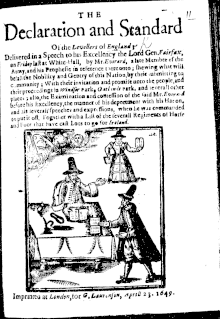
Diggers ( Eng. Diggers , "diggers"), self-name - " True Levellers " ( Eng. True Levellers ) - the movement of poor peasants that arose in 1649 during the English Revolution , opposed private property , primarily against private ownership of land . Diggers acted peacefully: they began to dig up communal lands, wielding shovels (hence the name "diggers" - "diggers"), and encouraging other poor people to follow suit. They hoped to attract thousands of people to the movement and move on to a new social system in which there would be no private property. The leader and ideologist of the diggers was Gerard Winstenley .
The first pamphlet directly expressing the ideas of diggers was The New Law of Justice, written by Winstenley. The New Law of Justice, published in the days of the trial of Charles I , developed the ideas of his previous treatises and other pamphlets, including the editions of rural levellers, “The Light that Shone in Buckinghamshire ” and “The Even Greater Light that Shone in Buckinghamshire.” In his new pamphlet, Winstenley said that private property should not exist, the land should be shared. Justifying this position, Winstenley referred to a certain divine sign - the words he heard: “Work together and eat your bread, tell it to everyone!” He believed that after the monarchy and the power of the Lords were eliminated, the injustice in the distribution of land should be destroyed, but since this has not been done, we must begin to work together on empty land, which in England is a huge number. But you can’t take away land and property by force, Winstenley said. He writes that the destruction of the old world (and he believed that when all people work together, it will be a completely different world in which there will be no place for pride and anger, “no one will want to have more than others, or to be a master over others, or demanding something personally ”) should not be carried out“ through wars, decrees or by the hands of people ”, but“ the Lord alone will be a healer, and a healer, and a bearer of the New Law of Justice ”. Winstenley suggests that everyone live according to their own understanding, and not follow someone else’s instructions (including the church); completely abandon private property; abandon the domination of some over others, destroy prisons, stop flagellation and execution.
April 8, 1649 in the wasteland at the foot of the hill of St. George, not far from the town of Cobham, in the county of Surrey , the first group of diggers settled, who began to plow and dig up previously never-cultivated land. Their actions caused such a commotion among local gentlemen and large freeholders that a certain Henry Sanders considered it necessary on April 16 to report on what happened directly to the Council of State. “A bunch of people led by a retired soldier Everard,” Sanders reported, “came to St. Hill. George and began to dig the earth, inoculating it with parsnip, carrots and beans. On Friday there were from 20 to 30 people. Spending the whole day at work, they invite everyone to come to their aid, promising food, drink and clothing. They say that after ten days they will be 4-5 thousand. "
This peaceful speech provoked fear among local landlords and freeholders who filed a complaint with the government. Then the frightened Council of State ordered General Ferfax to disperse the "illegal gathering" of "promiscuous and rebellious people," whose actions could "disrupt the peace and tranquility of the republic." When to the hill of St. George was approached by two cavalry squadrons, the diggers quietly left at the request of the officer, who informed Ferfax about the peaceful intentions of the diggers. The next day, Everard and Winstenley met with Ferfax (and shocked him by not taking off their hats) and announced the basic principles of movement.
The digger manifesto “Banner Raised by True Levellers ...” was soon published. In it we meet the same ideas as in other digger pamphlets: the idea of land as a “common treasury”, criticism of private property, denunciation of landlords. In addition, the pamphlet contains criticism of the existing order in the country, criticism of the authorities, which disappointed the population. As in other documents of diggers, in the manifest there are constantly references to religious texts.
It is worth adding that the levelers began to decisively reject the Diggers: the abolition of private property was contrary to their ideas, it would scare away most of the supporters of the levelers among small owners. Such small owners very actively interfered with the diggers in the construction of the community - their buildings were somewhat destroyed, and already in May there was a break with Everard, and Winstenley remained almost the only ideological inspirer of the movement.
In June, the digger's “Declaration of the Poor Oppressed People of England” appeared, signed by 45 individuals, including Winstenley, who, apparently, was the author of this pamphlet. The “Declaration” was intended to clarify the intentions of diggers. It again speaks of the illegality of the existence of private property and declares that people have found the courage to resist the descendants of the people who seized their land. At the same time, diggers did not go further than cultivating communal lands, believing that it was impossible to act with weapons, hoping to defeat with love and the "Christian spirit." But part of the colony was burned by soldiers, and then local freeholders came to destroy it. Winstenley writes to Ferfax, who recently promised not to touch the diggers and provide them with some freedom, is trying to once again talk about the essence of the colony, to awaken conscience in the hearts of officers. A declaration of the actions of freeholders is published. But the diggers remained unheard. Moreover, the freeholders filed a lawsuit in a local court. The court went with an incredible amount of violations: the accused were never even given a word. Diggers were sentenced to fines exacted by cows, and Bikkerstaff was imprisoned. Winstenley filed a complaint with the House of Commons, but the members of the House were busy with "more important matters." In autumn, Winstenley is again sentenced to a fine.
In 1650 - 1651, performances of diggers continued, although they were actively opposed by landlords, wealthy peasants, and officials, as reflected in the pamphlet "New Year's Gift to Parliament and the Army." Nevertheless, the movement of diggers is growing and spreading in at least 8 counties (in addition to Surrey). However, the performances of the diggers annoyed the landlords and, due to their active resistance, by the end of 1651 the movement of “true levellers” was completely suppressed. In 1652, Winstenley publishes his most significant work, The Law of Freedom , which sets out his ideas in the most detailed terms and draws a picture of the structure of the world, which, according to Winstenley, should be put into practice. Here we find the last mention of diggers as an active peasant movement.
Literature
- The English Bourgeois Revolution of the 17th Century / Ed. Acad. E. A. Kosminsky and Ph.D. East. Sciences Y. A. Levitsky . - M .: Publishing House of the Academy of Sciences of the USSR , 1954. - T. I. - 494 p. - 10,000 copies.
- Barg M. A. Genesis of the ideology of true levellers // History of Socialist Doctrines: Collection. articles memory acad. V.P. Volgin. - M .: Nauka , 1964 .-- S. 149-198.
- Barg M. A. Social Utopia of Winstenley // History of Socialist Doctrines: Collection. articles. - M.: Publishing House of the Academy of Sciences of the USSR , 1962. - P. 58—88
- Lavrovsky V. M. , Barg M. A. English bourgeois revolution. Some problems of the English bourgeois revolution of the 40s of the XVII century. M., 1958
- Pavlova T. A. Folk utopia in England of the 17th century. Perceptions of social justice. M .: IVI RAS , 1998. ISBN 5-201-00507-1
- Pavlova T.A. Law of freedom. The Story of Gerard Winstanley. - M .: Politizdat , 1985. - ( Fiery revolutionaries ).
- Pavlova T.A. Winstanley. - M.: Young Guard , 1987. - (The life of wonderful people ). ISBN 5-235-00009-9
- Pavlova T. A. Gerard Winstanley on the paths of transition to a new system // History of Socialist Doctrines: Collection. articles memory acad. V.P. Volgin. - M .: Nauka , 1964 .-- S. 167-186.
- Pavlova T. A. The ideal of man in the works of Gerard Winstanley // History of Socialist Doctrines: Collection. articles memory acad. V.P. Volgin. - M .: Nauka , 1964 .-- S. 145-162.
- Pavlova T. A. On the origin of the communist views of Winstanley // History of socialist teachings: collection of articles. - M .: Nauka , 1987. - P. 129-153
- Pavlova T. A. Runters and Winstanley // History of socialist doctrines: collection of articles. - M .: Nauka , 1986. - S. 113-133.