Lady Be Good - Bomber B-24D "Liberator" of the US Army Air Forces who disappeared during his first sortie on April 4, 1943. The plane, which belonged to the 376th bomber group, flew to bombard Naples , but did not return to the base, after which it was considered to have disappeared over the Mediterranean Sea together with the entire crew (9 people). In November 1958, the aircraft was found in the Libyan Desert , 710 km from the sea, by an exploration party of British Petroleum .
| The crash of the bomber B-24 Liberator "Lady Be Good" | |
|---|---|
| General information | |
| date of | April 4, 1943 |
| Character | CFIT |
| Cause | Navigation error |
| A place | Libyan desert |
| Coordinates | |
| Dead | 9 {all) |
| Aircraft | |
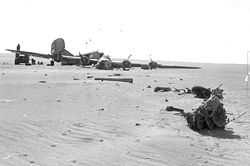 Remains of an airplane in the Libyan desert | |
| Model | B-24D Liberator |
| Aircraft name | Lady Be Good |
| Affiliation |  |
| Departure point |  Benghazi , Libya Benghazi , Libya |
| Destination | Benghazi , Libya |
| Crew | 9 |
| Dead | 9 |
| Survivors | 0 |
Further investigation concluded that upon returning to the base, the crew did not notice that an airfield had flown and was moving over the desert, probably taking the light reflected from the sand dunes for glare from the sea surface. After a long flight over the desert, the aircraft began to run out of fuel, and the pilots left the bomber in parachutes. Subsequently, all survivors of the landing died in the desert, trying to reach people (at least one died during the landing). The remains of all crew except one were found in 1960.
Content
- 1 Prior circumstances
- 1.1 sortie
- 1.2 Disappearance
- 2 Detection
- 2.1 Aircraft: 1958
- 2.2 Bodies of pilots: 1960
- 3 notes
- 4 Literature
Prior Circumstances
Sortie
The Liberator, with its own name, Lady Be Good, was the new aircraft to enter the 514th Bomber Squadron on March 25, 1943. The squadron was part of the 376th bomber group of the 9th Air Army [1] , based at Solukh airfield near the Libyan city of Benghazi ( Eng. Soluch Field ). The aircraft had a serial number "41-24301" and a tactical number "64", put on the nose [2] . Lady Be Good's own name was hand-drawn on the starboard side in front of the fuselage.
The crew of the bomber was recruited from the recently arrived in the part of the pilots. All of them arrived in Libya a week earlier than the plane - March 18, 1943. In their first joint sortie, twenty-five Liberators were to attack Naples harbor on the evening of April 4th. The raid took place in two waves. The first to fly were twelve Liberators, followed by the remaining thirteen, including Lady Be Good [3] . After the attack, all the machines were supposed to return to their airfields in North Africa .
- Crew
- 1st Lieutenant William Hatton, pilot ( born William J. Hatton )
- 2nd Lieutenant Robert Touner, co-pilot ( eng. Robert F. Toner )
- 2nd Lieutenant Hayes, Navigator ( DP Hays )
- 2nd Lieutenant John Worawka, scorer ( John S. Woravka )
- Sergeant Technician Harold Ripslinger, Flight Engineer ( Eng. Harold J. Ripslinger )
- Sergeant Technician Robert Lamotte, Radio Operator ( Robert E. LaMotte )
- Staff Sergeant Guy Shelley, gunner ( English Guy E. Shelley )
- Staff Sergeant Vernon Moore, Gunshot ( Vernon L. Moore )
- Staff Sergeant Samuel Adams, gunner ( eng. Samuel E. Adams ) [1]
A bomber took off from Solukh airfield shortly after 15:10 [4] among the latter. After takeoff, a strong wind and limited visibility prevented the pilots from joining the main group, and the bomber continued to fly alone.
Nine Liberators returned due to a sandstorm , four cars continued to fly. At 19:50, bombers appeared in the sky above Naples at an altitude of 7600 m. Due to poor visibility, the Liberators were unable to attack the main target. On the way back, two bombers bombed a reserve target, and the other two dropped bombs in the Mediterranean Sea to reduce weight and save fuel [3] .
Disappearance
Lady Be Good was single-handedly returning to Libya from a sortie. At 0:12 (April 5), pilot William Hatton reported on the radio that the Liberator’s automatic radio compass was not working, after which he requested directions to the base [3] . The plane probably flew over the airfield, not noticing the flares that launched from the ground to attract the attention of pilots. The next two hours, the bomber flew over the Sahara desert , farther and farther away from the sea. At about 2:00 the crew left the plane by parachute, and the deserted Libererator flew another 26 kilometers before falling in the sands of Calanshio Sand Sea in the Libyan Desert . The search and rescue operation, organized by the Solukh base, could not detect any traces of the missing plane, and what happened to the car and the pilots became a mystery [3] .
Discovery
Aircraft: 1958
After the crew left the plane, the latter continued for some time to fly. Judging by the well-preserved skeleton and the fact that one of the engines worked during the landing, the plane gradually lost altitude and, having reached a flat deserted surface, landed on its belly.
On November 9, 1958, the British Petroleum Exploration Party reported to the US Wheelus Air Base in Tripoli ( English Wheelus Air Base ) about the discovery of a plane crash site in the desert. The US military did not inspect the aircraft, because the records of the base did not contain information about the loss of the aircraft in the area [3] [5] . Nevertheless, the crash site was marked on maps that geologists were supposed to use during the exploration of Kalansho sand, planned for next year [5] .
On February 27, 1959, British geologists Gordon Boverman, Gordon Sheridan, and John Martin [6] noticed debris near , located 710 kilometers from Soluh airfield. On May 16, the crash site was first seen from an airplane by the Dakota crew of Silver City Airways . On May 26, the US military from the Wilus base first arrived at the site of the fall of the Libererator [7] .
The Liberator was well preserved, despite the fact that the fuselage split into two parts. Airborne machine guns and radio were in good condition, there was a supply of food and water on board. Tea from a thermos found among things could be drunk. At the crash site, no remains of the crew were found, nor were parachutes. Everything indicated that the crew left the car in the air. The records made by the navigator ended on the description of the flight over Naples [3] .
| Debris Lady Be Good | |||||||||
| |||||||||
Bodies of Pilots: 1960
In February 1960, the U.S. Army began an official search for the remains of crew members. On February 11, the remains of five people were found in the desert - Hatton, Touner, Hayes, Lamotte and Adams. Among personal belongings was found the diary of the second pilot, Touner, which contained notes about the group’s campaign in the desert [8] . Diary entries break off on April 11, 1943 [9] . Based on a search of the remains, the investigation concluded that three other pilots went north for help, and their bodies were probably buried in sand dunes .
In May 1960, when information about the aircraft and bodies found had already hit the press, the Air Force and Ground Forces began a joint operation, codenamed “Climax” ( eng. Operation Climax ). The search involved a C-130 transport aircraft and two H-13 army helicopters. On May 12, 1960, the British Petroleum Exploration Party discovered the body of Staff Sergeant Guy Shelley, 38 km from the five previously discovered bodies. On May 17, an American helicopter discovered the body of technician Sergeant Ripslinger, lying 42 km from Shelley's body [3] . Ripslinger walked through the desert from a crash site of about 200 miles (i.e., approximately 320 km) and, at the time of death, was 100 miles from the base. These two bodies are the only ones found during the operation "Climax".
On August 11, 1960, British geologists discovered the body of Worawka [10] . Due to a parachute malfunction, the pilot crashed to the ground near the place where the remaining crew members landed [10] . The remains of Voravka were taken out by the US Air Force.
The body of Staff Sergeant Vernon Moore was not found. But, presumably, his remains could be found by the British army patrol in 1953 (in the same area where Shelley and Ripslinger were later found). Since the British were not at that time notified of the loss of the American pilot in these places, the body was photographed, mentioned in the report and buried on the spot without further investigation. In 2001, one of the patrol members recalled the incident. An examination of the remains from the photograph concluded that they probably belonged to a man and it could have been Moore. However, the detection of this body and accurate identification are highly unlikely [11] .
Notes
- ↑ 1 2 Ruffin, 2015 , 2876.
- ↑ Ruffin, 2015 , 2857.
- ↑ 1 2 3 4 5 6 7 Vanishings! - Lost in Libya . History International Channel. (March 1, 2010, September 6, 2010).
- ↑ Ruffin, 2015 , 2890.
- ↑ 1 2 Barker, 1988 , The Lady Be Good.
- ↑ Martinez, 1999 , pp. 82-85.
- ↑ McClendon, 1962 , p. 93.
- ↑ Ruffin, 2015 , 2969.
- ↑ Ruffin, 2015 , 3001.
- ↑ 1 2 Ruffin, 2015 , 3012.
- ↑ www.ladybegood.com
Literature
- McClendon DE Lady Be Good, Mystery Bomber of World War II. - Aero Publishers, 1962. (English)
- Barker R. . Great Mysteries of the Air. - Revised edition. - L .: Javelin, 1988 .-- ISBN 0-7137-2063-8 . (eng.)
- Martinez M. Lady's Men - The Story of World War II's Mystery Bomber and Her Crew. - Blue Jacket Books / Naval Institute Press. - 1999. - ISBN 978-1557505538 . (eng.)
- Ruffin SA Lost Lady of the Desert // Flights of No Return: Aviation History's Most Infamous One-Way Tickets to Immortality . - Kindle Edition. - Zenith Press , 2015. - 256 p. (eng.)