
Point in cylindrical coordinates.
A cylindrical coordinate system is a three-dimensional coordinate system , which is an extension of the polar coordinate system by adding a third coordinate (usually denoted {\ displaystyle z}  ), which sets the height of the point above the plane.
Point {\ displaystyle P}  given as {\ displaystyle (\ rho, \; \ varphi, \; z)}
  . In terms of a rectangular coordinate system :
- {\ displaystyle \ rho \ geqslant 0}
 - distance from {\ displaystyle O}
  before {\ displaystyle P '}
  , orthogonal projection of a point {\ displaystyle P} to the plane {\ displaystyle XY}
  . Or the same as the distance from {\ displaystyle P} to the axis {\ displaystyle Z}
  .
. - {\ displaystyle 0 \ leqslant \ varphi <360 ^ {\ circ}}
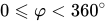 - angle between axis {\ displaystyle X}
  and segment {\ displaystyle OP '}
  .
. - {\ displaystyle z} equal to applicate point {\ displaystyle P} .
When used in the physical sciences and technology, the international standard ISO 31-11 recommends the use of the notation {\ displaystyle (\ rho, \; \ varphi, \; z)} .
Cylindrical coordinates are useful when analyzing surfaces that are symmetrical about an axis if the axis {\ displaystyle Z} take as the axis of symmetry. For example, an infinitely long round cylinder (cylindrical surface) in rectangular coordinates has the equation {\ displaystyle x ^ {2} + y ^ {2} = c ^ {2}} 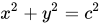 , and in cylindrical - a very simple equation {\ displaystyle \ rho = c}
  . From here comes the name "cylindrical" for a given coordinate system.
Content
2 points in cylindrical coordinates.
Since a cylindrical coordinate system is only one of many three-dimensional coordinate systems, there are laws for the transformation of coordinates between a cylindrical coordinate system and other systems.
Cartesian coordinate system
The unit vectors of the cylindrical coordinate system are related to the Cartesian unit vectors by the following relations:
{\ displaystyle {\ begin {cases} {\ vec {e}} _ {\ rho} = \ cos \ varphi {\ vec {e}} _ {x} + \ sin \ varphi {\ vec {e}} _ {y}, \\ {\ vec {e}} _ {\ varphi} = - \ sin \ varphi {\ vec {e}} _ {x} + \ cos \ varphi {\ vec {e}} _ {y }, \\ {\ vec {e}} _ {z} = {\ vec {e}} _ {z}, \ end {cases}}}
and form the right three:
{\ displaystyle {\ begin {cases} {\ vec {e}} _ {\ rho} \ times {\ vec {e}} _ {\ varphi} = {\ vec {e}} _ {z}, \\ {\ vec {e}} _ {z} \ times {\ vec {e}} _ {\ rho} = {\ vec {e}} _ {\ varphi}, \\ {\ vec {e}} _ { \ varphi} \ times {\ vec {e}} _ {z} = {\ vec {e}} _ {\ rho}. \ end {cases}}}
The inverse relations have the form:
{\ displaystyle {\ begin {cases} {\ vec {e}} _ {x} = \ cos \ varphi {\ vec {e}} _ {\ rho} - \ sin \ varphi {\ vec {e}} _ {\ varphi}, \\ {\ vec {e}} _ {y} = \ sin \ varphi {\ vec {e}} _ {\ rho} + \ cos \ varphi {\ vec {e}} _ {\ varphi}, \\ {\ vec {e}} _ {z} = {\ vec {e}} _ {z}. \ end {cases}}}
The law of transformation of coordinates from cylindrical to Cartesian:
- {\ displaystyle {\ begin {cases} x = \ rho \ cos \ varphi, \\ y = \ rho \ sin \ varphi, \\ z = z. \ end {cases}}}
The law of transformation of coordinates from Cartesian to cylindrical:
- {\ displaystyle {\ begin {cases} \ rho = {\ sqrt {x ^ {2} + y ^ {2}}}, \\\ varphi = \ mathrm {arctg} \ left ({\ dfrac {y} { x}} \ right), \\ z = z. \ end {cases}}}
Jacobian is equal to:
- {\ displaystyle J = \ rho.}
The cylindrical coordinates are orthogonal, therefore, the metric tensor has the diagonal form in them:
- {\ displaystyle g_ {ij} = {\ begin {pmatrix} 1 & 0 & 0 \\ 0 & \ rho ^ {2} & 0 \\ 0 & 0 & 1 \ end {pmatrix}}, \ quad g ^ {ij} = {\ begin {pmatrix} 1 & 0 & 0 \\ 0 & 1 / \ rho ^ {2} & 0 \\ 0 & 0 & 1 \ end {pmatrix}}.}
- Differential squared curve length
- {\ displaystyle ds ^ {2} = d \ rho ^ {2} + \ rho ^ {2} \, d \ varphi ^ {2} + dz ^ {2}.}
- Lame coefficients have the form:
- {\ displaystyle H _ {\ rho} = 1, \ quad H _ {\ varphi} = \ rho, \ quad H_ {z} = 1.}
- Christoffel Symbols {\ displaystyle \ {\ rho, \; \ varphi, \; z \}} :
- {\ displaystyle \ Gamma _ {22} ^ {1} = - \ rho, \ quad \ Gamma _ {21} ^ {2} = \ Gamma _ {12} ^ {2} = {\ frac {1} {\ rho}}.}
The rest are zero.
Differential Operators
Gradient in a cylindrical coordinate system:
- {\ displaystyle \ mathrm {grad} \, \ psi = {\ vec {e}} _ {\ rho} {\ frac {\ partial \ psi} {\ partial \ rho}} + {\ vec {e}} _ {\ varphi} {\ frac {1} {\ rho}} {\ frac {\ partial \ psi} {\ partial \ varphi}} + {\ vec {e}} _ {z} {\ frac {\ partial \ psi} {\ partial z}}.}
Divergence in a cylindrical coordinate system:
- {\ displaystyle \ mathrm {div} \, {\ vec {a}} = {\ frac {1} {\ rho}} {\ frac {\ partial \ rho a _ {\ rho}} {\ partial \ rho}} + {\ frac {1} {\ rho}} {\ frac {\ partial a _ {\ varphi}} {\ partial \ varphi}} + {\ frac {\ partial a_ {z}} {\ partial z}}. }
Rotor in a cylindrical coordinate system:
- {\ displaystyle \ mathrm {rot} \, {\ vec {a}} = \ mathrm {det} {\ begin {pmatrix} {\ frac {1} {\ rho}} {\ vec {e}} _ {\ rho} & {\ vec {e}} _ {\ varphi} & {\ frac {1} {\ rho}} {\ vec {e}} _ {z} \\ {\ frac {\ partial} {\ partial \ rho}} & {\ frac {\ partial} {\ partial \ varphi}} & {\ frac {\ partial} {\ partial z}} \\ a _ {\ rho} & \ rho a _ {\ varphi} & \ a_ {z} \ end {pmatrix}} = {\ vec {e}} _ {\ rho} \ left ({\ frac {1} {\ rho}} {\ frac {\ partial a_ {z}} {\ partial \ varphi}} - {\ frac {\ partial a _ {\ varphi}} {\ partial z}} \ right) + {\ vec {e}} _ {\ varphi} \ left ({\ frac {\ partial a_ {\ rho}} {\ partial z}} - {\ frac {\ partial a_ {z}} {\ partial \ rho}} \ right) + {\ vec {e}} _ {z} \ left ({\ frac {1} {\ rho}} {\ frac {\ partial \ rho a _ {\ varphi}} {\ partial \ rho}} - {\ frac {1} {\ rho}} {\ frac {\ partial a_ { \ rho}} {\ partial \ varphi}} \ right).}
{\ displaystyle r (t) = \ rho {\ vec {e}} _ {\ rho} + z {\ vec {e}} _ {z}}
{\ displaystyle {\ dot {r}} (t) = {\ dot {\ rho}} {\ vec {e}} _ {\ rho} + \ rho {\ dot {\ varphi}} {\ vec {e }} _ {\ varphi} + {\ dot {z}} {\ vec {e}} _ {z}}
{\ displaystyle {\ ddot {r}} (t) = ({\ ddot {\ rho}} - \ rho {\ dot {\ varphi}} ^ {2}) {\ vec {e}} _ {\ rho } + (2 {\ dot {\ rho}} {\ dot {\ varphi}} + {\ ddot {\ varphi}} \ rho) {\ vec {e}} _ {\ varphi} + {\ ddot {z }} {\ vec {e}} _ {z}}
- Euler angles
- Cylindrical chess
- Khalilov V.R., Chizhov G.A., Dynamics of classical systems: Textbook. allowance. - M.: Publishing House of Moscow State University, 1993 .-- 352 p.
