Yersinia [1] ( lat. Yersinia ) is a genus of bacteria from the Yersiniaceae family of the order Enterobacterales [2] , gram-negative rods are several micrometers in length and fractions of a micrometer in diameter, facultative anaerobes [3] .
| Yersinia | |||||||||||||
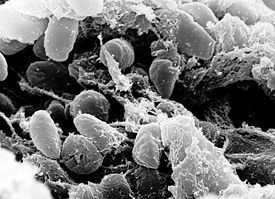 Yersinia pestis | |||||||||||||
| Scientific classification | |||||||||||||
|---|---|---|---|---|---|---|---|---|---|---|---|---|---|
| |||||||||||||
| International Scientific Name | |||||||||||||
Yersinia van Loghem 1944 | |||||||||||||
Study History
The genus is named after Alexander Yersen , a Swiss bacteriologist who discovered Yersinia pestis , the causative agent of plague. The genus Yersinia was singled out in 1944 by van Loghem (van Loghem [4] )
Pathogenesis
Some of the Yersinia pathogens for humans. Their natural reservoir is rodents , sometimes other mammals . Infection occurs through the blood (in the case of Yersinia pestis ) or through the esophagus (or less commonly Yersinia pseudotuberculosis ) through the use of contaminated products (especially vegetables, dairy and meat). There are suggestions that some bacteria of this genus may spread in the protozoal way.
Physiology
Some Yersinians have the ability not only to survive, but also to multiply at a temperature of + 1 ... + 4 ° C (which roughly corresponds to the temperature inside the refrigerator ). They also demonstrate relatively high resistance to heat - some of them can withstand temperatures of + 50 ... + 60 ° C for 20-30 minutes. Yersinia quickly inactivated by oxidizing agents .
Types
As of May 2019, the species includes 18 species [5] :
- Yersinia aldovae Bercovier et al. 1984
- Yersinia Aleksiciae Sprague and Neubauer 2005
- Yersinia bercovieri Wauters et al. 1988
- Yersinia enterocolitica (Schleifstein and Coleman 1939) Frederiksen 1964 - Yersiniosis pathogen
- Yersinia entomophaga Hurst et al. 2011
- Yersinia frederiksenii Ursing et al. 1981
- Yersinia intermedia Brenner et al. 1981
- Yersinia kristensenii Bercovier et al. 1981
- Yersinia massiliensis Merhej et al. 2008 emend. Souza et al. 2011
- Yersinia mollaretii Wauters et al. 1988
- Yersinia nurmii Murros-Kontiainen et al. 2011
- Yersinia pekkanenii Murros-Kontiainen et al. 2011
- Yersinia pestis (Lehmann and Neumann 1896) van Loghem 1944 typus - plague bacillus , the causative agent of plague
- Yersinia pseudotuberculosis (Pfeiffer 1889) Smith and Thal 1965 - pseudotuberculosis pathogen
- Yersinia rohdei Aleksic et al. 1987
- Yersinia ruckeri Ewing et al. 1978
- Yersinia similis Sprague et al. 2008
- Yersinia wautersii Savin et al. 2014
Notes
- ↑ Atlas of Medical Microbiology, Virology and Immunology: A manual for students of medical universities / Ed. A. A. Vorobyov , A. S. Bykov . - M .: Medical Information Agency, 2003. - p. 50. - 236 p. - ISBN 5-89481-136-8 .
- Domains Classification of domains and phyla - Hierarchical classification of prokaryotes (bacteria): Version 2.2 : [ eng ] // LPSN. - 2019. - 22 June.
- ↑ Ryan KJ, Ray CG (editors). Sherris Medical Microbiology. - 4th ed. - McGraw Hill, 2004. - p. 368-370. - ISBN 0-8385-8529-9 .
- ↑ van Loghem JJ The classification of plague-bacillus. // Antonie van Leeuwenhoek Journal of Microbiology and Serology. - 1944. - № 10 . - pp . 15-16 .
- ↑ Genus Yersinia : [ eng ] // . (Verified June 30, 2019) .
Links
- BBC News: Bacteria survives milk processing (English)
- Yersinia Enterocolitis Mimicking Crohn's Disease in Toddler (eng.)
- Sweden: Pork warnings over new stomach illness (English)
- Genome information is available from the NIAID Enteropathogen Resource Integration Center (ERIC) (eng.)