The Air Force and the Air Defense Forces of the Republika Srpska ( Serb. Ratno vazdukhovloplstvo and Anti-Airborne Vokske Republika Srpske ), abbreviated the Air Force and Air Defense Forces of the Republika Srpska ( Serb. V and Air Defense of the Armed Forces ) are a type of Armed Forces of the Republika Srpska . Officially formed May 27, 1992 . Took part in the wars in Bosnia and Herzegovina and Croatia , after the end of hostilities were reorganized. In 2006 they became part of the unified Armed Forces of Bosnia and Herzegovina , part of the helicopters was transferred to the civilian structures of the Republika Srpska .
| Air Force and Air Defense Army of Republika Srpska Serb. In and air defense HRV | |
| Years of existence | May 1992 - 2006 |
| A country |  Republika Srpska Republika Srpska |
| Enters into |  Armed Forces of the Republika Srpska Armed Forces of the Republika Srpska |
| Subordination | General Headquarters of the Armed Forces of the Republika Srpska |
| Headquarters | Banja Luka |
| Structure | consisting of the Air Force and Air Defense 5 types of troops:
|
| Number of | |
| Colors | |
| Celebration | May 27 |
| Participation in | Bosnian war War in croatia |
| Awards | |
| Combat operations | |
| Commanders | |
| Commanding | |
| Chief of staff | |
| Marks of Excellence | |
| Flag | |
| Identification mark |   |
| Emblem | |
| Awards | |
| Aviation technology | |
| Shock | J-22 Orao , G-4 Super Galeb , -21 Skastreb , SA 342 Gazelle |
| Fighter | |
| Anti-submarine | |
| Reconnaissance | SA 342 Gazelle , Ј-21 Split |
| Training | UTVA 75 , G-4 Super Galeb , Ј-21 Shastreb |
| Transport | Mi-8 |
| Wikimedia Commons | |
 Republika Srpska Air Force on Wikimedia Commons Republika Srpska Air Force on Wikimedia Commons | |
History
Background
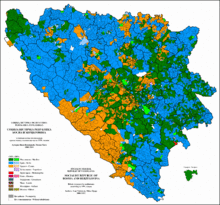
Bosnia and Herzegovina has historically been a multinational state. According to the 1991 census , 43.7 percent of the population were Bosnian Muslims, 31.4 percent Serbs, 17.3 percent Croats, and 5.5 percent identified themselves as Yugoslavs [1] . Most of the Yugoslavs were Serbs or children of mixed marriages. In 1991, 27% of marriages were mixed [2] .
As a result of the first multi-party elections held in November 1990 , the three largest nationalist parties, the Democratic Action Party , the Serbian Democratic Party and the Croatian Democratic Union , won.
The parties divided power along ethnic lines so that the head of the republic was Muslim Bosnia Aliya Izetbegovic, the chairman of the parliament was Serb Momčilo Krajišnik, and the prime minister was Croatian Jure Pelivan. On October 15, 1991, the Parliament of the Socialist Republic of Bosnia and Herzegovina in Sarajevo adopted the “Memorandum on the sovereignty of Bosnia and Herzegovina” by a simple majority [3] [4] . The memorandum met the hot objections of the Serbian members of the Bosnian parliament, who argued that the issues related to the amendments to the constitution should be supported by 2/3 members of parliament. Despite this, the “Memorandum” was approved, which led to a boycott of the parliament by the Bosnian Serbs. During the boycott, legislation of the republic was adopted [5] . On January 25, 1992, during the session of the Bosnian parliament, he called for a referendum on independence, calling it on February 29 and March 1 [3] .
February 29 - March 1, 1992, a referendum on state independence was held in Bosnia and Herzegovina. Turnout in the referendum was 63.4%. 99.7% of voters voted for independence [6] . The independence of the republic was confirmed on March 5, 1992 by the parliament. However, the Serbs , who constituted one third of the population of BiH, boycotted this referendum and declared insubordination to the new national government of BiH, starting from April 10 to form their own authorities with the center in the city of Banja Luka . The Serbian National Movement headed by the Serbian Democratic Party Radovan Karadzic .
In the summer of 1991, during the fighting in Slovenia and Croatia, the command of the Yugoslav Peoples Army decided to evacuate part of their forces from these republics. Parts of the federal army left the entire territory of Slovenia in accordance with the agreement between the Slovenian leadership and the Presidency of the Socialist Federal Republic of Yugoslavia . In Croatia, at that moment, the Yugoslav army left only a part of the districts, evacuating its forces to the territory of Serbian Krajina or Bosnia and Herzegovina. Some of the withdrawn units subsequently took part in the battles in Croatia. In particular, the forces of the Yugoslav Air Force left the airfields of the Church in Slovenia and Luchko and Pleso in Croatia. Air defense units that previously covered Zagreb were also withdrawn to the territory of Bosnia [7] .
After the signing of the Sarajevo armistice between Croatia and Yugoslavia, the federal army was reorganized. Her 5th corps of the Air Force and Air Defense was disbanded, as were some of its units. The remaining ones became part of the 5th Operational Group of the Air Force and Air Defense, in whose area of responsibility was the western part of BiH and Serbian Krajina. Since the beginning of the conflict in Bosnia, the Yugoslav army took a short part in the battles, but then the authorities in Belgrade decided to withdraw the army to the territory of Serbia and Montenegro before May 19, 1992 [8] . The personnel living in the territory of Bosnia was demobilized and, for the most part, joined the Republika Srpska Army , which was being established in May of the same year. To him, the Yugoslav army also left significant stockpiles of weapons and equipment. In particular, the airplanes and helicopters deployed at Makhovlyani airfield were in the process of forming the air forces and air defense of the Bosnian Serbs [9] .
Air Force and Air Defense during the war in Bosnia and Herzegovina
On May 12, 1992, the leadership of the Republika Srpska decided to create their own armed forces. One of their types was the Air Force and Air Defense, which began to function on May 19 of the same year. From the Yugoslav People's Army, the Bosnian Serbs received nine J-21 Jastreb aircrafts , thirteen J-22 Orao , one G-4 Super Galeb , twenty-seven SOKO Gazela helicopters, fourteen Mi-8 T helicopters. 75 and "Cube" , MANPADS " Strela-2 M" and "Needle" , as well as anti-aircraft artillery calibers 20-mm, 30-mm and 40-mm. At their disposal, the forces of aviation and air defense also received the infrastructure at the airfield of Makhovliani and the helicopter base of Zaluzhani [9] .
Officially, the Air Force and Air Defense of the Republika Srpska were established on May 27, 1992. On the same day, its combat aircraft made 16 sorties [10] [11] , acting on the regular troops of Croatia and the forces of the Bosnian Croats in Posavin . The first commander of the Air Force and Air Defense was General Zivomir Ninkovich [11] . The headquarters was headed by Colonel Bozo Novak [12] . On June 15, the General Headquarters of the Republika Srpska Army established an organizational structure for aviation and air defense forces. July 3, it was supplemented. However, since at that time a large-scale operation “Corridor-92” was going on, in which combat aircraft were widely involved, it was decided to postpone the formation and reorganization of the units until the end of the first stage of the operation. Only at the end of July of the same year, the formation of the aviation brigade, helicopter squadrons, etc. was started [13] .
During this period, the Air Force and Air Defense were actively involved in the battles in Posavina, where the Croatian army and units of the Croatian Defense Council interrupted ground communications between the western part of the Republika Srpska and its eastern regions. Combat aviation made several sorties a day, and air defense forces were deployed in the Banja Luka area to protect against Croatian aviation, which also operated in Posavin. On 9 June, the Bosnian Serb aircraft suffered their first casualties - the SOCO Gazel helicopter was shot down [14] . On June 11, J-21 Jastreb HRV in a two-seat modification was shot down near the village of Yokhovac. The pilot and the technician died [15] . On June 24, near the Derventa, Serbian MiG-21 was shot down by Serbian anti-aircraft artillery fire, the pilot was killed. After that, Croatian aviation stopped flights in Posavin. On June 28, the Bosnian Serbs lost their second plane: the J-22 Orao was shot down over Ojak by air defense forces of the 108th brigade of the Croatian army, the pilot was shot in the air [10] . In addition to combat aircraft in the operation "Corridor-92" transport helicopters played a large role. They evacuated 1894 wounded, made 2909 flights. Attack aircraft during these battles made 1242 flights, during the majority of which provided support to ground forces. In the summer of 1992, Aviation of the Republika Srpska also launched strikes against military-industrial facilities in Central Bosnia. On October 9, the UN Security Council adopted Resolution No. 781, which prohibited flights over Bosnia and Herzegovina. A day later, the Bosnian Serb Air Force suspended flights. [16]
After the adoption of the resolution by the UN Security Council, Western diplomats began to put pressure on the Bosnian Serb leadership, demanding the disbandment of combat aircraft. Their main argument was the lack of aircraft from their opponents - Bosnian Croats and Muslims. At the talks with Lord Owen, the President of the Republika Srpska Radovan Karadzic initially agreed with this demand, but after negotiations with Generals Ninkovic and Mladić he refused to liquidate the Air Force and Air Defense [17] . Combat aircraft did not perform sorties until the spring of 1993, but the helicopters continued flying, mainly engaged in evacuating the wounded and delivering cargo. In addition, the SOCO Gazel helicopters periodically provided support to ground forces. In the summer of 1993, the army of the Serbian Krajina allowed the Bosnian Serbs to use their airfield at Udbina [15] . This allowed the VRS to continue flying combat aircraft, since the airspace of the Serbian Krajina remained open. In addition to several aircraft, the army of the Republika Srpska transferred two batteries of the Kub air defense system to Krajina [18] . August 2, 1993 near Brcko Bosnian Muslims from the Strela-2M man-portable air defense system shot down an Mi-8T VRS that killed six officers and three civilians [10] . Among the dead were the commander of the 92nd mixed aviation brigade, lieutenant colonel Slobodan Kusturich and his family [19] [20] .
On February 28, 1994, the army of the Republika Srpska launched an operation to destroy ammunition for long - range rocket launchers in Bugojne and Novi Travnik. It involved six aircraft J-21 and two J-22, based at the airport Udbina. J-21 attacked a munitions plant in Novi Travnik, and J-22 dropped bombs on an armory in Bugojn. On the way back, they were intercepted by F-16 C fighters from the US Air Force engaged in securing a no-fly zone over Bosnia and Herzegovina. They shot down four J-21 Jasters, another one fell after fuel was consumed [15] . The last J-21 and both J-22 landed at Udbina airfield [21] [22] .
In the spring of 1994, NATO forces launched a series of strikes against VRS positions near Gorazde and in Eastern Herzegovina. The Serbs managed to knock out the French Etandar-IVP on April 15 with the help of the Strela-2M MANPADS, but the aircraft was able to safely return to the aircraft carrier. The next day, the British Sea Harrier [23] , which fell on Gorazde, was shot down by a Serb anti-aircraft complex. After these events, the Air Force and the RS Air Defense took part in the battles for Bihac in the fall of 1994. Initially, the VRS aircraft, taking off from Udbina, fired missiles from the airspace of Serbian Krajina, without violating the no-fly zone over Bosnia and Herzegovina. But on November 18, 1994, two J-22 Orao attacked military and industrial facilities directly in Bihac and one plane fell, hitting the pipe of one of the factories with its wing. As a result, in order to stop using the Udbina airfield, on November 21, NATO launched a massive air strike on it. The positions of the air defense of the Serbian Krajina in the Bania region and the Republika Srpska in Western Bosnia were also bombed [24] .
On May 2, 1995, during the offensive of the Croatian army on Western Slavonia , the RS air defense forces over Bosanska-Gradiška shot down the Croatian MiG-21 [25] , which had previously dropped several bombs on the city. On the same day, the 1st self-propelled air defense battery was deployed to the area, but Croatian aviation suspended flights. Also in May, NATO forces several times attacked HRV warehouses. Trying to intercept the attacking aircraft, the 1st self-propelled air defense battery on June 2, 1995 shot down an American F-16C , which fell near Bosanski Petrovac. The pilot managed to eject and hide for six days from the HRV search teams. On June 8, he was picked up by a NATO evacuation team. This incident led to major changes in the statutes of the US Air Force. Since then, strike aircraft operated exclusively with the support of aircraft with anti-radar missiles [26] .
Aviation of the Republika Srpska was actively involved in the battles in the Dinar Mountains in the summer of 1995, where the forces of the Croatian army and Bosnian Croats occupied the cities of Glamoc and Bosansko-Grahovo [10] . During Operation Storm, the VRS aircraft from the Udbina airfield in Serbian Krajina returned to Makhovliani airfield. All serviceable airplanes from the Krai army flew there. On August 6, 1995, two J-22 Orao HRVs attacked a chemical plant in Kutin (Croatia) [27] [28] . During this period, the loss of aircraft VRS amounted to two aircraft. One J-22 fell in June due to a pilot’s error on the runway of Udbina, and the second was shot down on 10 August by “friendly fire” near Drvar [29] .
On August 30, 1995, NATO launched Operation Deliberate Force , which lasted until September 21 of the same year. After its official end, several air strikes against Bosnian Serb positions were also carried out, the last bombardment occurred on October 9. One of the main objectives of the operation was the destruction of the air defense system of the Republika Srpska. 60 military facilities of the VRS were destroyed or damaged, including radar, communication centers, command posts, etc. NATO losses amounted to one Mirage-2000 shot down from Igla MANPADS on 30 August near Pale . After the operation, Colonel Charles “Chuck” Wold, a representative of the United States Air Force, said that despite the damage, the Bosnian Serb air defenses remained operational [30] .
On September 9, 1995, while NATO aircraft attacked the positions and targets of the Republika Srpska, the forces of the Croatian army, Bosnian Croats and Bosnian Muslims launched a series of major offensive operations in Western Bosnia and on the Ozren plateau. In these battles, the Serbs engaged aviation to support the ground forces. The important role of the VRS aircraft was played in countering the Croatian attacks on Novi Grad and Kozarska-Dubic (Operation Una-95) [15] , as well as in battles against the 5th Corps of the Bosnian Muslim Army. In the battles for Novi Grad, one J-21 Jastreb was shot down. The last combat sortie in the Bosnian war, the Air Force of the Republika Srpska was made in November 1995 [31] [10] .
During the fighting in the ranks of the Air Force and Air Defense of the Republika Srpska 89 soldiers were killed. Among them were 13 dead pilots and 15 people from the technical staff of the squadrons. Also, 35 people were killed in ground battles, and another 26 - during the bombing by NATO aircraft. Of the materiel, 12 aircraft were lost (5 J-22 and 7 J-21), as well as seven helicopters (5 SOKO Gazel and 2 Mi-8T) [31] .
Aircraft J-21 Jastreb number 24160 after the war became part of the monument to the fallen soldiers of the Air Force and Air Defense of Republika Srpska [15] .
Post War Period
After the cessation of hostilities, the personnel of the Air Force and Air Defense returned to the barracks. At the end of 1995, the Republic of Republika Srpska remained with 8 J-22 ORAO, 15 J-21 Jastreb, 1 G-4 Super Galeb, 2 UTVA-75, 22 SOKO Gazela helicopters, 12 Mi-8 helicopters. From November 1995 to April 25, 1996, when the IFOR forces were preparing to deploy in Bosnia and Herzegovina, all flights in its airspace were prohibited. After the ban was lifted, the Bosnian Serb aviation conducted only training flights in the Prnyavor area. Each of them was held under the control of international forces and had to receive prior approval. At the same time, during the first training sorties, airplanes and helicopters were not supposed to carry weapons [32] .
In March 1996, a reorganization was carried out in the RS armed forces, which consisted mainly in reducing the number of personnel and reorganizing the units. In the Air Force and Air Defense, the 155th brigade was transformed into the 855th, the 92nd mixed brigade into the 892nd battalion, the 51st battalion in the 851st, 172nd regiment in the 872nd, an EW platoon and an EW company in the 88 platoon and 88th company respectively, 474th regiment in 884 regiment, 474th base in 874th base. The 92nd multipurpose squadron, the 76th base, the 76th squadron, the air force security service and the assault company were disbanded. The number of military equipment was also reduced. According to the Dayton Accords , the Republika Srpska Army could have 21 combat aircraft and 7 combat helicopters [10] . Therefore, weapons and sights were dismantled from several helicopters. In 1998, the Air Force and Air Defense was led by General Milan Torbitsa [33] [34] .
In 1998, international forces of the SFOR lifted a ban on participation in joint exercises with ground forces previously imposed on the Air Force and Air Defense of the Republika Srpska Republic [10] . In 1999, during the bombing of NATO forces of the Federal Republic of Yugoslavia , some officers from the RS air defense units took part in combat operations as part of the Yugoslav anti-aircraft defense. After the war, they returned to the Republika Srpska. At the same time, the damage inflicted on Yugoslavia and, in particular, on its military-industrial complex, seriously complicated the maintenance of the combat capability of the Bosnian Serb aviation and the training of pilots [35] .
On July 17, 2002, Major-General Marinko Shilegovich headed the Air Force and Air Defense. [36] RS Aviation was not able to buy new aircraft and helicopters, limited to the repair of existing ones. Gradually, the number of serviceable equipment decreased. So, in the fall of 2002, the J-22 Orao aircraft made the last flights, after which they were sent for conservation. In 2003, 7 J-22 Orao, 9 J-21 Jastrab, 1 G-4 Super Galeb, 2 UTVA-75, 22 SOKO Gazela helicopters and 11 Mi-8 remained in the Air Force and Air Defense. The personnel consisted of 1,100 people, of whom 250 were conscripts. Also in the ranks of the Air Force were listed 64 pilots [37] .
In August 2005, the Republika Srpska Assembly agreed to accept the plan for the formation of a unified armed forces and defense ministry in BiH as part of a broad military reform proposed by the High Representative in Bosnia and Herzegovina Rafi Grigoryan. According to him, the armed forces of the entities were abolished, and defense issues were transferred to the government in Sarajevo. The Air Force and Air Defense of the Republika Srpska became part of the corresponding type of the BiH military. On the territory of the RS, military functions were retained only by the Makhovlyani airfield [10] . With the support of the RS authorities, the pilots who fired from the army founded the Helicopter Service of the Republika Srpska company, which received several helicopters for use, including three SOKO Gazela helicopters from the former Air Force and Air Defense. Within the company, these helicopters perform tasks in the interests of the Government and the Ministry of the Interior of the Republika Srpska [38] .
Air Force and Air Defense Organization of the Republika Srpska Army
Command
During the existence of the Air Force and Air Defense of the Republika Srpska, they were headed by the following commanders:
- Major General Zivomir Ninkovich (1992-1998) [9]
- Major General Milan Torbitsa (1998–2002) [33] [34]
- Major General Marinko Shil'govich (2002–2005) [39] [36]
Organizational structure during the war years
The definition of the organizational structure of the Air Force and Air Defense began in June 1992. The corresponding order was issued by the General Staff on 16 June. According to him, the Air Force and Air Defense should have the following structure [40] [41] :
- Headquarters
- 92nd mixed brigade
- 155th Air Defense Regiment (later reformed into the 155th Brigade)
- 51st aerial surveillance, detection and guidance battalion
- 474 air base (later renamed 74 base)
- airborne company
- EW platoon
- security Service
The order of the General Staff dated July 3, 1992 also created the following units [13] :
- 76th aviation base
- 76th Aviation Squadron
- 92nd Light Multi-Purpose Aviation Squadron
- 474th Light Artillery-Missile Regiment
- Repair Institute "Cosmos"
- repair-technical institute "Orao"
This organization of the Air Force and Air Defense was used throughout the war. February 17, 1994, it was supplemented by the creation of the 172nd medium self-propelled missile air defense regiment [42] .
Organizational structure in the post-war period
After the end of hostilities, the leadership of the Republika Srpska decided to reorganize the armed forces, reducing their number and eliminating many units. The new composition of the Air Force and Air Defense was approved on June 5, 1996 [43] :
- Headquarters
- 855th Missile Defense Brigade
- 892nd Aviation Brigade
- 851st Airborne Surveillance, Detection and Guidance Battalion
- 872th medium self-propelled missile air defense regiment
- 88th platoon of electronic intelligence
- 88th EW Company
- 884th Light Artillery Regiment
- 874th aviation base
Armament
| Type of | Production | Purpose | amount | A photo |
|---|---|---|---|---|
| SOKO-21 Јastreb | SFRY | fighter bomber | 9 [9] [15] [44] [11] | |
| SOCO J-22 Orao | SFRY | fighter bomber | 13 [9] [44] [11] | |
| SOKO G-4 Super Galeb | SFRY | combat training aircraft | 1 [9] [11] | |
| Mi-8T | the USSR | transport helicopter | 14 [9] [44] [11] | |
| SOCO Gazelle | SFRY | multipurpose helicopter | 27 [9] [44] [11] | |
| ZRK Cube | the USSR | anti-aircraft missile complex troop defense | three batteries [9] | |
| C-75 | the USSR | medium-range anti-aircraft missile system | four divisions [9] | |
| Strela-1 | the USSR | short-range anti-aircraft missile system | unknown [9] | |
| Strela-10 | the USSR | short-range anti-aircraft missile system | unknown [9] | |
| MANPADS "Strela-2M" | the USSR | man-portable air defense system | unknown [9] | |
| MANPADS "Igla" | the USSR | man-portable air defense system | unknown [9] | |
| M55 memory | SFRY | anti-aircraft gun | unknown [9] | |
| ZSU BOV-3 | SFRY | self-propelled anti-aircraft installation | unknown [9] | |
| ZSU M53 / 59 "Prague" | SFRY | self-propelled anti-aircraft installation | unknown [9] | |
| Bofors L60 | SFRY | anti-aircraft gun | unknown [9] |
Notes
- ↑ Klemenčič, Matjaž. The Reference Sourcebook / Matjaž Klemenčič, Mitja Žagar. - Santa Barbara, California: ABC-CLIO, 2004. - P. 311. - ISBN 1576072940 .
- ↑ Yugoslavia in the XX century, 2011 , p. 805.
- 2 1 2 Trbovich, Ana S. A Legal Geography of Yugoslavia's Disintegration . - Oxford University Press, 2008. - P. 221. - ISBN 9780195333435 .
- ↑ Cook, Bernard A. Europe Since 1945 . - Taylor and Francis, 2001. - P. 140. - ISBN 9780815340577 .
- ↑ Trbovich, Ana S. A Legal Geography of Yugoslavia's Disintegration . - Oxford University Press, 2008. - P. 220–224. - ISBN 9780195333435 .
- Re The Referendum on Independence in Bosnia-Herzegovina: February 29 - 1 March 1992 . Commission on Security and Cooperation in Europe (1992). The appeal date is December 28, 2009. Archived August 26, 2011.
- ↑ Vazduhoplovne snage bivših republika SFRJ, 2016 , p. 89
- ↑ Vazdušni rat nad Republikom Srpskom i Republikom Srpskom Krajinom, 2017 , p. 55.
- ↑ 1 2 3 4 5 6 7 8 9 10 11 12 13 14 15 16 17 18 Vazduhoplovne snage bivših republika SFRJ, 2016 , p. 93.
- ↑ 1 2 3 4 5 6 7 8 Danko Boroјeviћ. Od „Tsrnih panther“ to „Risova sa Vrbasa“ (Serb.) . http://udruzenjepvlps.org . The appeal date is September 12, 2017.
- ↑ 1 2 3 4 5 6 7 Boroјeviћ D., Iviћ D., 2014 , p. 149.
- ↑ Vazdušni rat nad Republikom Srpskom i Republikom Srpskom Krajinom, 2017 , p. 56.
- ↑ 1 2 Vazduhoplovne snage bivših republika SFRJ, 2016 , p. 95
- ↑ Vazdušni rat nad Republikom Srpskom i Republikom Srpskom Krajinom, 2017 , p. 66
- ↑ 1 2 3 4 5 6 Danko Boroјeviћ. Serbovi Mahovkana and Udbine (Serb.) . http://udruzenjepvlps.org/ . The appeal date is September 12, 2017.
- ↑ Vazduhoplovne snage bivših republika SFRJ, 2016 , p. 112
- ↑ Vazdušni rat nad Republikom Srpskom i Republikom Srpskom Krajinom, 2017 , p. 116.
- ↑ Vazduhoplovne snage bivših republika SFRJ, 2016 , p. 116.
- ↑ Vazduhoplovne snage bivših republika SFRJ, 2016 , p. 119.
- ↑ Vazdušni rat nad Republikom Srpskom i Republikom Srpskom Krajinom, 2017 , p. 152.
- ↑ Vazduhoplovne snage bivših republika SFRJ, 2016 , p. 125
- ↑ Vazdušni rat nad Republikom Srpskom i Republikom Srpskom Krajinom, 2017 , p. 182-184.
- ↑ Vazdušni rat nad Republikom Srpskom i Republikom Srpskom Krajinom, 2017 , p. 187.
- ↑ Vazduhoplovne snage bivših republika SFRJ, 2016 , p. 135.
- ↑ Vazdušni rat nad Republikom Srpskom i Republikom Srpskom Krajinom, 2017 , p. 240
- ↑ Vazduhoplovne snage bivših republika SFRJ, 2016 , p. 139.
- ↑ Report of the UN Secretary General, submitted in accordance with Security Council Resolution 1009 (1995) . The appeal date is February 14, 2013. Archived February 26, 2013.
- ↑ Vazduhoplovne snage bivših republika SFRJ, 2016 , p. 141.
- ↑ Vazduhoplovne snage bivših republika SFRJ, 2016 , p. 142
- ↑ Vazduhoplovne snage bivših republika SFRJ, 2016 , p. 150
- ↑ 1 2 Vazduhoplovne snage bivših republika SFRJ, 2016 , p. 160
- ↑ Vazduhoplovne snage bivših republika SFRJ, 2016 , p. 164.
- ↑ 1 2 Vazduhoplovne snage bivših republika SFRJ, 2016 , p. 167.
- ↑ 1 2 Blazhanoviћ, 2005 , p. 102
- ↑ Vazduhoplovne snage bivših republika SFRJ, 2016 , p. 168.
- ↑ 1 2 Blazhanoviћ, 2005 , p. 129.
- ↑ Vazduhoplovne snage bivših republika SFRJ, 2016 , p. 170
- ↑ Vazduhoplovne snage bivših republika SFRJ, 2016 , p. 174.
- ↑ Vazduhoplovne snage bivših republika SFRJ, 2016 , p. 169.
- ↑ Vazduhoplovne snage bivših republika SFRJ, 2016 , p. 94.
- ↑ Vazdušni rat nad Republikom Srpskom i Republikom Srpskom Krajinom, 2017 , p. 61.
- ↑ Vazduhoplovne snage bivših republika SFRJ, 2016 , p. 99
- ↑ Vazduhoplovne snage bivših republika SFRJ, 2016 , p. 165.
- ↑ 1 2 3 4 Vazdušni rat nad Republikom Srpskom i Republikom Srpskom Krajinom, 2017 , p. 58.
Literature
- Blessed J. Generali Voјske Republika Srpske. - Baњa Luka: Boračka organization Republika Srpske, 2005. - 304 p.
- Boroeviev D., Ivi D. - ISBN 978-86-918217-0-8 .
- Boroјeviћ D., Iviћ D. Orlovi sa Vrbasa. - Ruma: Stampa, 2014.
- Yugoslavia in the 20th century: political history essays / K. V. Nikiforov (otv. Ed.), A. I. Filimonova, A. L. Shemyakin, etc. - M .: Indrik, 2011. - 888 p. - ISBN 9785916741216 .
- Danko Borojević, Dragi Ivić, Željko Ubović. Vazduhoplovne snage bivših republika SFRJ 1992-2015. - Ruma: Štampa, 2016. - 341 p. - ISBN 978-86-86031-23-5 .
- Dimitrijević B. Vazdušni rat nad Republikom Srpskom i Republikom Srpskom Krajinom. - Beograd: Planeta print, 2017. - 374 s. - ISBN 978-86-87877-07-8 .
- David C. Isby. Balkan Battlegrounds: A Military History of the Yugoslav Conflict, 1990-1995 . - Washington: Diane Publishing Company, 2003. - Vol. 1. - 501 p. - ISBN 978-0-7567-2930-1 .
- Dr N Thomas & K Mikulan. The Yugoslav Wars (2). Bosnia, Kosovo and Macedonia 1992-2001. - Osprey publishing, 2006. - ISBN 1-84176-964-9 .
Links
- Od „Tsrnih panther“ to „Risova sa Vrbasa“ (Serb.) . The appeal date is August 1, 2016.
- Serbovi Mahovkana and Udbine (Serb.) . The appeal date is August 1, 2016.