"Marshal Budyonny" (as it was called by Poltava residents [1] ) - an armored train ( product ) of the NKPS-42 type operating on the southwestern front of the Great Patriotic War and the formation ( armored train ) of the Armored Forces of the Red Army of the Armed Forces of the USSR .
| Armored train "Marshal Budyonny" | |
|---|---|
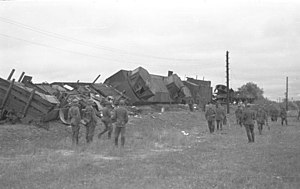 The armored train "Marshal Budyonny" defeated in a battle near the Potoki station . September 4, 1941 The armored train "Marshal Budyonny" defeated in a battle near the Potoki station . September 4, 1941 | |
| Affiliation |  the USSR the USSR |
| Subordination | to the heads of departments of armored forces of the armies of the Southwestern Front |
| Exploitation | August 1 - September 4, 1941 |
| Manufacturer | Poltava steam engine repair plant |
| Participation in | World War II |
| Technical details | |
| Power point | armored steam locomotive Oh |
| Reservation | armor sheets 30 - 50 mm |
| The number of armored cars | 2 artillery armored sites |
| Crew | 104 |
| Armament | |
| Light weapons | 12 DT machine guns |
| Artillery weapons | 4 76-mm guns Lender |
| Anti-aircraft weapons | 2 Maxim machine guns on anti-aircraft machines |
| Commanders | |
| Famous commanders | captain Yablonsky |
Built in 1941 at the Poltava Locomotive Repair Plant . From August 18 to September 4 he participated in the defense of the left bank of the Dnieper . Destroyed in battle near the Potoki station . Disbanded on September 14, 1941.
Content
- 1 Construction History
- 2 Battle Path
- 3 Memory
- 4 notes
- 5 Literature
Construction History
July 20, 1941 Poltava Locomotive Repair Plant received the assignment of command of the troops of the South-Western Front as soon as possible to build an armored train [1] . The complexity of the task was that the plant had neither technical documentation nor experience in the construction of armored trains. Two two-tower armored platforms were equipped on the basis of 60-ton gondola cars . Each platform was equipped with two 76-mm Lender guns and six DT machine guns - four on-board and two in the towers [2] An O-series steam locomotive was delivered from the Grebenka depot [1] , which was converted and reinforced (axles of wheel pairs and axle boxes were strengthened , the locomotive was sheathed with sheets of armor of 30-mm and 50-mm thickness, at the tender in the half-tower, 2 anti-aircraft guns Maxim were installed on anti-aircraft machines [3] . Four control platforms also entered the armored train . On August 1, 1941, the construction of an armored train was completed. Under the command of the senior battalion commissar P. S. Krivko, the armored train was tested and fired near the Kochubeyevka station [1] . The formation of the personnel of the armored train was led by the head of the Poltava Tractor School Colonel Sadovsky [2] . The crew consisted of 104 people, of which 50 people are workers of the Poltava Locomotive Repair Plant [1] . Captain Yablonsky was appointed commander of the armored train. On August 14, Sadovsky, by order of the school, announced the completion of the construction of the armored train, which was given the name "Marshal Budyonny" in honor of the Soviet military commander Marshal Semyon Mikhailovich Budenny [2] .
Battle Path
On August 18, 1941, the Marshal Budyonny armored train first went on a combat mission to suppress enemy air raids on the Kobelyaki - Annovka and Galeshchina - Potoki railway sections. The combat mission included the air defense of the bridge across the Psel river near the village of Potoki , as well as the protection of the Dnieper crossings in the Kremenchug region from German landing . At night, the armored train was at Galeshchina station, and during the day it patrolled the area around the bridge [4] . On the night of August 21, an armored train took aboard the commander -in- chief of the Southwestern direction, Marshal of the Soviet Union Budyonny and the commanders accompanying him, and moved through the station of Congrad to Novomoskovsk . At the station, Congrad was hit by an air raid . On the same day, during bombardments by the enemy of Novomoskovsk, an armored train participated in the withdrawal of trains from the city. Then he went to Pavlograd , where on August 23 he again received Budyonny. In the morning, an armored train arrived in Poltava , during the day patrolling the Kobelyaki-Potoki section. On the night of August 30–31, the Germans crossed the Dnieper and launched a large-scale offensive on Poltava. For three days, "Marshal Budyonny" fired artillery fire at enemy positions on the northern outskirts of the village of Potoki. On the evening of September 4, an armored train, which had previously covered anti-aircraft fire with units unloading at Annovka station, was ordered to escort a platoon of paratroopers to a bridge over the Psel river to strengthen its defense, and then take control of a section of the railway from the bridge to Potoki station and together with units 300 1st Infantry Division to defend the approaches to Poltava [4] . When approaching Potok, the armored train was fired by German artillery, as a result of which the connection of the armored platforms with the steam locomotive and the command post was disrupted. At the entrance semaphore at the station, the train ran into a German ambush - the tracks were blown up, the control platform and the first armored platform were overturned, and the locomotive and tender gave a roll to the left side. The Germans opened heavy artillery and rifle fire from the village of Podluzhdy .
The first platform tilted so that the guns could not shoot, being directed to the ground. The defense was led by the second platform of Lieutenant A. I. Kozyr. The gunner P.P. Andrushchenko in the first minutes of the battle found enemy artillery positions and directly destroyed two guns. Having concentrated fire on the second platform, the Germans made an attempt to surround the damaged armored train. The crew of the first armored platform reflected attacks with rifle fire and hand grenades. The machine gunner of the tender anti-aircraft gun V.V. Preobrazhensky also fired, despite the roll of the collapsed tender. The gunners of the second platform destroyed the German flamethrower. The battle lasted more than four hours. After the enemy set fire to the second armored area, the crew of the armored train in the cover of the night left Marshal Budenny. When the fighters retreated 500 - 600 meters, the second armored area exploded [4] (according to some sources, the armored train was blown up by the crew [1] , according to others - the explosion occurred as a result of detonation of shells of the second armored area as a result of the fire [2] ). On the morning of September 5, the crew of the armored train left for the Galeshchina station, from where it was sent to Poltava by railcar [4] . September 15, 1941 the remnants of the crew arrived in Kharkov for reformation. Thirty members of the "Marshal Budenny" team were included in the crew of the armored train " For the Motherland!" " [1] .
Memory
At the site of the mass grave of soldiers of the armored train "Marshal Budyonny" on November 4, 1956 [4] a memorial sign was installed with the inscription "Eternal memory to volunteer railway workers of the armored train" Marshal Budyonny "who died in battles for their homeland on September 4, 1941. Sergienko V.M., Chagin Ya. I., Romashov M.A., Gnipa. ?., Fly A.F. The names of the dead crew members of the armored train are listed on the marble plaques of the monument to the soldiers and workers of the PTRZ, who died on the fronts of the Civil and Great Patriotic Wars, established in 1969 on the territory of the Poltava Locomotive Repair Plant. The museum of the plant stores photographs of combatants and a model of an armored train.
Notes
- ↑ 1 2 3 4 5 6 7 Efimiev A.V., Manzhosov A.N., Sidorov P.F. Armored train "Marshal Budyonny" // Armored train in the Great Patriotic War of 1941-1945 .. - M .: Transport, 1992. - 246 p. - ISBN 5–277–01631–7.
- ↑ 1 2 3 4 Kolomiets M.V. Armored trains of the Red Army in the Great Patriotic War of 1941-1945 .. - M .: Strategy KM, 2007. - T. 2. - (Front-line illustration).
- ↑ M.V. Kolomiyets. Armored trains in the Great Patriotic War. "Land battleships" of the Red Army. - M.: Yauza, 2010. p. 117
- ↑ 1 2 3 4 5 History of factories and plants // Poltava Diesel Locomotive Repair Plant named after A. A. Zhdanov. Essays on the story. - Kharkov: Prapor, 1971. - 176 p.
Literature
- Efimiev A.V., Manzhosov A.N., Sidorov P.F. Armored train "Marshal Budyonny" // Armored trains in the Great Patriotic War of 1941-1945. - M.: Transport, 1992 .-- 246 p. - ISBN 5–277–01631–7.
- Kolomiyets M.V. Armored trains of the Red Army in the Great Patriotic War of 1941-1945. - M.: Strategy KM, 2007. - T. 2. - (Front-line illustration).
- Kolomiyets M.V. Armored trains in the Great Patriotic War. "Land battleships" of the Red Army. - M .: Yauza, 2010 .-- S. 117.
- History of factories and plants // Poltava Diesel Locomotive Repair Plant named after A. A. Zhdanov: Essays on History. - Kharkov: Prapor, 1971. - 176 p.