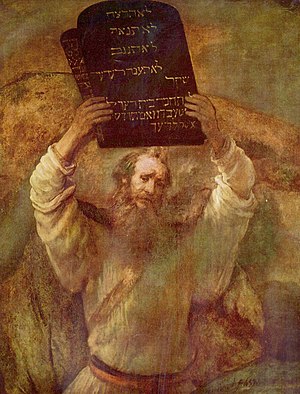
Moses breaking the tablets of the Testament ( Dutch: Mozes en de tafelen der wet ) is the work of the Dutch artist Rembrandt . The plot for the canvas is taken from the story in the Book of Exodus (Exodus 32:19). It is stored in the Berlin art gallery [1] .
| ||
| Rembrandt | ||
| Moses breaking the tablets of the Testament netder. Mozes en de tafelen der wet . 1659 | ||
| Oil on canvas . 168.5 × 136.5 cm | ||
| Berlin Picture Gallery | ||
| ( inv. ) | ||
Content
Creation History
The painting "Moses breaking the Tablets of the Covenant" was painted during the residence of Rembrandt on the outskirts of Amsterdam in the vicinity of the Jewish community. He was forced to move to this place after he sold his property and house in 1657–1658 in view of the bankruptcy, which he announced a year earlier. Together with his son and Cornelia (daughter of Hendrikje Stoffels ), he settled in a house rented for 225 florins annually on Rozengracht street. [2] The choice of a plot from the Old Testament for the painting is associated with a profound influence on the artist of the Mennonite movement, as well as Rabbi Menashe bin Israel, with whom Rembrandt was in special friendly relations. [3]
The plot of the picture
According to the Book of Exodus, Moses went to Mount Sinai to receive the commandments from God. They were recorded on two tablets of stone on both sides. In the absence of the prophet, the Israelites began to stir up unrest and demand from Aaron to show them the deity to whom they would sacrifice and pray. The latter demanded that everyone who had gold bring it, then he melted the golden calf and said that there was a deity who liberated the people of Israel from Egyptian captivity. When Moses came down from the mountain, he heard noise and singing, and when he came closer he saw a people dancing around a golden idol. Because the Israelites did not wait for him and believed in a new deity, a golden calf, the prophet in anger broke the stone tablets into many fragments. In addition, Moses burned an idol, dispelled the ashes above the water and forced everyone who doubted God to drink this water. [four]
“When he approached the camp and saw the calves and dances, then he inflamed with anger and threw the tablets from his hands and broke them under the mountain ... ( Exodus 32:19 )” [5]
Notes
- ↑ Ernst van de Wetering. -The Painter at Work. - A: Amsterdam University Press ,, 1997. - S. 209. - 340 p. - ISBN 9053562397 .
- ↑ Rembrandt's Bankruptcy: The Artist, His Patrons, and the Art Market in Seventeenth-Century Netherlands. Paul Crenshaw. - Rembrandt Harmenszoon van Rijn. - Cambridge University Press, 2006 .-- S. 79 .-- 221 p. - ISBN 9780521858250 .
- ↑ Rembrandt . Electronic Jewish Encyclopedia . eleven.co.il (2016).
- ↑ Lopukhin A.P. Explanatory Bible or commentary on all books of the Holy Scriptures of the Old and New Testaments. Exodus / Co-author - Direct Media. - M: Directmedia, 2013 .-- S. 176-178. - 200 p. - ISBN 5446006291 .
- ↑ Dmitry Shchedrovitsky. Introduction to the Old Testament. The Pentateuch of Moses. - M: Litres, 2016 .-- S. 586. - 1089 p. - ISBN 9785457546448 .