Humboldt Penguin [1] , or Humboldt Penguin [2] , or Peruvian Penguin [3] ( lat. Spheniscus humboldti ) - flightless bird from the penguin-like order.
| Humboldt Penguin | |||||||||||||||||||||||||||||||||
 | |||||||||||||||||||||||||||||||||
| Scientific classification | |||||||||||||||||||||||||||||||||
|---|---|---|---|---|---|---|---|---|---|---|---|---|---|---|---|---|---|---|---|---|---|---|---|---|---|---|---|---|---|---|---|---|---|
| |||||||||||||||||||||||||||||||||
| International scientific name | |||||||||||||||||||||||||||||||||
Spheniscus humboldti Meyen , 1834 | |||||||||||||||||||||||||||||||||
| Area | |||||||||||||||||||||||||||||||||
| |||||||||||||||||||||||||||||||||
| Security status | |||||||||||||||||||||||||||||||||


History
For the first time, a “Peruvian penguin” was mentioned by the conquistador Pedro Pizarro , who saw this in the Chincha Valley [4] .
General characteristics
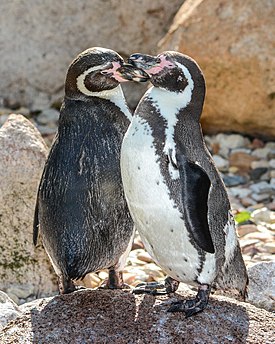
Humboldt Penguin has a black back and head, on a white belly - a black wide ring. On the sides of the head through the forehead and throat are narrow white rings, “glasses”. The beak is black with a red base, the legs are black. If there is enough food, the parents feed both chicks.
The chicks leave the colony at the age of 14 weeks, but their parents can feed them a few more weeks. After the breeding season is over, adult birds spend some time at sea, accumulating fat reserves before molting. Shedding lasts 2-3 weeks, during which the birds do not eat, being on the shore. On land, adult penguins have no natural predators; sea lions, sea leopards and killer whales prey on them at sea. In the colonies, skuas, seagulls and caracaras abduct eggs and small chicks.
Distribution
Humboldt Penguin nests on the rocky coasts of Chile and Peru from 8 ° to 34 ° S. w. [5] , where the cold Peruvian current passes, so another name is known - the Peruvian penguin. The number of the Humboldt Penguin is constantly decreasing. Changes in the system of ocean currents in the Pacific played a role in reducing the numbers of these birds.
The world population totals 12,000 pairs, of which 8,000 nest in Chile and 4,000 in Peru.
Photo Gallery
Humboldt Penguin underwater
Humboldt Swimming Penguin at Dublin Zoo
Humboldt Penguin Couple
Spheniscus humboldti Egg - Toulouse Museum
Notes
- ↑ Gladkov N.A. , Rogacheva E.V., Syroechkovsky E.E. Supervisor Floating birds (Impennes) // Animal Life. Volume 6. Birds / ed. V. D. Ilyichev, I.V. Mikheev, Ch. ed. V. E. Sokolov . - 2nd ed. - M .: Enlightenment, 1986. - S. 37, 112. - 527 p.
- ↑ Boehme R. L. , Flint V. E. The Bilingual Dictionary of Animal Names. Birds. Latin, Russian, English, German, French / Ed. ed. Acad. V. E. Sokolova . - M .: Rus. lang., "RUSSO", 1994. - S. 10. - 2030 copies. - ISBN 5-200-00643-0 .
- ↑ Kokshaysky N.V. Birds of Peru. Introduction to their study. - M .: Nauka, 1990 .-- 304 p. - ISBN 5-02-005354-6
- ↑ Pedro Pizarro. Relación del descubrimiento y conquista del Perú. - Lima: Pontificia Universidad Católica del Perú, Fondo Editorial, 1978.- P. 248 (277 p.)
- ↑ Latin America Encyclopedic Handbook, Volume 2, Soviet Encyclopedia Publishing House, Moscow, 1982, p. 355, art. Humboldt Penguin
Literature
- Beichek V., Shtasny K. Birds. Illustrated Encyclopedia. - M.: Labyrinth-Press, 2004 .-- 288 p.
- Life of animals. In 7 volumes. T.6 Birds. - M .: Education, 1986.- 527 p.