Eleanor of Scotland ( Eng. Eleanor of Scotland , German Eleonore von Schottland ; ca. 1433, Dunfermlin , Kingdom of Scotland - November 20, 1480, Innsbruck , County Tyrol ) - Princess of the House of Stuarts , nee Princess of Scotland, daughter of Jacob I , King of Scotland. The wife of the Archduke (since 1477) Sigismund ; in marriage - Countess of Tyrol and Archduke of Austria.
| Eleonora Scottish | |||||||
|---|---|---|---|---|---|---|---|
| English Eleanor of Scotland him Eleonore von schottland | |||||||
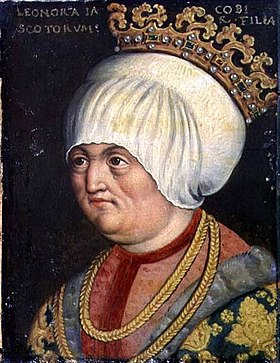 Portrait of an unknown brush | |||||||
| |||||||
| Predecessor | Anna Braunschweig | ||||||
| Successor | Catherine of Saxon | ||||||
| Birth | 1433 Dunfermline , Kingdom of Scotland | ||||||
| Death | November 20, 1480 Innsbruck , County Tyrol | ||||||
| Burial place | |||||||
| Rod | Stuart | ||||||
| Father | Jacob I , King of Scotland | ||||||
| Mother | Joan beaufort | ||||||
| Spouse | Sigismund , Count of Tyrol | ||||||
| Children | son : wolfgang | ||||||
| Religion | Catholicism | ||||||

She is credited with translating from French into German the medieval novel The .
Biography
Eleanor was born around 1433 in the city of Dunfermline. She was the daughter of James I, king of Scotland, and Joan Beaufort. [1] It is known that the early years of the princess passed in the palace of Linlithgow . In 1445, after the death of both parents, Eleanor moved with her sister Joan to the French kingdom . The princesses were taken in Tours at the court of King Charles VII . Over the next three years, they received a good education corresponding to their origin.
In 1448, Eleanor was engaged to Sigismund, Duke of Front Austria and Count of Tyrol . A proxy marriage was concluded in September of the same year in Belmont, near the city of Chinon. The young princess, having left the brilliant court of the French kingdom, set off on horseback on a long journey to the court of Tyrolean county, which, despite its provinciality, was considered one of the cultural centers of the Holy Roman Empire of the German nation. A modest wedding ceremony was held in Merano on February 12, 1449. The marriage was unsuccessful and left no offspring.
From 1455 to 1458, during the absence of a spouse, Eleanor, as regent, managed all of his possessions. During this period, she was involved in a dispute between her husband and Cardinal Nikolai Kuzansky. In 1467, during a regency in Forlander, the duchess moved her residence to Tan . Since 1469, Eleanor left state affairs, preferring the works of mercy and piety. She helped the poor and supported the church.
The archduchess shared her husband's fascination with literature, at whose court humanists Lorenz Blumenau and . In 1473, the poet dedicated to her the German translation of the Boccaccio composition On Famous Women ( lat. De Claris mulieribus ). Eleonora maintained a lively correspondence with Matilda of Palatinate and, probably, with a noble lady, from among those invited to Munich by the poet in 1467. Currently, the authenticity of correspondence with a noble lady by some researchers is being questioned.
Eleanor died on November 20, 1480 in Innsbruck. The version that she died due to childbirth of the only child conceived in this marriage is currently refuted . She was buried in the in the in the city of Stams .
Genealogy
Notes
Literature
- Bartsch K. Eleonore : [ him. ] . - München, Leipzig: Duncker und Humblot, 1877. - P. 5. - 798 p. - (Allgemeine Deutsche Biographie).
- Sudhof S. Eleonore : [ him. ] . - Berlin: Duncker und Humblot, 1959.- P. 437. - 800 p. - (Neue Deutsche Biographie). - ISBN 3-428-00185-0 .
- Wurzbach C. von. Habsburg, Eleonore von Schottland. // Biographisches Lexikon des Kaiserthums Oesterreich: [ him. ] . - Wien: Kaiserlich-königliche Hof- und Staatsdruckerei, 1860. - P. 160. - 492 p.