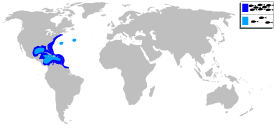
The North American deepwater hake lives in the western Atlantic Ocean from Nova Scotia and along the coast of the USA , in the Gulf of Mexico , with the exception of the northwestern coast of Cuba , in the Caribbean Sea from Puerto Rico and along the coast of Central and South America from Mexico to French Guiana [ 4] . Partially shares the area with North American hake . It is found on the outer crane of the continental shelf and in the upper part of the continental slope at a depth of 80–1170 m, the most common in the range 160–640 m [3] . Since this species of hake is caught both day and night, it has been suggested that it does not perform diurnal vertical migrations characteristic of other representatives of the genus. At a depth of over 550 m, segregation by size and gender is observed, only adult females are found here [5] .
The body is chased, moderately compressed laterally. The head is large, flattened from above, its length is 26.8–31.7% of the body length. The mouth is finite, the jaws are large. The lower jaw is slightly longer than the upper; the antenna on the chin is absent. The snout is elongated; its length is 31.0–37.2% of the length of the head. Scales on the nasal membrane are absent in most individuals. The interorbital space is extensive, slightly elevated, its width is 20.8-26.5%, and the diameter of large eyes is 17.1-27.7% of the length of the head [5] . There are opener teeth. The first full ray of the dorsal fin is flexible and resilient. The caudal fin is isolated from the dorsal and anal fin, the second dorsal and anal fins are approximately the same height. The transverse processes of the vertebrae in the hatch are widened and flattened [4] . Gill stamens well developed, thick, short, with blunt tips. On the first branchial arch, there are 8–11 branchial stamens [5] .
Two separate dorsal fins, the first - short, high, triangular in shape. The second dorsal fin is elongated and partially divided by a shallow recess located 1/3 of the end of the fin. The anal fin is similar to the second dorsal fin. The pectoral fins are long, slender and high, reaching to the beginning of the anal fin. The lateral line is almost straight, raised in the front part, consists of 104–119 scales. The teeth on both jaws are well developed, large and sharp, arranged in two uneven rows. External teeth are small and fixed. There are no palatine teeth. The caudal fin is smaller than the head; the fork increases with age. The dorsal surface of the body and head, with the exception of the anterior tip of the snout, is covered with fine and thin cycloid scales [5] . In the first dorsal fin there are 11–13 rays, in the second dorsal fin 35–40, in the anal 35–41, in the pectoral fins 12–16. The length of the pectoral fins is 16.9–22.3%, and the ventral fins are 13.8–20.6% of the body length. The ventral fins are located slightly in front of the pectoral fins. The posterior margin of the caudal fin is truncated in young individuals, and slightly concave in adults. The number of vertebrae is 51–55. The color of the caught fish is pale yellow [5] .
The maximum recorded length is 70 cm. The average length of males and females does not exceed 30 cm and 45 cm [3] .