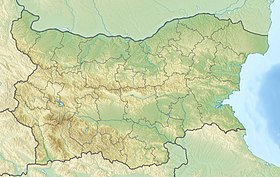
“Driven stones” ( Bulgarian: Beat the stones , “Beat the stones”, “Stone forest”, “Diliktash” - from the tour. Dikili taş - the driven stone) - rock formations in Bulgaria , located 18 km from Varna on both sides of the road Varna - Sofia near the villages of Slynchevo , Banovo and Strasimirovo and the city of Devnya . Distributed into large and small groups on an area of 7 km² [ specify ] .
| Driven stones | |
|---|---|
| bulg. Beat the stones | |
 | |
| IUCN Category VI (Sustainable Management Area) | |
| basic information | |
| Square | 2.53 km² |
| Established | 1937 year |
| Location | |
| A country |
|
| Region | Varna region |
| Nearest town | Devnya |



They are stone columns with a height of 5 to 7 m (some up to 10 m), a thickness of 0.3 to 3 m of different sections. The columns are not solid, hollow and filled with sand.
There are several hypotheses of their origin, which can be combined into two main groups - organic and inorganic origin. The first of them explains the appearance of columns by the accumulation of coral and algae; according to the second, their prismatic form is the result of weathering of rocks, like the “ Bridge of Giants ” in Northern Ireland, or the formation of sand-limestone nodules. In order to preserve the unique object, in 1937 the rocks were declared a natural monument .
Gallery
Literature
- Yudovich Ya. E., Vetoshkina O.S., Ketris M.P. Bulgarian geological phenomenon // Bulletin of the Institute of Geology, Komi Scientific Center, Ural Branch of the Russian Academy of Sciences. - 2009. - Issue. 2 . - S. 12-15 .
- Dinev L., Mishev K. Bulgaria: a brief geography . - M .: Publishing house "Thought", 1973. - S. 360. - 368 p.
- Bankovsky L., Bankovsky V. What is “Broken Stones”? // Chemistry and life: journal. - M. , 1972. - No. 6 . - S. 76-79 .
- Dimitrov, Lyubomir Pobiti Kamani (Bulgarian) (link not available) . Varna-bg.com. Date of treatment August 2, 2006. Archived on May 17, 2007.
- de Boever E., Birgel D., Thiel V., Muchez P., Peckmann J., Dimitrov L., Swennen R. 2009. The formation of giant tubular concretions triggered by anaerobic oxidation of methane as revealed by archaeal molecular fossils (Lower Eocene, Varna, Bulgaria. Palaeogeography, Palaeoclimatology, Palaeoecology 280, 23-36.
- Moscow State University M.V. Lomonosov. Bulletin of Moscow University: Geography, Volume 21 // Publishing House of Moscow University: journal. - M. , 1966. - No. 21 . - S. 71 .