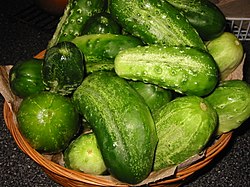
Fermentation [1] ( fermentation, fermentation, preservation [2] ) - harvesting vegetables for future use [3] , a method of preserving vegetables by lactic acid fermentation , during which lactic acid is formed, which has a preservative effect on products (along with added common salt ). Essentially pickled vegetables are so-called salted vegetables ( cucumbers , tomatoes , beets and others). Peoples of the Pechora and Perm Territories of Russia fermented fish [4] .
Content
History
Souring is the most ancient way of preserving vegetable products for preparing seasonal stocks (mainly for the winter), which was most often used in the 19th century, since then the diet of the bulk of the population consisted mainly of plants cultivated by them [5] .
In the past, in Eastern Europe, cucumbers and sauerkraut were fermented without using salt , but later cucumbers were stored by pouring them with a solution of salt. Later, salt was also used for sauerkraut.
Principle
Fermentation, salting and urination are classified as biochemical methods of conservation. This method is based on the formation of a natural preservative in the process of lactic acid fermentation - lactic acid, which accumulates as a result of lactic acid fermentation. The mechanism is the conversion of carbohydrates during fermentation to lactic acid under the influence of lactic acid bacteria. Lactic acid gives the product a specific taste and smell, and also prevents the reproduction of extraneous microflora [6] .
Vegetables are fermented in brine (in whole or in pieces) or in their own juice (for this, they are chopped, chopped on machines, chopped with slices), salt is added, under the action of microbes ( lactic acid bacteria ), the process of fermentation (fermentation) is underway [3] . Salt is not a necessary component, but it affects the taste and delays the development of pathogenicity. Salt for brine is usually taken in the amount of 5% of the amount of water. Salt for fermentation in own juice is usually taken in the amount of 1.5-2% of the weight of vegetables.
Depending on the temperature, the amount of salt and the desired result, the fermentation can take place from several days to several months or even years.
Varieties
In South India, pickled products are called “achar” or “achard”: this term is used throughout the Indian subcontinent , up to Nepal in the north, as well as in Malaysia [7] . The etymology of this word is unambiguously unclear; Persian, Arabic, native languages of America, as well as Latin are called as a source [7] . The most popular type of achar is pickled mango , it is canned with mustard , garlic , salt and vinegar , and salty cashews are also known [7] .
Storage
Sour foods are stored at temperatures from 0 to 2 ° C. They store fermented, salted, soaked fruits and vegetables in the same container as they are fermented. For this, glaciers, warehouses, trenches with ice, cellars and ponds are used [6] . For storage of root crops and vegetables, a structure deepened into the ground, a cellar, was used [8] .
Biochemistry
In the process of pickling with the help of lactic acid fermentation, the colloids of the cell tissue under the action of salt and acid partially break down or irreversibly coagulate, greatly swelling. This leads to the loss of vital functions by the cell; as a result, all biochemical processes of a hydrolytic and oxidative nature inherent in living tissue are stopped in it. Under the influence of salt and acid, the vital activity of most microorganisms (putrefactive bacteria and molds) stops or slows down, the action of which under normal conditions leads to the destruction of vegetables.
Vegetables are salted and fermented, using mainly spontaneous fermentation , in which all the epiphytic microflora of vegetables is involved. Therefore, fermentation involves not only lactic acid bacteria , but also yeast , butyric acid and acetic acid bacteria . The lactic acid bacteria involved in the process differ in the amount of acid produced per unit time and the development conditions. Some of them emit gases , others turn sugar into lactic acid without emitting gases; some bacteria produce aromatic substances - esters . In cucumbers, a long B. abderhaldi stick is sometimes found, which causes the brine to become mucilaginous, making it viscous.
Notes
- ↑ Souring Large explanatory dictionary of the Russian language. - 1st ed.: St. Petersburg: Norint, S. A. Kuznetsov. 1998
- ↑ Souring Dictionary of Russian synonyms
- ↑ 1 2 Souring Agricultural Directory Dictionary
- ↑ Pokhlebkin V.V. National cuisines of our peoples (The main culinary trends, their history and features. Recipe). - M .: Food industry, 1980. - 304 p.
- ↑ Podobod A.O. Istoriya of Ukraine. 9th class: Rozrobki lesson. - X .: “Ranok”, 2010. - 320 p. ISBN 978-966-672-999-9 (page: 104) (Ukrainian)
- ↑ 1 2 Sour, salted, soaked fruits and vegetables
- ↑ 1 2 3 The Oxford Companion to Food / Alan Davidson, Tom Jaine. - Oxford University Press , 2014 .-- S. 196. - ISBN 978-0-19-104072-6 .
- ↑ Borisenko V.K. Ukrainian ethnology. - Libid, 2007—398 st. (page 143) (Ukrainian)
Literature
- Souring Great Soviet Encyclopedia . - M .: Soviet Encyclopedia 1969-1978