Averostra ( lat. , Literally - a bird's snout) - a treasure that includes most theropods , which have a pro-maxillary fenestra ( fenestra promaxillaris ), an additional hole in the front external side of the upper jaw . Two groups of Averostra: Ceratosauria and Orionides - lived in the Cretaceous period . By the beginning of the Cretaceous – Paleogene extinction , Ceratosauria and two groups of Orionides, Tyrannosauroidea and Maniraptoriformes , continued to exist, and only one subgroup of Maniraptoriformes, birds , survived extinction and survived to this day.
| † Averostra |
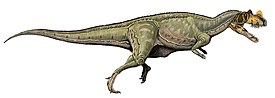
Ceratosaurus nasicornis |
| Scientific classification |
|---|
| No rank : | Bilateral symmetrical |
| Infraclass : | Archosauromorphs |
| No rank : | Archosauriformes |
|
| International scientific name |
|---|
Averostra Paul , 2002 |
Geochronology201—0 Ma | million years | Period | Era | Aeon |
|---|
| 2,588 | Even | | | Ka | F
but
n
e
R
about
s
about
th | | 23.03 | Neogene | | 66.0 | Paleogen | | 145.5 | a piece of chalk | M
e
s
about
s
about
th | | 199.6 | Yura | | 251 | Triassic | | 299 | Permian | P
but
l
e
about
s
about
th | | 359.2 | Carbon | | 416 | Devonian | | 443.7 | Silur | | 488.3 | Ordovician | | 542 | Cambrian | | 4570 | Precambrian |
◄ Nowadays◄ Cretaceous-Paleogene extinction◄ Triassic extinction◄ Mass Permian Extinction◄ Devonian extinction◄ Ordovician-Silurian extinction◄ Cambrian explosion |
|---|
|
The Averostra group was named by paleontologist Gregory Paul in 2002 as an apomorphic clade including Dromaeosauridae and Avepoda (now Neotheropoda ) with pro-maxillary fenestra [1] . The group was later redefined by Martin Eskurra and Gilles Cooney in 2007 as a nodal clade containing Ceratosaurus nasicornis , Allosaurus fragilis , their closest common ancestor, and all his descendants [2] .
