African river swallow [1] ( lat. Pseudochelidon eurystomina ) is one of two species of river swallows of the swallow family , the order Passeriformes . Initially, it was not assigned to the swallows, but then, given the powerful beak and strong legs, it was taken out into a separate subfamily along with the Asian white-eyed forest swallow .
| African River Swallow |
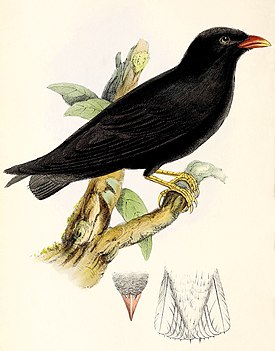
African River Swallow (Illustration from 1861 Ibis Magazine) |
| Scientific classification |
|---|
| No rank : | Bilateral symmetrical |
| Infrastructure : | Passerida |
| Subfamily : | Pseudochelidoninae |
| View: | African River Swallow |
|
| International scientific name |
|---|
Pseudochelidon eurystomina
Hartlaub , 1861 |
| Security status |
|---|
Not enough data IUCN Data Deficient : 22712036 |
|
Content
Quite large swallows are 14 cm long, mostly black, with a blue-green sheen on the head and a green tint on the back and wings. The inner side of the wings is brownish, the lower part of the body is purple-black, and the fly feathers are black, the eyes are red, the beak is orange-red, the tail is rectangular and black, 4.8 cm [2] in length. The average length of the wings is 14 cm [2] . Young birds are similar in appearance to adults, except for plumage, which has a more brownish tint. This species has an arsenal of non-musical sound signals, which demonstrates both on the ground and in flight, although the purpose of the ground signals is not yet known.
The main breeding area covers the territory of the Democratic Republic of the Congo along the Congo River and its tributary, Ubanga , in an area characterized by a mixture of different types of tropical forests, including marshy and seasonally flooded areas. African river swallows are migratory birds wintering in coastal savannahs in southern Gabon and the Republic of Congo . Reproduction also occurs in these coastal areas, but it is not known whether the brood of the same or a separate population living here permanently.
African river swallows feed in packs, catching in flight various insects, especially flying ants . In the breeding season, they do not perch, although they often land on the ground.
African river swallows nest in burrows on the sandy banks of the rivers, often with pink bee-eater , however, the duration of hatching and plumage is unknown. They also dig tunnels at night during wintering. They are found quite often in their limited region, despite the fact that they are caught in large quantities by local residents. Sometimes you can meet large flocks. However, due to the lack of data on breeding regions and population sizes, the International Union for Conservation of Nature does not indicate the conservation status of this species.
The generic name Pseudochelidon comes from the ancient Greek prefix ψευδο ( pseudo ) - a lie, and the words χελιδον ( chelidôn ) - a swallow [3] . The species name reflects the outward resemblance to the syrups from the genus Eurystomus [4] .
When the German zoologist Gustav Hartlaub first described the African river swallow in 1861, he attributed this species not to the swallow, but to the blue- swallow [5] . Later authors either placed it in their own monotypic family, or in the art . A study of the anatomy of this swallow, conducted by Percy Low in 1938, showed that the species is closest to the swallows, but distinct enough to carry it to a separate subfamily, Pseudochelidoninae [2] [6] .
Another species of the subfamily, the white-eyed river swallow Pseudochelidon sirintarae , known only in one place in Thailand , is probably extinct. These two species have a number of features that distinguish them from other swallows, including strong legs, a powerful beak, a large syrinx (vocal organ of birds) and an excellent bronchial structure [2] . Genetic studies have confirmed that the white-eyed and African river swallows form a treasure separate from ordinary swallows from the subfamily Hirundininae [7] .
Two species of river swallows in a sense occupy an intermediate position between typical swallows and other passerines [8] and their leg muscles are arranged more like a typical representative of passerines than like a typical swallow [9] . The degree of differences suggests that river swallows are relict populations of a group of species that separated from the main branch in the early period of their evolutionary history [2] . Like other early swallow, these swallows nest in self-dug burrows [10] . Their physical characteristics and mating behavior indicate that they were the most primitive of the swallow [8] .
- ↑ Boehme R. L. , Flint V. E. The Bilingual Dictionary of Animal Names. Birds. Latin, Russian, English, German, French / Ed. ed. Acad. V. E. Sokolova . - M .: Rus. lang., RUSSO, 1994. - 845 p. - 2030 copies. - ISBN 5-200-00643-0 .
- ↑ 1 2 3 4 5 Turner & Rose. . - 1989. - S. 85-86.
- ↑ uk.rec.birdwatching - Scientific bird names explained (neopr.) . sbpoley.home.xs4all.nl. Date of treatment July 29, 2016.
- ↑ G. Hartlaub. XXXV. — On a New Bird from Western Africa (English) // Ibis. - 1861. - October ( vol. 3 , iss. 4 ). - P. 321—328 . - ISSN 1474-919X . - DOI : 10.1111 / j.1474-919X.1861.tb08850.x .
- ↑ Dr G. Hartlaub. Ueber einige neue Vögel Westafrica's (German) // Journal für Ornithologie. - 1861. - Januar ( Bd. 9 , H. 1 ). - S. 11-13 . - ISSN 0021-8375 . - DOI : 10.1007 / BF02002444 .
- ↑ Percy R. Lowe. Some Anatomical Notes on the Genus Pseudochelidon Hartlaub with reference to its Taxonomic Position (English) // Ibis. - 1938. - July ( vol. 80 , iss. 3 ). - P. 429-437 . - ISSN 1474-919X . - DOI : 10.1111 / j.1474-919X.1938.tb00576.x .
- ↑ Frederick H. Sheldon, Linda A. Whittingham, Robert G. Moyle, Beth Slikas, David W. Winkler. Phylogeny of swallows (Aves: Hirundinidae) estimated from nuclear and mitochondrial DNA sequences (Eng.) // Molecular Phylogenetics and Evolution. - 2005 .-- April ( vol. 35 , iss. 1 ). - P. 254-270 . - DOI : 10.1016 / j.ympev.2004.11.008 .
- ↑ 1 2 Olson, SL A classification of the Rallidae. - 1973. - S. 381-416.
- ↑ Abbot S. Gaunt. Myology of the Leg in Swallows // The Auk. - 1969. - January ( vol. 86 , iss. 1 ). - P. 41-53 . - DOI : 10.2307 / 4083540 .
- ↑ DW Winkler, FH Sheldon. Evolution of nest construction in swallows (Hirundinidae): a molecular phylogenetic perspective (English) // Proceedings of the National Academy of Sciences. - 1993 .-- 15 June ( vol. 90 , iss. 12 ). - P. 5705-5707 . - ISSN 0027-8424 . - DOI : 10.1073 / pnas.90.12.5705 .
