Bernstorff Palace ( dated. Bernstorff Slot ) is a palace located in the Danish commune of Gentofte . It was built in the middle of the 18th century for the Minister of Foreign Affairs of the Kingdom of Denmark, Count Johan Bernstorf , after whom he received its name. The building was owned by the Bernstorf family until 1812. In 1842, it was bought by the Danish king Christian VIII . Here lived the first Danish monarch from the Glucksburg dynasty Christian IX along with his family until his death in 1906. Afterwards, the palace was used by the Danish Emergency Services. Now it is used as a hotel, as well as for various conferences.
| Palace | |
| Bernstorf | |
|---|---|
| dates Bernstorff slot | |
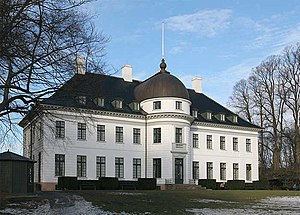 Bernstorf Palace | |
| A country |  Denmark Denmark |
| Commune | |
| Architectural style | Neoclassicism |
| Architect | |
| Founder | Count Ernst Johan Hartwig Bernstorf |
| Founding date | 1759 |
| Building | 1759 - 1765 years |
| Site | Johan Hartwig Ernst |
History

The building was designed by French architect Nicolas Henri Jardin, who came to Denmark to complete the construction of Frederick’s church in Copenhagen after the death of its creator, Nikolai Aitved in 1754. The palace is one of the earliest examples of neoclassical architecture in Denmark. The two-story building was completed in May 1756. September 13, 1770 Bernstorf was dismissed as a result of intrigues Johan Struane . He left with his nephew Andreas Peter to Paris. In 1772, the first owner of the palace passed away. The building passed to his nephew, where he lived every summer until his own death in 1797 and the palace was inherited by his two sons [1] .
In 1812, the Bernstorf family sold the palace. It was purchased by Scottish entrepreneur Christopher McEvoy. After his death in 1839, the building was bought by the military judge Peter Kalko, who, because of the awful state of the palace at that time, intended to demolish it. Due to public discontent in the press, the palace was not demolished and later purchased by King Christian VIII [1] .
In 1854, the palace was handed over to the use of Prince Christian Glucksburg, who was the heir of the childless King Frederick VIII. Here the future king lived with his family, even after accession to the throne in 1863. The Russian Emperor Alexander III and the English King Edward VII, who were married to the daughters of King Christian IX, lived in the palace. In 1888, at the International Scandinavian Exhibition, the wife of the King, Louise of Hesse-Kassel, bought the nearby villas, where numerous relatives and friends of the royal couple stayed. After the death of King Christian in 1906, the palace was taken over by his younger son Valdemar , who lived there with his family until his death in 1939 [1] .
Palace Garden
A large landscape park was laid out around the former royal palace. The park zone includes a forest, lawns, a rose garden, an orchard and a tea house. Apricots, peaches, grapes, apples, pears, cherries and plums grow in the garden of the palace. Rare varieties of cucumbers, artichokes, lettuce and melons were brought here from France and the Netherlands. Many rare trees and shrubs were planted, including chestnuts , acacias, holliest , tulip trees , plane trees and other plants. Many of the plants that were planted in the park were first brought to Denmark. The royal gardens of the time of King Christian IX were handled by the Danish landscape architect . In 1888, a Swedish-style villa was built in the garden, which now hosts events and conferences [1] .
Notes
- ↑ 1 2 3 4 Bernsdorf Slot (English) . - The history of the palace of Bernstorf on the official website. The appeal date is July 31, 2016.
Links
- Bernstorff Slot (Danish) (inaccessible link) . The appeal date is July 25, 2016. Archived October 6, 2016.