Apollo Actius [1] ( Parnassius actius ) is a diurnal butterfly of the Sailfish family ( Papilionidae ).
| Apollo Actius |
 |
| Scientific classification |
|---|
| No rank : | Bilateral symmetric |
| Hoard : | Insects with full transformation |
| Nadotryad : | Amphiesmenoptera |
| Infrastructure : | Butterflies |
|
| International Scientific Name |
|---|
Parnassius actius Eversmann , 1843 |
|
Content
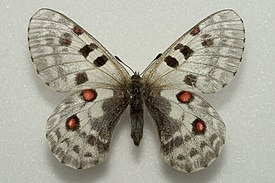
Fore wing length 30–35 mm. White wings lightly pollinated with dark scales. The outer border is translucent, in males it is narrow, and in females it is usually wide. Between it and the middle cell there is a transverse narrow sling, delighted with blackish, medium-sized spots merging with each other. Between it and the end of the middle cell there are two small red spots with a black ring. In the center and at the end of the middle cell is located on a large black spot, also the oval black spot is located at the inner edge, near its middle. The back wing has dark darkings at the ends of the veins, which in females can merge into the outer margins. On a white background, further parallel to the outer edge is a transverse row of medium-sized, sometimes very weak, blackish spots. Also at the front edge are quite large red spots [1] .
Turkmenistan , Uzbekistan , Tajikistan , Kyrgyzstan , northeastern Afghanistan , the Indus Valley ( Pakistan ), India ( Jammu and Kashmir) and Southwestern China , including Xinjiang [1] .
Occurs in alpine meadows, along the valleys of mountain rivers, adjacent to the outcrops of rocks and rocky slopes. In the Pamirs it is found exclusively on rocky outcrops and scree [1] .
Develops in one generation. Flight time is in July - early August [1] . Butterflies are more active only in sunny weather. Females often sit in the grass, and being frightened - sharply take off and fly over distances up to 100 meters. Butterflies fly slowly, often planning, sitting down on various flowering plants. Visited large flowers of plants. Caterpillars feed on the crested.
- ↑ 1 2 3 4 5 USSR Red Book : Rare and endangered species of animals and plants. Volume 1 / Home ed. Collegium: A. M. Borodin, A. G. Bannikov , V. E. Sokolov, and others. - 2nd ed. - M .: Forest industry, 1984. - 392 p.
