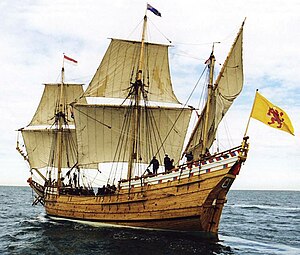
"Deufken" ( Dutch. De Duyfken ) - Dutch three-masted barque, from the time of the Republic of the United Provinces . Built by order of the Dutch East India Company and launched in 1595. In 1608, it was recognized that it could not be repaired. It was on this barque that the Dutch captain Willem Janszon became the first European to reach the shores of the Australian continent. [1] Although the images of Deufken were not preserved and the details of its appearance are unknown, the Australians built a sailboat in 1999, which they pretend to be an exact copy of Deufken.
| Leufken | |
|---|---|
| niderl. De duyfken | |
 | |
| Service | |
 Dutch East India Company Dutch East India Company | |
| Class and type of vessel | Barque |
| Organization |  Dutch East India Company Dutch East India Company |
| Launched | 1595 |
| Commissioned | 1595 |
| Main characteristics | |
| Displacement | 110 tons |
| Upper Deck Length | 19.9 m |
| Draft | 2.4 m |
| Speed | 4 knots |
| Crew | 15 people |
| Armament | |
| Total number of guns | 8 guns |
History
Build
The three-masted barque "Döfken" ( Dutch. De Duyfken ) was built in 1595 and replenished the fleet of the Dutch East India Company. The vessel was relatively small in size: 20 meters long, 6 meters wide and with a draft of 2.4 meters at a speed of 4 knots. The vessel was of the type - bark, with three masts and eight guns in service. Intended for the transport of small goods and a team of fifteen people. Made in the traditional Dutch technology for building ships, the essence of which was a special technique for processing boards and the method of fastening them (“plank-first”). Like all Dutch ships of that time, it had a relatively small draft for its size, which gave an advantage when sailing in shallow water, a gain in speed and allowed to serve with a smaller crew. [2]
Participation
- Flight of Admiral Wolfert Hermanszon ( Dutch: Wolfert Hermansz ) 1601-1603. [3] Bark Deufken, under the command of Willem Schouten ( Dutch: William Cornelison Schouten ), as part of the Dutch fleet, participated in the breakthrough of the Portuguese blockade of Bantam - the trading city of the Dutch-East Indian Company. [four]
- In 1603, the Deufken bark under the command of Willem Janszoon ( Dutch Willem Janszoon ) was a escort squad ship of twelve vessels en route from the Republic of the United Provinces to Banatam. Near the Strait of Mozambique , two Portuguese ships were captured. [2]
- In 1605, the Dutch East India Company reappointed Willem Janszon as captain of Barque Deufken and sent him in search of new markets for trade and discovery of unknown lands and islands near New Guinea. [five]
Shipwreck
In June 1608, the barge Deufken, as part of an escort squadron, set off to capture the Taffaso fortress on Makian Island, in modern Indonesia. After a battle lasting about five hours, with three Spanish ships, the bark Deufken received significant damage and, together with other vessels, leaves the battle. After that, the bark reached the island of Ternate , part of which was controlled by the Dutch East India Company. Despite all the attempts and efforts made, the bark Deufken was recognized as incapable of further swimming and was abandoned. [6]
Replica
The idea of building a replica of the famous barracks “Deifken” arose in 1993. The author and organizer of the fundraising project and the implementation of the project was Michael J. Kailis . Along with him, historian Michael Young and Charlie Welker, Chairperson of the Deufken Foundation, launched a fundraising campaign. About $ 3.7 million dollars were raised, due to which the construction became possible and was completed in 2000. Observing historical authenticity, for construction there was an order of oak wood from Latvia, the ends and sails of flax and hemp. It is noteworthy that the plank-first ship construction technology was identical to the one on which the original Deufken barge was built in 1595. Its essence was that the vessel was built without a set of frames that determine the future shape of the vessel. For its formation, external cladding from boards subjected to heat treatment is used, which are later strengthened from the inside with a transverse set. [7] [8]
The Deufken replica hull was launched on January 24, 1999 in Fremantle , Western Australia, and on July 10, 1999 the ship was ready for sailing. Until the beginning of 2000, the bark was preparing for the first expedition, and a crew was selected to manage the sailing ship. On the first voyage, on April 8, 2000, the Deufken barque was commanded by Captain Harry Wilson and eighteen sailors from Western Australia , South Australia and New South Wales , as well as two historians, a marine biologist, two artists, Indonesian and Dutch translators and film crew from Sydney. The route ran to Indonesia and Papua New Guinea and back to Australia. [9]
Notes
- ↑ Lincoln P. Paine. Ships of Discovery and Exploration. - Houghton Mifflin Harcourt, 2000 .-- S. 47. - 2008 p. - ISBN 0547561636 .
- ↑ 1 2 The Duyfken . South Land to New Holland - The Duyfken . National library of Australia. Archived on September 14, 2006.
- ↑ bezorgd door Perry Morree. Dodo's en galjoenen: De reis van het schip Gelderland naar Oost-Indië, 1601-1603. - Uitgeversmaatschappij Walburg Pers, 2001 .-- S. 18. - 352 p. - ISBN 9057301717 .
- ↑ Robert Parthesius. Dutch Ships in Tropical Waters: The Development of the Dutch East India Company (VOC) Shipping Network in Asia 1595-1660. - Amsterdam University Press, 2010 .-- S. 79 .-- 217 p. - ISBN 9053565175 .
- ↑ James Jupp. The Australian People: An Encyclopedia of the Nation, Its People and Their Origins. - Cambridge University Press, 2001 .-- S. 256. - 940 p. - ISBN 0521807891 .
- ↑ Jan Lettens. Duyfken (I) (+1608) . The Wrecksite . wrecksite.eu (04/03/2010).
- ↑ Nick Burningham. The Deyfken - an experiment in marine archeology . Australian Broadcasting Corporation (1999).
- ↑ John L. Coombes. Tall Ships: The Sixteen Square Riggers of Australia and New Zealand. - Exisle Publishing, 2015 .-- S. 19-23. - 128 p. - ISBN 0908988842 .
- ↑ Fugro sponsors 'Het Duyfken' . Annual Report 2000 . FUGRO NV (2001).
Literature
Robert Garvey. National Geographic "De bouw van een schip: de VOC-replica Duyfken". 2002. - Vipmedia Publishing & Services 2002, - P. 104 - ISBN 9789076963266