Château de Chenonceau ( Château de Chenonceau ) is located near the small village of the same name Chenonceau in the French department of Indre and Loire . Included in the number of castles, commonly called castles of the Loire . It has a "folk" name - "ladies' castle". One of the most beloved, famous and visited castles in France . It is privately owned but open to the public.
| Castle | |
| Chenonceau | |
|---|---|
| Chenonceau | |
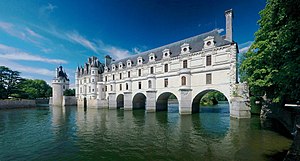 View of the castle from the Cher river | |
| A country |  France France |
| The Department | Indre and Loire |
| Architect | and |
| Established | |
| Building | XV century |
| condition | historical monument ( 1840 ) |
| Site | chenonceau.com |

Content
 History of the creation and reconstruction of the castle

The estate, where the castle of Chenonceau rises today, belonged to the de Marc family, descendants from Auvergne since 1243 . Their property was also an ancient fortress located here, surrounded by water ditches and connected to the bank of the Cher River by a drawbridge. Near the fortress stood a mill .
During the reign of Charles VI, Jean de Marc placed an English garrison in his fortress, which prompted the king to order to tear down all defensive fortifications and secure the land for their rightful owners. Money difficulties forced the family to sell their inheritance to Thomas Boye, the financial quartermaster in Normandy . In 1512, he also bought a fortress . Fallen in love with the Renaissance style , Boyer decided to destroy the old castle, with the exception of the donjon , in order to erect a new structure.
A rectangular structure was erected on the ruins of the mill with protruding corner towers surrounding the lobby with lancet arches on four sides. On the ground floor were four rooms connected to four other rooms on the second floor by a wide straight staircase . At the beginning of the XVI century , a gradual abandonment of spiral staircases began, which began to be replaced by stairs with direct flights. The huge costs of construction work explain the motto that the Boye family ordered to engrave along with their initials, T. V. K.: "Who ever comes here, let him remember me."
Construction work, which was carried out in the absence of her husband, Catherine Bonet, wife of Thomas, was completed in 1521 , after which Cardinal Bonet, Bishop of Bourges , consecrated the chapel of the castle [1] . In 1524, Thomas Boyer died in Italy , where he went in the retinue of the king, his wife passed away two years later. After the transfer of ownership to the hands of their son Antoine, the castle was confiscated by Francis I under the pretext of compensation for a number of violations in financial matters for which Thomas was responsible. According to some sources, the expropriation of 1533 was dictated by the king’s desire to have a beautiful estate famous for its hunting grounds. Francis I sometimes visited Chenonceau accompanied by a small circle of close associates: Eleanor of Habsburg , his second wife, his son Henry , his daughter-in-law Catherine de Medicis , her favorite Anna de Pisletos , the Duchess d'Etamps and Diana de Saint-Valle-de-Poitiers , the favorites of his son . The castle arranged hunting trips, holidays, literary evenings in the fashion of that time. Diana always had a great influence on the Dauphin Heinrich, who, becoming king in 1547 , despite his marriage to Catherine de Medici, did not stop showering Diana with all kinds of gifts, although he was 19 years younger than her. Soon, the castle of Chenonceau became the property of Diana, contrary to all laws prohibiting the alienation of possessions belonging to the king. Diana de Poitiers in 1551 began work on improving the property, including redevelopment of the park and orchard, which grew vegetables and fruits, which were considered exotic at that time, such as artichokes and melons . She forced to measure the depth of the Cher River in order to build a stone bridge , which was carried out according to the project of F. Delorme .
In 1559, Henry II died of a mortal wound inflicted on him at the tournament by the spear of Count Montgomery . The Queen , becoming regent , hastened to return the castle of Chenonceau. Diana realized that it was better to give in, and retired, and soon died at the age of 66.
Returning to Chenonceau, Catherine de Medici organized magnificent festivities in honor of her son Francis II and his wife Maria Stewart . The architect Primaticcio designed the estate with extraordinary splendor: columns, statues, fountains , triumphal arches, obelisks . A battery of 30 guns saluted in the courtyard. New gardens were built and new office buildings built. These works were completed in 1568 at the time of the signing of the Amboise Peace .
Another commemorative celebration took place in Chenonceau in 1577 , timed to coincide with the return of Henry III from Poland to confirm the right of inheritance for his brother Charles IX . Here, the idea of a holiday that took place in Plessis-les-Tours was renewed, when women dressed in men's suits, and men in women's.
In 1580, the architect Andrue Ducerso realized the vision of Philibert Delorme , building a new wing on the bridge over the Cher River. This two-story structure consisted of two long facades , cut through rhythmically alternating windows, risalits , lucarnes . The upper floor, equipped as a ballroom, was richly decorated , like the rest of the castle. Luxurious holidays ended with the death of Catherine in 1589 . In her will, she passed the castle of Chenonceau to Louise de Vaudemont , the wife of Henry III . A few months later in the same year, in August 1589 , the king was mortally wounded by Jacques Clement . Before his death, he dictated a letter to his wife, in which he said: "My darling, I hope that I will recover soon, ask the Lord for me and do not leave where you are." Perhaps these words caused the queen to remain in Chenonceau until her death. All the festivities ceased, the furniture and the walls of her bedroom (still exists today) were covered in black draperies as a sign of mourning.
According to the royal custom, which existed from the time of antiquity , she wore white mourning , which she did not take off until 1601 , the year of her death, whence her name “White Lady” arose. The castle was inherited by Francoise de Merker , wife of Cesar of Vendome . From this moment on, the kings of France left Chenonceau. The last to live was Louis XIV in 1650 at the age of 12. The state of abandonment in which the Dukes of Vendome and Bourbon Conde left the castle was interrupted with the conversion of one of its wings to the Capuchin monastery . A drawbridge remained from this era, which served to isolate the monks from the outside world.
In 1733, the Duke of Bourbon sold the castle to the wealthy landowner-banker Claude Dupin. His wife, a fan of art, science, literature and theater, opened a fashion salon in Chenonceau, which glimpsed the names of many celebrities of that era. Louise Dupin set up a small theater with performances and equipped a physical room. The rooms of the old apartments were newly furnished and became more comfortable.
Madame Dupin spent her last years in a castle surrounded by her village servants, who loved her very much. Thanks to this, Chenonceau did not receive any damage during the revolution .
Madame Dupin died in 1799 at the age of 93 and was buried in the park. The empty castle was sold in 1864 to Madame Pelouze (née Wilson), who undertook major restoration work, intending to restore the castle to its original appearance (before the transformation of Catherine de Medici). Thus, the facade lost its windows and caryatids , but the wing on the bridge over Cher was not touched. After the Peluse family went bankrupt, the castle was confiscated in 1888 and sold to Henri Emile Anatole Menier, one of the wealthy industrialists of the time. The castle is still the property of this family. In 1914, Gaston Meunier , then the Senator of the Department of the Seine and Marne , converted the castle into a hospital , where he placed more than 2,000 wounded until the end of World War I. During World War II, there was a liaison point for local partisans, since one part of it went into the zone occupied by the Nazis , and the second into the territory of the Vichy regime.
Castle and surroundings tour
Today, the castle, fully restored, is open to the public.
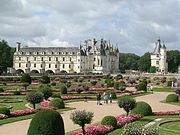
At the entrance to the estate, you need to cross a long alley bordered by centuries-old plane trees , which leads to a wide esplanade . On the right side is the garden of Diana de Poitiers, at the entrance to which - the Chancery - the house of the manager, built in the 16th century . The garden is protected from flooding by a walking terrace . At the corner of the Main Courtyard, washed by the waters of the Cher River, stands a medieval partially updated dungeon , the oldest castle construction.
The drawbridge allows access to the lower floor, where you can see the Guards Hall, whose walls are hung with tapestries of the 16th century . In the chapel are sculptures of Carrara marble , among which is the " Madonna and Child". In addition to the Green Hall and the Room of Diana de Poitiers, you can visit the gallery, where paintings by Rubens , Primaticcio , Van Loo , Minyara and Nattye are exhibited . You can go upstairs to the second floor with direct marches to see the Room of Gabrielle d'Estre, the Main Room, or the Room of the “Five Queens” (named after two daughters (including Queen Margot ) and three daughter-in-law (including including Maria Stewart ) Catherine de Medici, the Room of Catherine de Medici and the Room of Charles of Vendome.
In a kitchen filled with copper utensils, the original huge skewer is of particular interest.
In the office premises outside the castle, which used to have royal stables , and in the premises where silkworms were first raised in France, the Wax Museum - “Ladies Gallery” is located. There are scenes from the life of the castle with some of the most famous historical characters . Also near the castle there is a farm of the 16th century , a flower garden in which about 130 thousand plants are grown for planting in gardens every spring and arranging bouquets in the premises, a garden , a yew maze with caryatids , arranged in the spirit of Catherine de Medici according to the Italian plan of 1720 , meadow , on which donkeys graze, and several catering establishments .
See also
Notes
Links
- Official Site - Chenonceau (Fr. )
- Booklet in Russian
- Chenonceau Castle on the site "Castles of the Loire"
- Chenonceau Castle on the site "Russian France"
- Chenonceau Castle on the site "Castles of France"
- Wikimedia Commons has media related to Chenonceau Castle